90s in the Jewish Autonomous Region. Sale of goods using coupons
Photo: People's Archives of Rimma Lavochkina
December 2, 1934
“Birobidzhan Star” (12+) reported that on December 2, a meeting of the Birobidzhan city party activists was held, which discussed the results of the Plenum of the Central Committee of the All-Union Communist Party of Bolsheviks “On the abolition of the rationing system for bread and some other products.”

The meeting participants approved the decisions of the Central Committee of the All-Union Communist Party of Bolsheviks and determined the tasks for the further development of the trading network and improvement of its work.
December 2, 1934
The organizational bureau of the regional committee of the All-Union Communist Party of Bolsheviks for the Jewish Autonomous Region sent a telegram to the Leningrad regional party committee expressing deep sorrow over the death of the staunch fighter for communism S. M. Kirov.
Kirov Sergei Mironovich (real name Kostrikov) is a Soviet statesman and party leader. Born on March 27, 1886 in the city of Urzhum, Vyatka province (now Kirov region).
Since 1904, member of the RSDLP, Bolshevik. During the revolution of 1905-1907. was a member of the Tomsk Committee of the RSDLP, organizer of fighting squads, an illegal printing house, agitator and propagandist.
For his revolutionary activities he was arrested several times.
After the February Revolution of 1917, he participated in the creation and work of the Vladikavkaz Council of Workers' and Soldiers' Deputies. Participated in the organization of the Terek and North Caucasian Soviet republics as part of the RSFSR.
During the Civil War 1917-1922. organized the delivery of weapons, ammunition, and medicines from Moscow to the North Caucasus.
Member of the Central Committee of the RCP(b)-VKP(b) from 1923 to 1934.
Kirov was one of the best orators in the party. During the struggle for power after the death of V. I. Lenin, he decisively took the side of I. V. Stalin.
In 1926, he was elected first secretary of the Leningrad Provincial Committee of the All-Union Communist Party of Bolsheviks. In his post, he paid great attention to the reconstruction of the city economy, restoration and further development of the city’s industrial base.
In 1933, Kirov received, by resolution of the Politburo of the Central Committee of the All-Union Communist Party of Bolsheviks, the exclusive right (as part of the “troika” – together with the head of the Leningrad NKVD department F. D. Medved and the chairman of the executive committee of the Leningrad City Council I. F. Kodatsky) to apply the highest measure of “social protection” – the execution of “enemies of the people.”
On December 1, 1934, Kirov was shot dead in Smolny by a minor party official L.V. Nikolaev..
The murder of S. M. Kirov was used by I. V. Stalin in the fight against his political opponents. The NKVD was given instructions to look for those who ordered the murder. Stalin personally supervised the investigation and edited the draft indictment.
The murder of Kirov became the reason for organizing mass repressions throughout the country.
December 2, 1952
By decision No. 463 of the Birobidzhan City Executive Committee, Uritsky Street was renamed Kirov Street.
December 2, 1953
On the third page of the Birobidzhan Star newspaper dated December 2, 1953, an article was published “Readers discuss the work of N. E. Shundik.” It tells about a reader's conference (0+), dedicated to the discussion of the novel by the Far Eastern writer Nikolai Eliseevich Shundik “The Swift-Footed Deer” (6+). The book tells about the life of the Chukotka people during the Great Patriotic War and in the post-war years on a collective farm with the same name as the novel, “The Swift-Footed Deer.” The red thread in the novel is the idea of the rapid movement of the Chukchi towards a new life, of overcoming centuries-old backwardness, ignorance and superstition.

Day in the history of the Jewish Autonomous Region. Photo: Photo: Regional Library
This event was organized by the regional library. Sholom Aleichem. Students from the school of cultural education took part in the discussion, including the future famous Nanai poet Andrei Passar, library readers, and librarians. The speech of the conference participant, the Chukchi woman Atalemkotval, who used the book as an example, spoke about the new life of a woman in the North.
The conference ended with a concert (0+) of an amateur art group, in which students from the Northern Peoples Department took part.
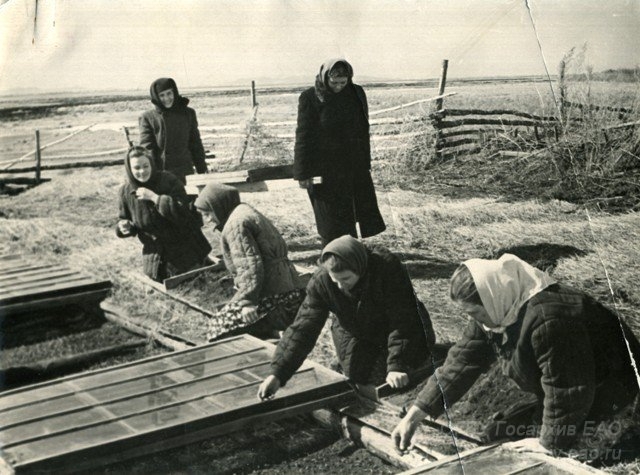
In the same issue of the newspaper, under the heading “Achievements of Science – to the Service of Agriculture” there is a publication of a candidate of agricultural sciences I. Mamchenkova “Growing vegetable seedlings in peat-humus pots.” The material introduces a progressive, in those days, way to achieve high yields of vegetables by growing seedlings in nutritious peat-humus pots. The specialist recommends three recipes for preparing mixtures, depending on what materials are available on the farm and for what crop the soil mixture is intended. This method of growing vegetable seedlings is based on the experience of advanced vegetable farms, breeding stations and agricultural research institutes.