What is the Dacian New Year and how did it become popular. The mysteries of an ancient holiday, rediscovered by Romanians


Although there is no archaeological evidence or historical sources to attest that the ancients celebrated the “Dacian New Year”, the supposed ancient celebration has come to captivate more and more Romanians. Some scholars have linked it to the temples of Sarmizegetusa Regia, and others have sought its meaning in archaic traditions.
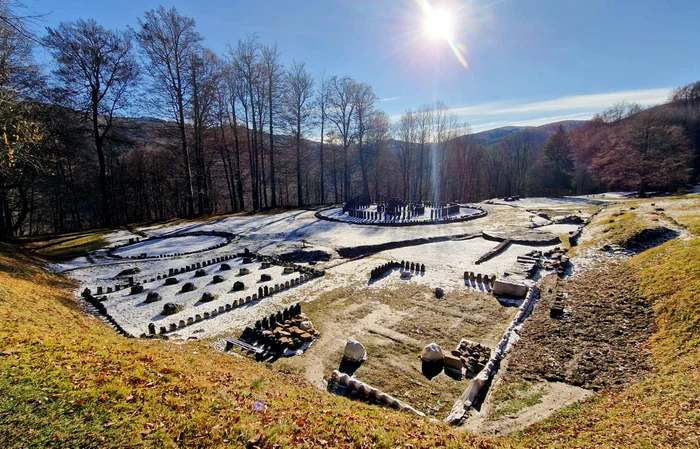
Sarmizegetusa Regia would have been the site of the temples of solar divinities. PHOTO: SR Administration
A lot of archaic beliefs and rituals adorn the Christian holidays kept by Romanians. Some scientists have tried to find out their origins and meaning and have been amazed by the sheer number of them.
“First of all, it is striking the Christian face that all our holidays have, even those whose names were given to us by the church; however, as a tradition and as an oral literature, the people borrowed very little from the church”. showed the ethnologist Tudor Pamfile over a century ago.
Religious holidays, full of rituals and ancient beliefs
Author of several collections of traditions and myths of the Romanian people, Tudor Pamfile observed that the Romanians attributed unusual attributes to the saints and added all kinds of fantastic stories and superstitions to their celebrations.
“These popular creations overwhelm the texts and teachings of the Christian religion, which remain almost drowned, with all the officialdom they enjoy. The Romanian people, like all Christian peoples, are Christians almost only in name, by practicing a few signs, which they often don't even realize. If the Christian religion preaches only one faith, that of God's help, everyone will admit that it is too little; all religions have it, even more so, before of the Christian one and after the reception of Christianity. It is too insufficient to cover all needs, the people said to themselves. says the ethnologist.
The scientist from the beginning of the last century offered the example of a teacher from Muscel who, for a year, had written down in a notebook all the holidays considered non-Christian that the women in the villages celebrated.
“What do you think I found out? More than a hundred pagan holidays, good working days, in which women do nothing but talk in the summer by the side of the road, in the shade, and in the winter to give advice from one house to another, talking or laughing at the other, insulting each other, and often ending up with a reproach or an insult, to give the judge more work…, well to lose even more working days, beating the roads to the detour”, the teacher noted in 1909, quoted by Tudor Pamfile.
Saint Andrew and pre-Christian rituals
The Dacian tribes lived two millennia ago on the current territory of Romania and were also a source of inspiration for some of the Romanian holidays. The celebrations of some deities of the ancients were replaced by religious holidays, but their old myths could not be erased by the Christian religion, being tacitly accepted by the church, some ethnologists claimed.
One of these holidays, brought back to the attention of Romanians in recent decades, was the Dacian New Year, celebrated, according to some scientists, between November 14 and December 7, the transition from autumn to winter.
“At the end of November and beginning of December appears, in the popular calendar, the greatest concentration of holidays and customs dedicated to the wolf (Ovidenia, Sântandrei, Night of the Ghosts, Moș Nicolae, Zilele Bubatului, Varvara). Then a ritual scenario of death and rebirth of calendar time survives, probably the Dacian New Year”, ethnologist Ion Ghinoiu pointed out.
At the center of the Dacian New Year celebrations was Saint Andrew's Day (November 30), the apostle also called the “Protector of the Romanians”, about whom legends say that, before his martyrdom, he would have reached Dobrogea to preach Christianity.
Romanians observed a lot of rituals dedicated to the feast of Saint Andrew. In some areas, they fasted so as not to “anger the wolves” (animals associated with it), did not process wool and skins or, for fear of the undead, smeared doors, gates, cattle horns and windows with garlic.
It was believed that the dead and the living undead come out on this night, so people ate garlic, made crosses in the windows and kept the lights on. The girls performed rituals of finding the bear, with mirrors, garlic rolls, walking barefoot or listening to roosters crowing.
Superstitions prevented the peasants from lending anything, and forbade sweeping and sewing, because they might bring disease or trouble, and the animals were carefully guarded to be protected from him.
The Dacian New Year, at the center of solar cults
Other scientists have identified the passage into the Dacian New Year with the winter solstice period, around Christmas. The ethnologist Romulus Vulcănescu showed that the name “Crăciun” has an autochthonous, pre-Christian origin, and would have been given to a deity revered in ancient times by the Dacians.
It was an archaic celebration of the winter solstice, related to the rebirth of time and basically the transition into a new year.
“The cult of Crăciun as ancestor and grandfather seems to be a much older solar cult than the cult of Mithras, which later penetrated into Dacia, and than the Christian cult and the explanation that was given to it afterwards. We cannot yet specify the antiquity; in any case, it comes down to our era, thus anticipating the two forms of solar religiosity that have contaminated it in our era”. said Romulus Vulcănescu.
The ruins of temples and sanctuaries in Sarmizegetusa Regia have been interpreted by archaeologists as evidence of a cult dedicated to solar deities, practiced by the Dacians. One such place is Soarele de Andesite, discovered in the 1950s in the Dacian capital.
“The discovery of the andesite pavement representing the image (symbol) of the sun has a special significance. It brings a new confirmation to the hypothesis on the urano-solar nature of the Dacian religion and proves once again the close connection between the round sanctuaries on the 11th terrace of Grădiştii Hill and the heavenly phenomena. It would be possible that this pavement was even a solar altar, the hearth serving for sacrifices”. specified archaeologist Constantin Daicoviciu, after the 1959 excavation campaign.
The great circular temple of Sarmizegetusa Regia, discovered in the early 1800s, received similar interpretations. Some archaeologists saw it as a sanctuary dedicated to the Uranus-solar deities, others as a Dacian calendar, battle arena, necropolis, circus, stone workshop or even a place to store grains over the winter.
“The great round sanctuary at Sarmizegetusa, with the rhythmic arrangement of its pillars, implies making some celestial observations, more natural within the solar cults than in the worship of subterranean divinities”noted Hadrian Daicoviciu, in the Dacia volume.
Nowadays, at the beginning of winter, many tourists seek out Sarmizegetusa Regia, attracted by the idea that the ruins of its temples became places for the celebration of some archaic festivals, of which very few clues have been preserved.