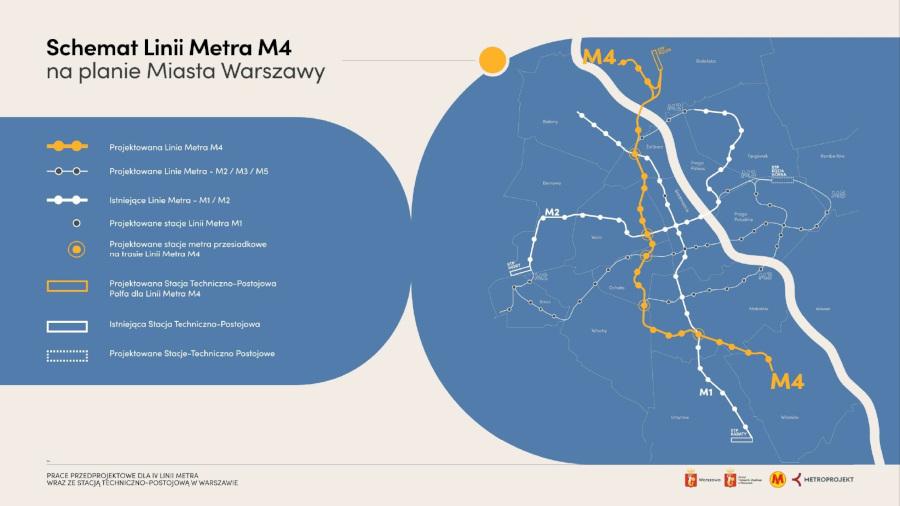
The planned fourth metro line, 26 kilometers long, will be operated completely autonomously, with three types of stations. It will serve nine districts and will have 23 stations. Its construction will start from the Białołęka side, although it is not known exactly when.
During a meeting with journalists on Thursday, the Mayor of Warsaw, Rafał Trzaskowski, emphasized that the construction of new metro lines depends on financing.
– If there is no financing from the European Union or if the government does not shoulder this financing, the city budget will not cover the construction of the third, fourth and fifth metro lines. And nowhere in the world is the local government able to undertake this type of investment on its own, said Trzaskowski.
He recalled that the city has already signed a contract for the design of the M3 line and its construction should start in 2028, according to the schedule.
– However, the M4 line will be completely autonomous, i.e. the system will drive the train itselfobserves the trails, reacts to unexpected situations, optimizes speed and energy consumption. These are solutions proven in many European metropolises, which provide higher frequency, higher security, and lower energy consumption – he added.
He emphasized that the designers' recommendation is to start its construction from Białołęka and further south.
– This is supposed to be the transport spine of Warsaw. It is to be the longest, fastest and most modern line, covering a huge number of districts, he noted.
He said that M4 can be built in stages or along its entire length, and the decision will be made at a later stage of work.
He added that pre-design works will be completed in 2027, and in mid-2028 the city will receive a detailed description of the impact zones of the metro infrastructure on neighboring buildings. In parallel, geological works are being carried out, and the culmination will be a conceptual design, which will become the basis for preparing a construction design.
Trzaskowski emphasized that the M3 and M4 lines are to complement each other and will not compete with each other for financing.
– This is not an auction about which district will win the metro, but a long-term investment and the construction of one coherent organism. We are building a metro for the entire city, he added.
He noted that the metro serves not only Warsaw residents, it is planned so that residents of the entire agglomeration can use the public transport system. He also emphasized that the metro can also be a place of refuge.
The President of the Warsaw Metro, Jerzy Lejk, pointed out that the fourth metro line is a line of a strictly integrative nature understood in several aspects.
– It connects various places generating traffic in the city, integrates the railway with the city communication system and integrates Warsaw public transport – he added.
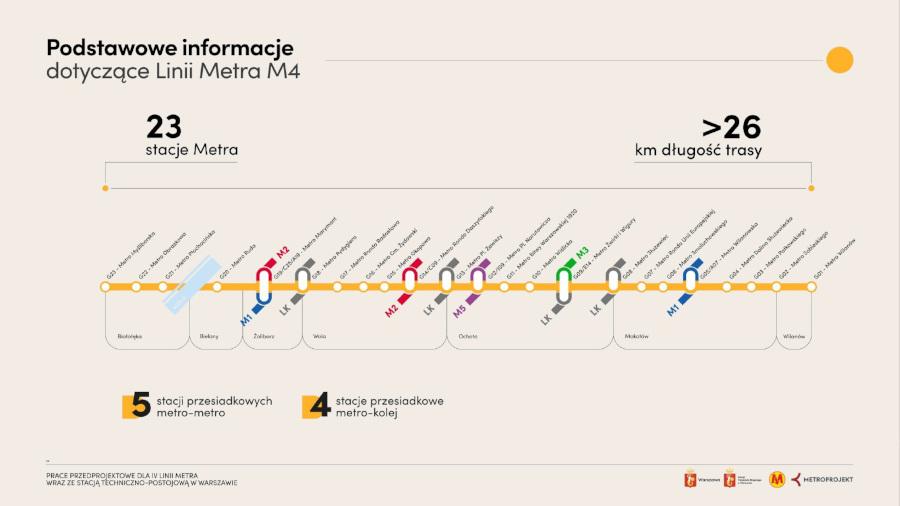
On the fifth metro line there will be five transfer stations to other lines, as well as four transfer stations to rail.
He also explained the levels of control automation that are now in the Warsaw metro and will be on the M4 line.
Currently, the Warsaw metro operates in the GoA2 system, which divides responsibility for decision-making between automation and the driver.
– In the current system, there is a balance with emphasis on the driver and staff activity. The system that we intend to implement for the M4 line is the GoA4 system, in which all important elements related to safe traffic management will be automated, said Lejk.
Karol Kalwarczyk, investment director of the Warsaw Metro, explained that there will be three types of stations on the M4 line.
The most common will be a type A station, with a compact structure, with an island platform and stairs in the outline, providing passengers with quick access to the platform and fitting into the compact urban development.
– The next type of station – type B – is intended for places where we expect a larger number of passengers. The staircases are moved to the ends of the platforms to provide passengers with the maximum width of the platform platform, Kalwarczyk said.
He noted that type C is proposed for places with the highest passenger traffic, where metro lines intersect or where there are important transfer points.
– It introduces side platforms with separation of passenger flows to ensure comfort and safety – he added.
It is not known exactly when construction of the new line will start.
– We have done the first tests. In 2027, we will have a clearer picture in terms of finances, of all the challenges that lie ahead, and perhaps in 2027 we will be able to answer this question more precisely, in which part of the 2030s these projects will be able to be implemented, he explained.
The planned M4 line will connect Białołęka with Wilanów. It will also run through Bielany, Żoliborz, Wola, Ochota and Mokotów.
There will be 23 stations: Myśliborska, Obrazkowa, Płochocińska, Ruda, Marymont (transfer with the M2), Rydygiera (transfer with the railway), Rondo Radosława, Cmentarz Żydowski, Okopowa, Rondo Daszyńskiego (transfer with the M2), Plac Zawiszy (transfer with the railway), Plac Narutowicza (transfer with the M5), Bitwy Warszawskiej 1920 r., Wiślicka, Żwirki i Wigury (transfer with M3 and railway), Służewiec (transfer with railway), Rondo Unii, Smoluchowskiego, Wilanowska (transfer with M1), Dolina Służewiecka, Patkowski, Sobieskiego and Wilanów. (PAP)
masses joz//