“This hasn't happened in over 85 years.” A famous Russian political scientist predicts what will happen


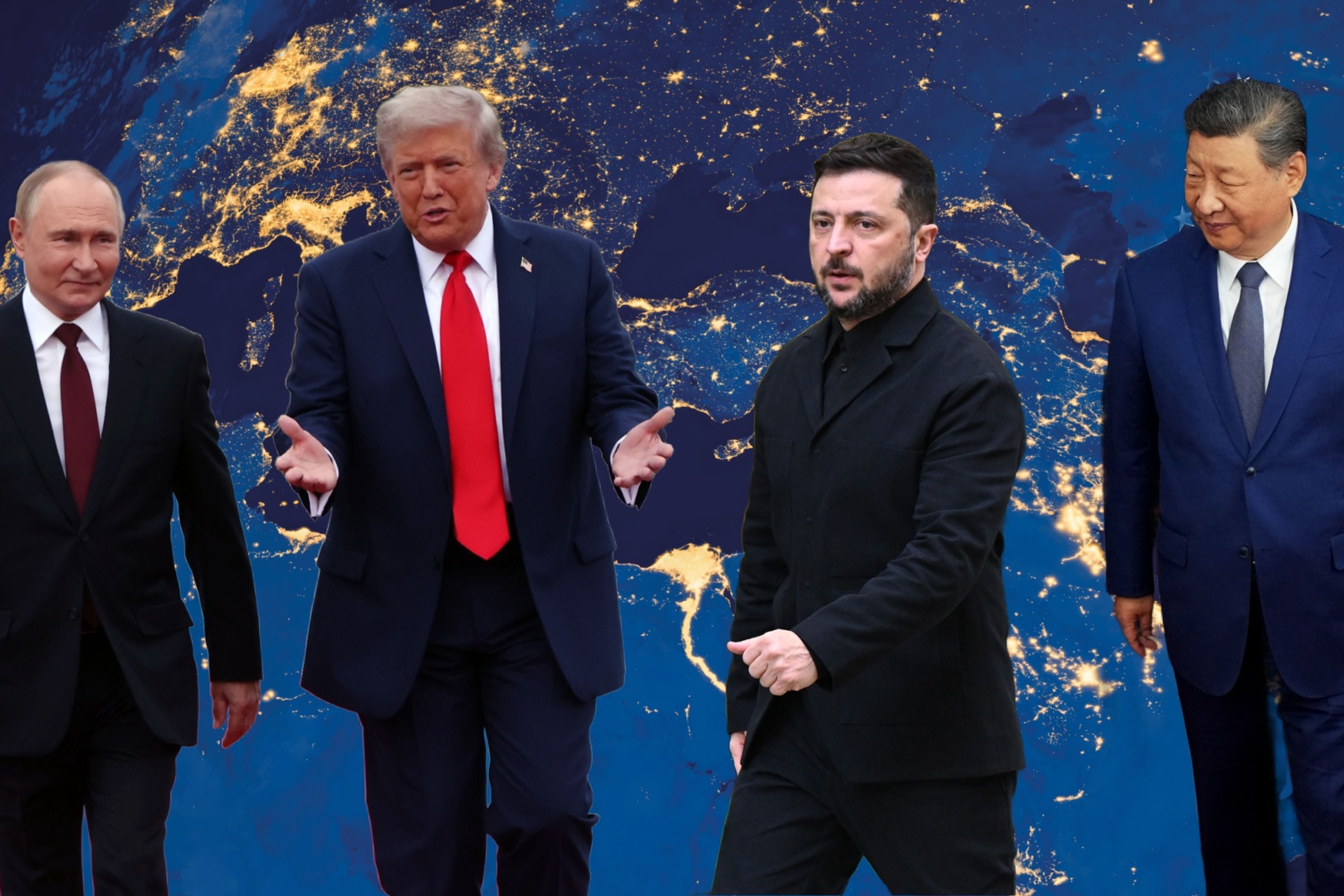
Changing borders by force cannot be justified, much less praised; nor can you blame Ukraine and mock the allies who failed to defend it. This does not mean, however, that it is not worth considering the consequences of the decision that may be made in the coming weeks. What will happen may be the beginning of a new world order and for many years. So let's look at the future not only of Ukraine, but also of Europe, Russia and China. Beijing's appearance here is not a coincidence.
Attention is drawn to the sarcastic comment of Trump's former opponent in the fight for the White House. Hillary Clinton wrote on X [dawniej Twitter]that “giving Ukraine an ultimatum to capitulate to Russia, Trump finally receives a reward: the Nevill Chamberlen Award for betraying peace, freedom and justice.”
And here I would start by saying that the comparison of Donald Trump with Neville Chamberlain will be incomplete if we limit ourselves only to Munich – because the story that began in September 1938 had a continuation. Well, Great Britain and France, which allowed the Sudetenland to be “squeezed” from Czechoslovakia, did not take any action when Germany occupied the entire Czech Republic, or even when – a year later – it attacked allied Poland.
Today, I see no reason to believe that history may repeat itself: neither Ukraine intends to disarm after the “peace agreement”, nor Europe is ready to forget about the danger of Russian aggression.
There is another important difference: in 1938, Hitler was just taking his first steps, testing his armies in the European campaign, while in 2025, Putin clearly demonstrates the exhaustion of the Russian army and its inability to significantly expand the zone of offensive operations.
The article continues below the video
Therefore, I believe that if a peace treaty is concluded in a form similar to the one currently proposed, the most likely course of events will not resemble the history of 1938–1940.
Ending the war on the front line or even on the formal borders of Donbas will reduce neither Europe's suspicion of Putin nor Ukrainians' willingness to oppose Russian claims. This is why the main issues will be Ukraine's readiness for rapid integration with the EU and the financing of its armed forces for an indefinite period. Even an army of 600,000 people, requiring the modernization of the material base and modern equipment while maintaining constant combat readiness, constitutes an excessive burden for Ukraine and can only exist with external financing.
If both of these things are provided, then I have no doubt that Putin's successes will end there. Revanchism and militarization, which he has made the basis of his policy in recent decades, will henceforth be part of the arsenal of Ukraine and Europe. In turn, the Kremlin will have to present the results of the war as victorious – and, as a result, tone down its current rhetoric.
This is at least due to how keen Moscow is to lift sanctions, resume economic cooperation with the West, and even restore its status in the G7 [G8].
Another issue should not be underestimated: Putin has spent more than a decade mobilizing [w szerokim znaczeniu tego słowa — od ideologicznej po częściową wojenną] Russian society – and it will be clearly impossible to carry it out again, if he wants to, in a relatively short time. It should be noted that the Kremlin has not decided to fully switch its economy to military tracks and introduce a state of emergency.
I would therefore venture to say that – again, if Europe shows sufficient responsibility – For Ukraine, such a peace treaty will become an option that will allow it to formally integrate with the Western worldnot just words. On the other hand, Kiev will be able to develop its economy and armed forces, given the continuing threat from Russia. As I have been saying since 2015, this approach may allow Europeans to outlast Putin – their inability to defeat him has been clearly demonstrated in recent years.
Don't blame Donald Trump here. For two and a half years of war, during which the United States was led by the now popular Joe Biden, there was no breakthrough on the front.
As the history of war shows, truces almost always benefit the defending parties, and there is currently no reason to believe this will be otherwise. Of course, if the Western partners immediately forget all their promises after concluding peace, events will unfold according to the worst-case scenario, but this is not very likely: the logic of London and Paris in 1938–1939 was partly due to the fact that Hitler was looking east. Putin clearly sets his goals in the West.
Will Taiwan be next?
This does not mean, however, that the “Trump peace treaty” will not trigger other processes. On the one hand, they can seriously harm global security as a whole; on the other hand, they can also cause serious problems for those who have consistently taken a pro-Ukrainian position.
In the first case, I mean, of course, China and the issue of Taiwan. If the Western world recognizes the transfer of territories cut off from Ukraine by force to Russian control, it will be difficult to find arguments against the “reunification” of the detached island with the PRC, the independence of which has not been formally recognized by any Western power. It is not without reason that Putin devoted himself to the role of a “mine sweeper” against the Chinese “tank”. After the war in Ukraine, Comrade Xi [Jinping] will understand what a nuclear power waging a limited war in its “near abroad” can expect from the West. And this will only mean one thing: complete freedom of action regarding the occupation of Taiwan.
At this point I would recall another historical analogy that, for some reason, is never talked about: the world war that fully broke out in Europe in 1939 had already begun in Asia in 1931, when the Japanese [wszystkie podobieństwa wydarzeń są oczywiście przypadkowe] they created a puppet separatist state in China. They then launched a full-scale aggression against China, which was not supported in this fight by any of the great powers.
It cannot be ruled out that the boomerang may return in the new century – and the campaign in Europe in 2014–2025 will become the same announcement of a great conflict as the Japanese campaign in Asia in 1931–1938.
The importance of the Pacific region today is similar to the place and role of the Atlantic region in the politics of the first half of the 20th century, so I would advise you to pay special attention to such a scenario of developments in which Putin's Russia, which initiated the revival of militarism in the new century, naturally moves to the rear line of a greater power when it fulfills its historic mission.
In the second case, I would like to draw attention to the inevitable change in the West's attitude towards Russia in the event of the normalization of the situation in Ukraine. It is no coincidence that Putin and Trump's plan paid a lot of attention to the lifting of sanctions and the development of economic cooperation — this means that Russia will once again become an ordinary partner for Europe, even if not a preferential one. The latter does not mean either a sincere warming of relations, or the restoration of a simplified visa system, or many other things – but it clearly envisages relations with Russia, here I use the immortal expression of Daniel Treisman [brytyjsko-amerykańskirgo politologa, profesora na Uniwersytecie Kalifornijskim w Los Angeles]as with a “normal country”.
What next for the Russian opposition?
This is enough to “zero out” the entire anti-Putin émigré opposition, whose existence currently depends on Western financing to an even greater extent than the activities of the Ukrainian army. After all, it would be strange to try to undermine the position of the authorities with whom you have just made peace and which you have convinced to stop aggression against your neighbor. It would be even more strange to look for emigrant activists to replace the current government representatives. It would be much more logical to invite the “legally elected” deputies of Putin's “parliament” to return to the assembly. In fact, any considerations about the “illegality” of Putin himself and the totalitarian Russian regime will turn out to be radically devalued in the new situation..
I assume that at the stage of peace negotiations in Ukraine, Western politicians, if they raise the issue of Russian political prisoners at all, will be for the last time. There is no doubt that the West's support for anti-Putin forces in recent years has been driven by its hostility towards Putin's Russia and the hope that these forces can help change the current regime in Russia. However, restoring relations with the Kremlin combined with understanding the durability of the Putin system will do the trick: anti-Putin emigration will exactly repeat the fate of the anti-Soviet emigration from the 1930s.
An agreement to end the war in Ukraine – which in the current situation seems inevitable, and its various variants may, as the negotiations in Geneva show, differ only in minor details – is much more likely not to upset the balance, but will stabilize the situation in Europe. Ukraine will have the opportunity to come together as a nation, getting rid of the people of its eastern territories that were leaning towards Russia and bringing in refugees from Europe before they integrate into European societies – and become a member of the European Union. This will provide an opportunity to both accelerate economic development and overcome the corruption and oligarchic order that has developed in the country since the 1990s.
Europe will be able to reflect on the experience of Russian aggression and adapt to the era of the new “Cold War”, learning to counter propaganda and hybrid aggression and gradually overcoming the illusion of the arrival of “eternal peace”.
The United States will clearly have more problems. The baton of confrontation with the Western world will be taken over by China, and its center will rapidly shift from Europe to Asia. This will be the most important trend of the 2030s, additionally reinforced by the awareness that for the first time democracies have failed to achieve a decisive victory over authoritarian powers. On the contrary, they were forced to make concessions.
For Putin, this outcome of the war will be a huge success: he will manage to achieve almost all of his goals, save the economy from collapse, resume its “constructive cooperation” with the West, free the Russian elites from the threat of global obstruction – and get rid of all internal opposition by identifying it with an external enemy.
The time of peace will therefore not be much simpler than the age of war. The new realities should not be underestimated. Nor should they be considered to be the result of some accident. All the previous days, as well as the efforts and mistakes of each of us, led us to a new day. As we reflect on the coming period in history, we should all remind ourselves more often of the wise words of Ecclesiastes: “Do not say, 'Why were the former days better than these?' For it is not out of wisdom that you ask this question” (Ecclesiastes 7:10).