American General Curtis King, about troop reductions: “Romania is a central element and part of this alliance.” Washington promises that the commitment to the eastern flank remains unchanged


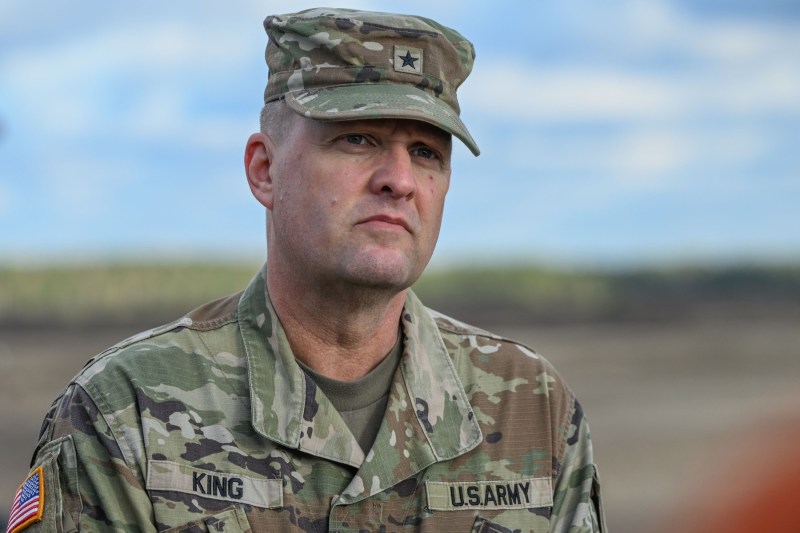
Brigadier General Curtis W. King, commander of the 10th US Army Air and Missile Defense Division. Photo: Artur Widak / NurPhoto / Shutterstock Editorial / Profimedia
Brigadier General Curtis King, the commander-in-chief of the 10th Command of the US Air Force and Anti-Missile Defense, assured on Tuesday that Washington remains faithful to its collective defense commitments within NATO, and the readjustment of American troops does not in any way undermine this principle, Romania remaining “a central element and part of this alliance”, according to News.ro.
In a press briefing, General Curtis King was asked how the US military ensures, given recent Russian drone incursions, that any rotation adjustment or reduction of US troops is not perceived by adversaries as a lessening of commitments to the eastern flank deterrence line, especially when the threat remains high. The question was asked by Alex Raufoglu, Kyiv Post correspondent in Washington, who first revealed Washington's intention to reduce troops in Romania.
“I want to say that we are in an alliance. The United States is in the NATO alliance, a defensive alliance, and Romania is a central element and part of this alliance. We will continue to maintain our commitment and work and assist this collective defense, because we are part of NATO together with Romania,” General King emphasized.
Last week, Polish, Romanian and US forces trained in Poland on an unmanned aerial system (UAS) to support national defense and the activities of Operation Eastern Satin, a response to recent Russian drone incursions into NATO airspace.
Also, on Friday, in Germany, the Flytrap project – also intended for the annihilation of drones – organized a competition between suppliers, in which 20 companies, selected from 230 candidates, presented their equipment. The competition awarded one winner a cash prize and fast-track status to become a registered program with the US War Department.
“We're moving so quickly to do this, to add the capability, the lethal capability to detect any drone that makes a raid, to be able to detect that early and then be able to provide a lethal capability to engage it. And I think what we're seeing is that we already have the capability to do that now, as we've seen. We have the capability to detect those drones now. That adds a capability to build,” General King commented on the recent drone incursion.
“Because some of these frontiers are very large, we can expand that capability or we can provide a lethal capability that does that at a much lower cost, about a tenth of what we think Russia is paying to build a Shahed drone. Those capabilities are obviously mobile aircraft, but now we have another land-based capability that can also be very mobile. It can be moved as we detect these systems early, to bring them to the point where they need to we destroy these drones”, the general said.
He emphasized that it all comes down to how quickly new capabilities can be added, but equally important is how the existing capabilities that the US and NATO countries have along the eastern flank are optimized. It's about “how we optimize these capabilities through software, through data integration and active-passive sensor integration to enhance the overall ability to defeat any drones that enter their airspace,” said the commanding general of the US Air Force's 10th Air and Missile Defense Command.