The war in Ukraine is a global test. Donald Trump didn't start it. But he will have to end it [OPINIA]


When I visited Ukraine in September, senior officials told me that Kiev hoped to reach a peace agreement by the end of this year – they estimated it would happen in November.
While Ukraine disappeared from international headlines, intense diplomatic activity continued behind the scenes.
They culminated in a controversial 28-point peace plan presented by the United States – a document that looked more like a list of Russian demands awkwardly translated into English than an American proposal.
There has been speculation in Kiev and European capitals about the limited diplomatic experience of President Trump's envoy, Steven Witkoff, which has intensified since the resignation of Ukraine's respected envoy, General Keith Kellogg.
Perhaps this explains why President Trump sent his Secretary of State – a much more experienced diplomat – to an emergency meeting called by European leaders in Geneva on Sunday, November 23.
Marco Rubio emerged from that meeting with his Ukrainian counterparts saying negotiations were “more advanced than at any time in the last 10 months.” He emphasized a statement that Europe has been emphasizing since Trump took office. — We all realize that ending this war will require providing Ukraine with a sense of security, he said.
Soft play with hard cards
On the same day, European leaders unveiled their own 24-point peace plan — a document that continues to grant significant concessions to Moscow. He proposes that Ukraine undertake not to regain occupied territories by force and limit the number of its armed forces to 800,000. soldiers – more than 600 thousand suggested in the American plan.
Ukraine would receive security guarantees reflecting Art. 5 NATO, and reconstruction would be financed from frozen Russian assets stored in Europe. Most importantly for European allies, Russia would have no say in future NATO expansion.
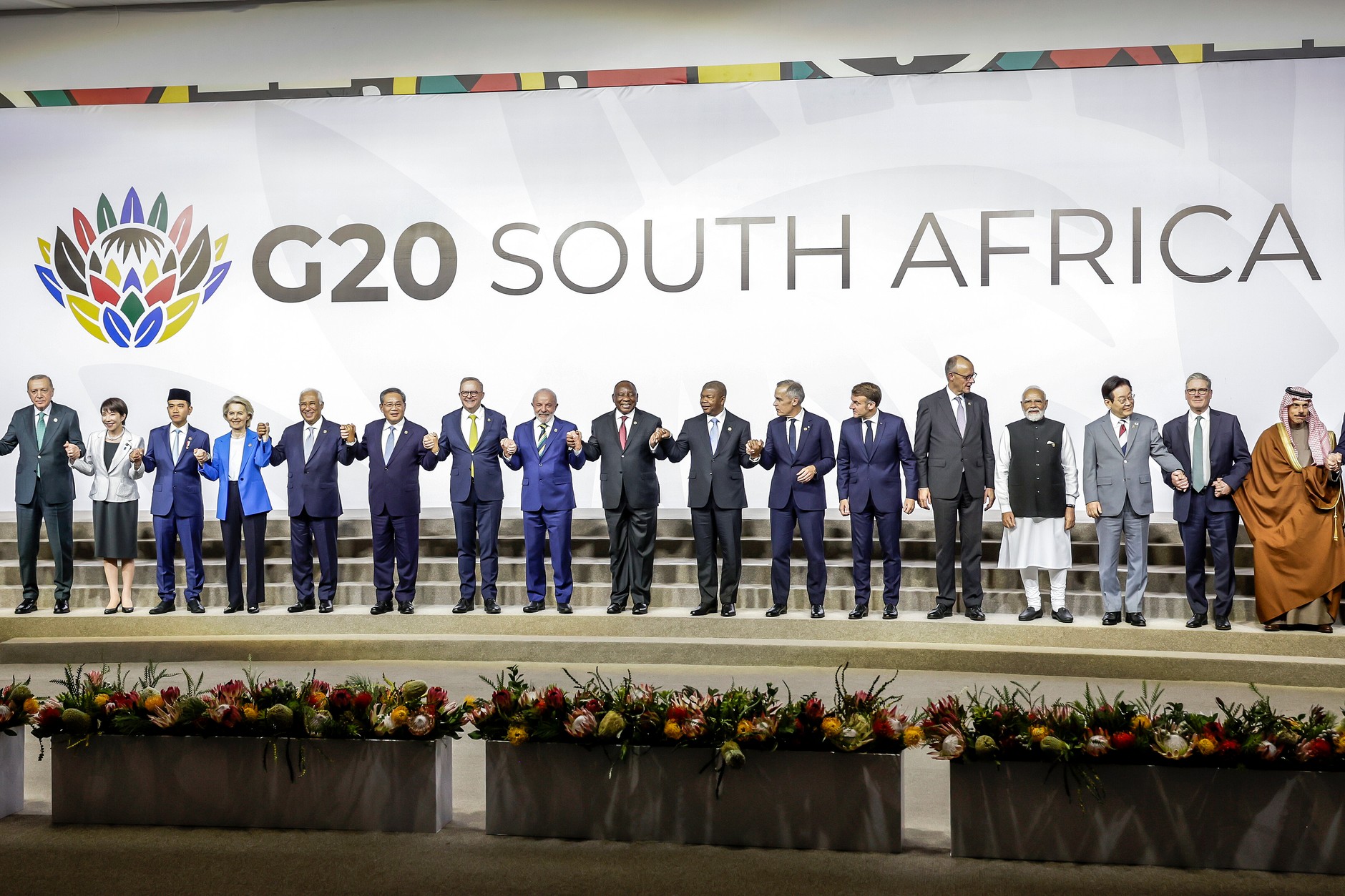
More than a dozen leaders including Germany's Friedrich Merz, France's Emmanuel Macron, Britain's Keir Starmer, the EU's Ursula von der Leyen and Canada's Mark Carney at the G20 world leaders summit. Johannesburg, South Africa, November 22, 2025EPA/GIANLUIGI GUERCIA / POOL / PAP
However, the plan still offers significant benefits to Moscow: it would retain all of Ukraine's currently occupied territories and would be effectively readmitted to the global economic system. Russia is even being reconsidered to re-admit Russia to the G8, the club of leading economies from which it was excluded after the 2014 invasion of Ukraine.
Whether this European proposal will gain momentum or gain support from the White House will become clear in the coming days when two of Trump's key European “advisors” — Alexander Stubb of Finland and Giorgia Meloni of Italy — travel to Washington. Nevertheless, the immediate success is obvious: Europe managed to delay the upcoming deadline set by Trump for November 27, i.e. Thanksgiving Day, and begin to transform a document that looked like a surrender into the basis for real negotiations.
High risk loan truce
This war can only end if it is followed by lasting peace.
No one wants peace more than Ukraine. The Ukrainians are exhausted, their energy infrastructure is severely damaged, and their troops are stretched to the limit. However, exhaustion does not mean surrender.
Kyiv needs certainty.
If he agrees to freeze the front line and accept a ceasefire, he wants to have a guarantee that Russia will not reorganize and strike again. At least not before a change of leadership in the Kremlin or the collapse of the Russian state – in today's unstable world such a scenario is not at all unrealistic.
There is one more point that needs to be made. President Trump accused Ukraine of being ungrateful for his efforts to end the war. The facts say otherwise. At Trump's request, Ukraine:
- agreed to an unconditional ceasefire after the first meeting with the US president,
- and signed a critical minerals agreement.
Europe has shouldered most of the burden of military, humanitarian and financial aid. Meanwhile, Russia continues to run the Trump administration in circles.
Washington says responsibility for this war rests with Europe – and in many ways it is. The EU deserves criticism for turning a blind eye to the annexation of Crimea in 2014 and continuing with existing policies even as Russia advanced in Donbas in 2015.
However, the United States and Great Britain also bear responsibility for this war.
It was Washington and London that guaranteed Ukraine's security and sovereignty in 1994 in exchange for the world's third-largest nuclear arsenal. If Ukraine kept its nuclear weaponsits current defense posture would be very different — and, as President Trump often says, this war would probably never break out.
The article continues below the video
A hot potato in Trump's hands
Whether he likes it or not this war is now his war. He didn't start it, but he has to finish it. And it can only end if the peace that follows is lasting.
This is not just about fair conditions for Ukraine, nor about the hundreds of thousands of Ukrainians who face abandonment in the occupied territories and exposure to systematic Russian war crimes.
America's opponents today look at Washington as a barometer: they are checking how far the United States will be pushed and how much it will be willing to give up to dictators with nuclear weapons who make a living by testing the West's weaknesses.
Trump warns that Zelensky risks starting World War III. But as Sir Winston Churchill once said: “Your choice was between war and dishonor.” You have chosen disgrace, so you will have war.