Tension before the championships in the USA. “The threat level is extremely high.” Americans are completely unprepared

The lack of drone tracking equipment, the paralysis of the US Department of Homeland Security, and changing security regulations all raise serious concerns shortly before the start of the games. Time is short – millions of tourists will soon go to the USA, Mexico and Canada.
Some — especially local officials in states like California — worry both about the risks and who will be blamed if something goes wrong.
— If there is an incident, or when an incident occurs, there will be a lot of blaming each other. Everyone will look for a scapegoat, says a representative of the drone production industry who wished to remain anonymous. One threat in particular comes to the fore for which Americans are completely unprepared.
In April, Secret Service Director Sean Curran said his agency was having difficulty acquiring counter-drone technology. He blamed “supply chain problems,” noting that the agency spent more than $100 million. (over PLN 365 million) over the last year and a half to catch up. Curran also said the Secret Service would ask the Pentagon for support.
Common counter-drone measures include portable or body-worn devices that detect or disrupt unmanned aircraft, as well as radio frequency sensors or cameras.
Department of Homeland Security (DHS) Secretary Markwayne Mullin said earlier this month that the “threat level is extremely high,” especially in areas outside stadiums.
DHS accused Democrats of undermining preparations during the 76-day budget impasse that ended April 30, saying the pause prevented the department from making operational preparations.
Customs and Border Protection, the Federal Protective Service, the Transportation Security Administration, the Coast Guard and the Secret Service are participating in federal preparations.
Curran also said the Los Angeles area, where eight of the 78 U.S. World Cup matches will be played, is “not ready to detect and counter drones,” so the Secret Service intends to train law enforcement officers (local officials told POLITICO disputed that claim).
The first match in the United States will take place on June 12 in Inglewood, California, between Paraguay and the United States.
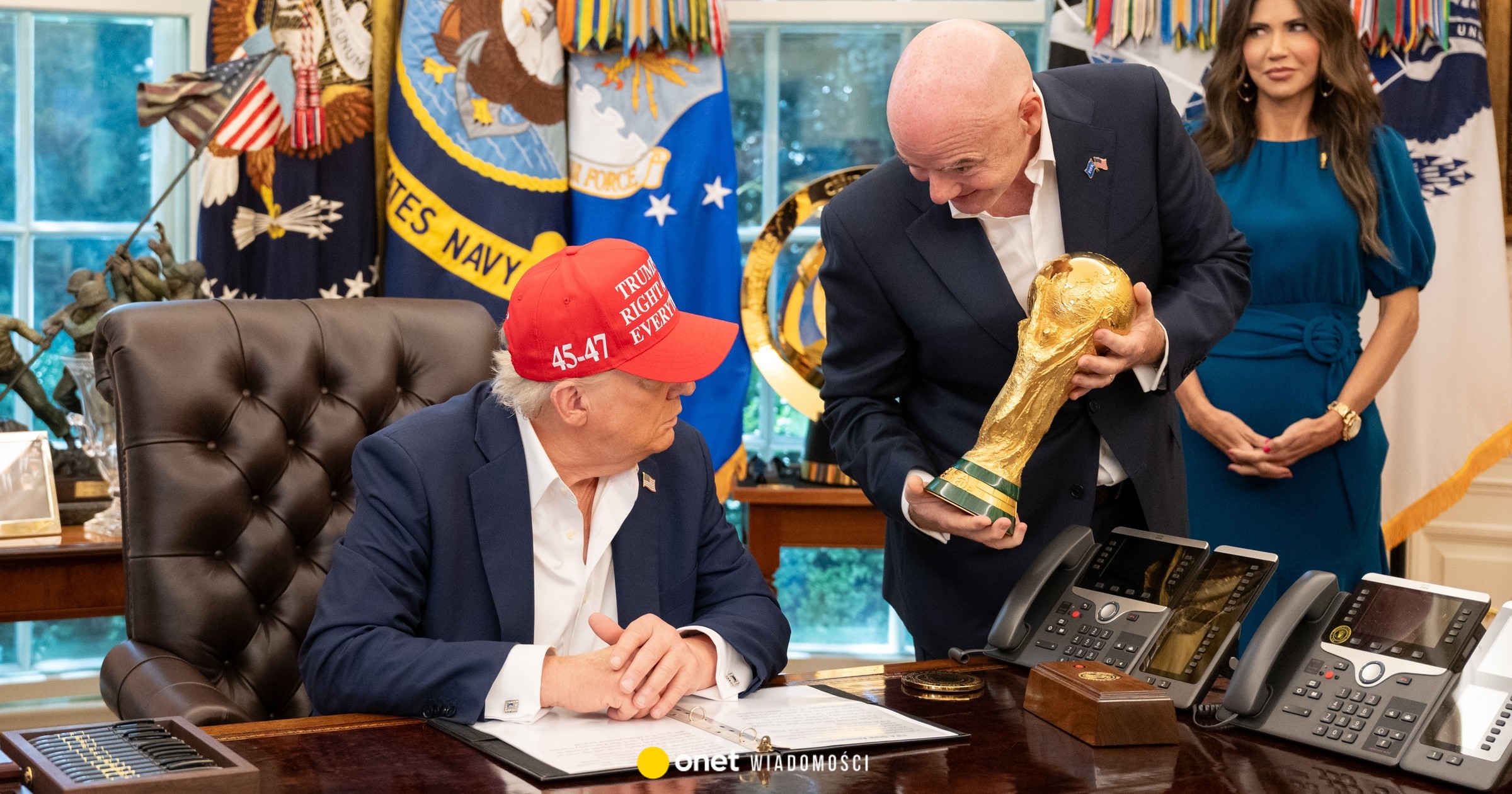
US President Donald Trump speaks while accepting the FIFA Peace Prize with FIFA President Gianni Infantino during the FIFA World Cup group draw, December 5, 2025.BRENDAN SMIALOWSKI / AFP
“The rules are still being developed.”
For years, U.S. authorities have relied on a patchwork of agency-specific measures to detect, identify and track drones. State and local governments have pursued their own approaches. The situation changed somewhat in December with the expansion of counter-drone powers under the new Defense Policy Act.
The new law, known as the Safer Skies Act, directs the Department of Homeland Security (DHS) and the Department of Justice — in cooperation with the Pentagon and the U.S. Department of Transportation — to develop and publish new rules for state and local law enforcement agencies.
— Now we need to actually implement the law. The moment for this is terrible, because [władze] they are trying to implement regulations and at the same time trying to enforce them – and this is difficult – says a representative of the drone production industry in an interview with POLITICO. “The rules are still being developed.”
Officials are catching up. The FBI's Alabama Drone Training Center — which opened last year — offers advanced training for law enforcement officers and security personnel. Huntsville's drone school has trained 65 state police officers, FBI Director Kash Patel told lawmakers Tuesday.
“The waiting list is long,” Patel said during a Senate hearing on the FBI's budget request. “Every agency across the country wants their police officers to be there” because of the center's advanced training capabilities, he said.
— Another group is trained every three weeks [funkcjonariuszy] — says a representative of the drone production sector in an interview with POLITICO. The FBI did not respond to questions about the frequency of training, including information about course completion rates.
It remains an open question whether these desperate efforts will be enough to secure large-scale events.
— The president recognized drones as a very serious threat and realized that we need to allocate another 500 million [dol. — ok. 1 mld 827 mln zł] for protection, Andrew Giuliani, executive director of the White House World Cup task force, told POLITICO last month.
In December, the US Federal Emergency Management Agency (FEMA) announced that $250 million. (over PLN 913 million) will go to 11 states where the world championships will be held and to the Washington region to prepare for the 250th anniversary of the founding of the United States.
— Additionally, late last year we pushed for the Safer Skies Act to be included [ustawie o polityce obronnej] Giuliani said, adding that the legislation expanded state and local law enforcement capabilities “to counter drones.”
“We want to make sure states and local governments can address emerging threats,” he added.
The Department of Homeland Security (DHS) has stated that it plans to use all available authorities, technologies and partnerships as part of its ongoing security efforts.
Technologies used in counter-drone operations often range from radio systems that interrupt the drone's connection to its operator to more advanced tools designed to track, disrupt or intercept unmanned aircraft.
Sometimes they can also come into conflict with each other.
In a podcast sponsored by the Department of Homeland Security, Alice Hong, director of DHS's National Urban Security Technology Laboratory, said earlier this month that federal, state, local and private stadium operators will bring their “counter-drone kits” to games, but all entities must be “closely coordinated” on an airspace monitoring plan. Otherwise, “these systems can actually interfere with each other and create gaps in coverage,” she said.
“An extremely intense period”
Aerospace and technology companies are currently working to increase the supply of technologies that can help deal with drones, largely because a lack of appropriate legislative powers over the years has dampened demand for the creation of these technologies.
President Trump's executive orders were aimed at expanding access to U.S.-made drones and counter-drone technology, and several companies have since announced expansion of domestic production.
Detective Michael Hackman of the Los Angeles Police Department (LAPD), who heads the counter-drone program, disputed Curran's claim that local officials are unprepared.
He said the LAPD is “very well prepared” and its staff has supported many counter-drone operations in cooperation with the FBI's Los Angeles office. The Los Angeles-area World Cup games will be played at SoFi Stadium in Inglewood — outside police jurisdiction — but the LAPD will oversee security at the FIFA Fan Fest and at several official fan zones nearby, Hackman said.
“One of the main challenges is public awareness,” Hackman said in response to emailed questions from POLITICO. “Ensuring that people understand and comply with drone restrictions – especially at large events – is crucial to preventing incidents before they happen.”
In addition to event-specific efforts, the LAPD is also expanding a permanent, city-wide counter-drone infrastructure “to improve situational awareness and readiness for rapid response,” he said.
LAPD uses a multi-layered system to detect and track drones, combining remote identification — which acts like a license plate for drones — radio frequency detection, radar and camera technologies, Hackman said. It uses cyber and electronic means to respond and uses ground teams that can locate and engage drones directly.
Not everyone has such freedom of action.
The Arlington, Texas, police department — which has jurisdiction over the “Entertainment District” that houses AT&T Stadium, where nine games will be played — has long maintained drone detection systems there to help officers locate unwanted drones. The command is currently working on further expanding the system to include ways to disable drones and has recently been granted greater local authority, the command said in a statement.
Like the Los Angeles Police Department, some Arlington officers completed specialized training at the FBI's counter-drone training center in Alabama, Arlington police said. However, the Arlington department said it does not yet have the infrastructure to conduct mitigation operations on its own.
This shouldn't be a surprise. For years, local law enforcement agencies did not have the proper tools to remove drones from populated areas, largely because responsibility for most counter-drone operations rested largely at the federal level. — [Kongres] it has not expanded these rights for many years, a representative of the drone industry said in an interview with POLITICO. “For now, our focus is on helping the industry and authorities maintain cooperation over the next three months to get through this particularly intense period,” he added.