The MPC already has one important data, and on Friday it will get the second one. Will he cut his feet again in a week?

According to Bank Pekao analysts, the decline in the rate of wage growth means that we are now in the territory of inflation-neutral wage growth (5-6 percent per year). This, in turn, opens the way to further cuts in interest rates and, according to analysts, the next reduction in the Monetary Policy Council will take place in December.
“The source of the surprise was primarily the public sector. In the mining industry, wages were 1.6% lower than in October 2024 – this is the second consecutive negative increase in wages in this struggling industry. In the energy sector, the increase in wages was symbolic and amounted to 1.3% y/y. Among the more market-oriented industries, a surprise was recorded in transport and warehousing: 2.4% y/y. In other sectors, wage dynamics oscillates between 7 and 9 percent y/y and shows no signs of slowing down,” analysts wrote in a commentary on the Central Statistical Office data.

|
Central Statistical Office, National Bank of Poland, own study
Wages are currently slowing down faster than inflation, and their real dynamics has slowed down to 3.8%. y/y, which is already close to the real GDP growth (3.7% for the third quarter of 2025), and therefore approximately the increase in labor productivity. This means that wage growth no longer actually generates inflationary pressure.
“We should therefore expect a slowdown in the growth of service prices in our country – the last afterimage of the inflation peak of 2023. This opens the way to further normalization of monetary policy. We expect that in December the Monetary Policy Council will reduce interest rates for the fourth time in a row“- we read further.
See also: “The MPC has plenty of time to pull the trigger many times.” Important forecasts for borrowers
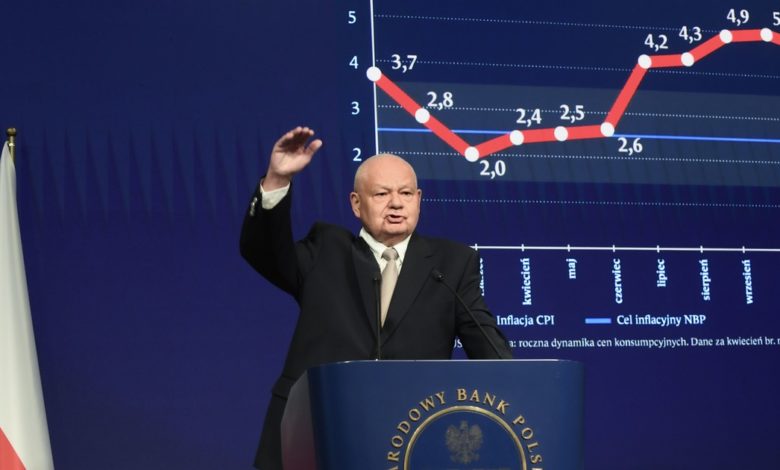
In May, the Monetary Policy Council resumed cuts and in five moves reduced the reference rate to 4.25 percent, which means a drop of 1.50 percentage points. The next meeting will be held on December 2 and 3. Analysts are wondering whether the Monetary Policy Council will reduce the cost of money in the last month of the year (changes in rates in December are rare, but President Adam Glapiński argued at the last conference that changes at this time are not unusual).
According to PKO BP analysts, the slowdown in wages is permanent. They estimated that the average annual wage growth will slow down to 6.4% next year. with 7.9 percent in 2025 and at the end of 2026 it will be approximately 5.5%.
A lower-than-expected salary increase – according to PKO BP – may support the Monetary Policy Council in making a decision to reduce interest rates at its December meeting. However, analysts warned that Friday's CPI inflation data would be more important. We will meet them on Friday, November 28. “At the moment, we remain in the scenario of stabilizing rates until the end of the year, with a non-zero probability of a reduction by 0.25 percentage points.” – noted PKO BP experts.
“As for the December decision of the Monetary Policy Council, the data have a mixed tone – on the one hand, weaker wages and PPI suggest lower inflation pressure, on the other hand, strong results of industry and construction suggest faster GDP growth. Although we assume that the next cut will be in January, today's data increases the likelihood that the Monetary Policy Council will cut rates in December. Either way, we still assume that the target rate level is 4.00 percent, which means yet another move,” they wrote Santander economists.
A more cautious voice regarding the December MPC meeting
“The slower growth in wages compared to September is not visible in all subsectors – the highest year-on-year dynamics are recorded in services, while weaker in, among others, mining, energy and transport. Wage dynamics are in a downward trend, although in our opinion the last months of the year should bring some stabilization. A small increase in the minimum wage will have a dampening effect on wages at the beginning of next year,” wrote Bank Millennium economists.
See also: Inflation reached 18.4 percent. in February 2023, which was the highest level in 26 years. Then Adam Glapiński was right
“Today's data (nor probably tomorrow's retail sales) do not determine whether the Monetary Policy Council will cut interest rates again at its meeting in December. Dovish members of the Council may emphasize the slowing wages and falling inflation in November (our forecast is 2.6% y/y compared to 2.8% y/y in October). In turn, supporters of stabilizing interest rates will probably focus on the cuts already made, better economic prospects and closing the output gap. Moreover, may want to wait for the new year's data to assess the impact of the minimum wage increase and changes in price lists, including new electricity prices,” wrote Bank Pekao economists.
They maintained their expectations that the Monetary Policy Council would return to cuts only in the first quarter of 2026. “Nevertheless, these expectations are uncertain, and the CPI inflation reading in November will be decisive,” they said.