
Ways to multiply your savings. From real estate to the stock exchange [GOTOWE ROZWIĄZANIA]


Is it worth investing in real estate and how? How do REITs differ from ETFs? What are the risks behind small caps? How to get dividends regularly? What would a professional invest his money in? Where to look for security in investing?
In Business Insider, we present tips and ready-made solutions for different pockets and different approaches to risk.
Important: the companies and valuations included in the text are for information purposes only and do not constitute a recommendation or any other form of suggestion for the purchase or sale of financial products. Investment decisions should be preceded by your own analysis of risk and financial situation.
Read also in BUSINESS INSIDER
According to research conducted by CBM Indicator on behalf of the Warsaw Banking Institute Foundation and the GPW Foundation, as many as 96 percent Poles believe that investing in financial instruments makes sense, and 43 percent would like to become an investor in the future.
The main barriers mentioned by respondents were not only the lack of funds, but also the lack of knowledge and emotional concerns. And that speaks very well of them. Awareness of risk and a sober assessment of your situation are the basis for, firstly, expanding your knowledge and, secondly, investing your money prudently.
Is it worth investing in real estate and how?
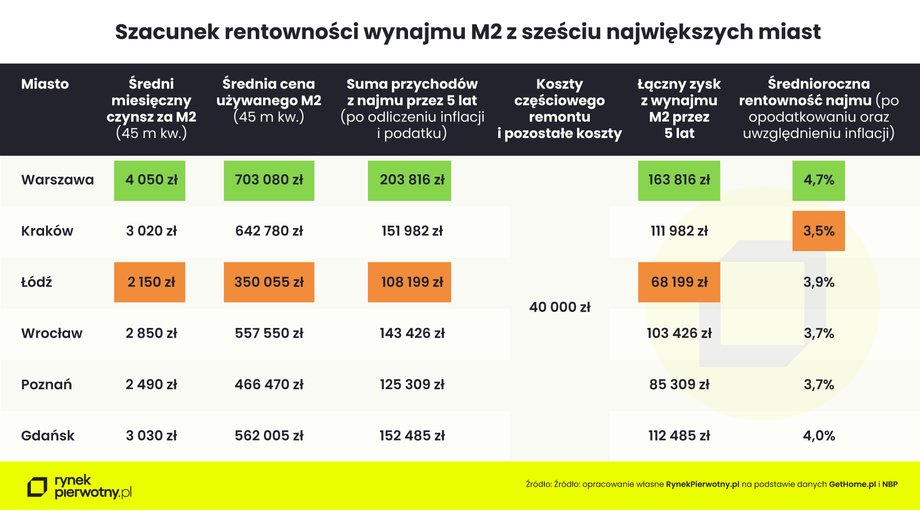
Before we move on to stock market investments, let's first look at something that is much closer to many Poles – real estate. What is the profitability of such an investment today? We checked it in Business Insider together with Andrzej Prajsnar, an expert from the RynekPierwotny.pl portal.
The analysis shows that within a year the average annual rental yield after taxes and inflation decreased to 3.9%.
|
Primary Market
You can read more about it here: Passive income from real estate. This is how much you can earn from renting today [WYLICZENIA]
However, you do not have to buy an apartment to receive “rent” every month. REITs that regularly pay dividends allow you to recreate rental flows, without loans, renovation teams and without worrying about tenants. By relying on companies like Realty Income, you can put together portfolios that provide a steady stream of after-tax cash. This solution is attractive to people who want predictable income every 30 days and diversification, instead of one address in the land and mortgage register.
Find out more here: Instead of a rental apartment, invest in REITs. Receive “rent” from the exchange without an apartment [DOCHÓD PASYWNY]
The stock exchange, or the next level of initiation
However, when we discuss the topic of REITs, we enter a completely different level of investing. For most people, financial markets are no longer as intuitive as real estate, which can also be “influenced”. There are also concepts such as ETFs, small caps and dividends.
If you want to expand your knowledge, we regularly publish sample solutions in Business Insider as part of Onet Premium and create ready-made investment portfolios for educational purposes. However, we make a reservation – these are only examples, not recommendations that guarantee a certain profit. Investment decisions should always be preceded by your own analysis of risk and financial situation.
Below are examples of texts from which you can gain knowledge:
What would a professional invest in?
At Business Insider, we also talk to professionals. Recently, we asked the president and manager of one of the Investment Fund Companies to outline three simple and three more sophisticated ways of investing from PLN 10,000. PLN up to PLN 1 million.
— The value of the invested funds is only one of the factors determining the way we invest. Other illustrative but important variables include, but are not limited to the value of the investment in relation to financial assets of a given person, his or her level debtneeds in terms of liquidity funds and the length of the period for which they can be invested [horyzont inwestycyjny — red.]. The answer to the question of how much loss a given person can accept is also important [tolerancja ryzyka — red.] and what kind he has knowledge about investments – explains the president of VIG/C-QUADRAT TFI, Michał Szymański.
Specifics? Here are expert examples for 10k. zloty.
Simpler version:
- 30-40 percent — shares
- 15-20 percent — corporate bonds
- 25-40 percent — treasury bonds
- up to 5 percent – cash
A more aggressive versionfocusing on higher diversification – including international – and broader investment education:
- 15-25 percent — domestic shares
- 15-25 percent — global foreign equities
- 20-25 percent — corporate bonds
- 20-25 percent — treasury bonds
- up to 5 percent – cash
You can read more here: What to invest 10,000, 100,000? and PLN 1 million? Six strategies from an expert
Safer ways to invest your money
The very word “investing” contains risk. However, there are options where it is much lower than others.
How much savings do you need to have to regularly receive interest equivalent to the national minimum wage, average salary or five-digit sums in your account every month? At Business Insider, we calculated it using the example of a simple, predictable and safe form of investing money that is available to everyone – bonds. You can buy one treasury bond for PLN 100, but to live on the interest, you need a much larger sum.
You can find the calculations here: Passive income for the cautious. You can live off the interest and never work again [WYLICZENIA]
On the example of five portfolios composed of various types of savings bonds, we show how money can “work” itself. People who like to know in advance how much they will earn, those who are more or less patient, those who like more frequent payments to their account, and those who want to protect themselves against inflation and interest rates for years will find something for themselves.
You will find these solutions here: Passive income for the cautious. This is how you will protect your money [GOTOWE PORTFELE]
Note: the information contained in the text is for informational purposes only and does not constitute an investment recommendation, information recommending or suggesting an investment strategy within the meaning of applicable regulations, or any other form of advice regarding the purchase or sale of financial products.


