The largest laboratory of human conversations in history is now opening its doors. A picture emerges from an analysis of tens of thousands of ChatGPT dialogues by The Washington Post completely different from the marketing promises of a productivity revolution associated with many messages OpenAI Whether Anthropic. Instead of a super assistant for work, we see primarily a digital confidant. AI becomes someone (or rather something) people ask for advice, comfort, listening, and only then for help at work.
This is an important change of perspective, especially when we are talking about a tool that is already used by approximately 800 million people a week. That's how many users ChatGPT has.
Check also: Start-ups are increasingly afraid that OpenAI or Anthropic will eat their business
How the image of ChatGPT users was created
The main data source is collection of approx. 47 thousand talks conducted from June 2024 to August 2025.which users themselves made public by creating “share” links and sharing them, among others. on social media or forums. These links later found their way to the Internet Archive and were picked up by many news outlets and marketing agencies.
By default, conversations with ChatGPT should be private, but this piece of exposed reality provides a rare opportunity to do so look inside the black box. From the entire corps, over 90,000 The Washington Post editorial team selected those conducted mainly in English and analyzed them thematically – first in a random sample manually, then with the help of AI models.
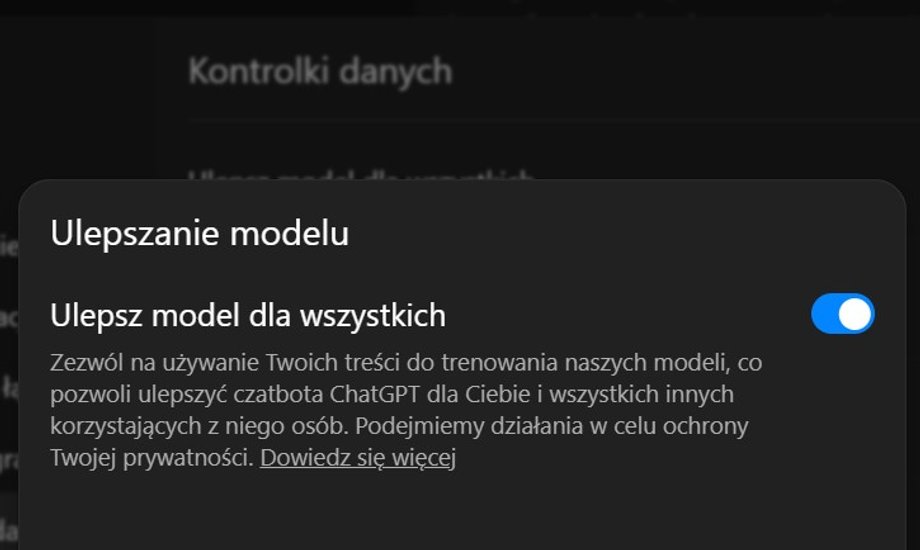
“Allow your content to be used to train our models, making the ChatGPT chatbot better for you and everyone else using it” – This option is enabled by default in ChatGPT, even in the paid version.
|
OpenAI/mat. own
This is of course not a representative picture of all users. The analysis includes people who, for some reason, decided to show their conversations publicly. The collected data clearly shows what people are asking when they are not writing on LinkedIn about “increasing productivity with AI”, but are sitting alone in front of the screen.
ChatGPT as an advisor, confidant and conversation partner
From the beginning, ChatGPT was touted as a tool that would change the way you work. It will speed up writing emails, reports, code and creating presentations. OpenAI, in its own large study, also strongly emphasizes the themes of productivity and time savings at work.
The next part below the video:
Meanwhile, the analysis shows that although many conversations concern searching for specific information (e.g. explanation of a concept, summary of a text, help with a task), a very large part of it is not related to performing any tasks at all, but concerns thinking and experiencing. Okay. 10 percent conversations are more abstract in nature – they are philosophical considerations, discussions about politics, the meaning of life or the nature of consciousness. A similar percentage concerns purely emotional threads. Users write about the feeling of loneliness, ask for relationship analysis, simulate conversations with loved ones or they ask the bot to play the role of a therapist, mentor or role-playing partner.
In many cases, these conversations contain extremely private information, such as: full names, addresses, details of family life, intimate marital problemsand even data needed to prepare a police report. People also paste dozens of phone numbers and hundreds of unique e-mail addresses, asking for help in preparing legal letters or business messages. There is no shortage of medical documentation, e.g. research results containing confidential datafor ChatGPT to analyze individual information and prepare recommendations.
All this creates the image of a tool that for many users is not cold, office technology, but something like an intelligent friend available 24/7. Someone you can talk to, who will answer right away, who won't judge and won't get tired of asking any questions.
Read also: OpenAI completes the transformation into a commercial company. Now the earning will start
ChatGPT as a partner and family doctor
One of the most sensitive areas where people turn to ChatGPT is health. Prof. Robert Wachter, head of the department of medicine at the University of California, San Francisco, evaluated the bot's responses in a dozen real conversations about health issues.
Wachter admitted in an interview for The Washington Post that ChatGPT is great at summarizing complex medical information, explaining test results and presenting various treatment options in a way that is understandable to a layman. In several cases, he rated the answers as 10/10 – they were complete, well nuanced and referred the patient to the doctor in the appropriate manner.
But at the same time four other answers received a failing grade from him. The problem was always the same. The chatbot did not ask for details. He didn't ask additional questions about symptoms, didn't try to determine whether the situation was urgent, didn't check risk factors, but immediately stepped into the role of an expert giving advice. In other words, he was doing something that, according to prof. Wachter, completely conflicts with one of the basic roles of a doctor. He did not answer the question with a question and only draw conclusions from the fuller picture, but went straight to recommendations.
Importantly, in some cases the bot suggested solutions based on unproven therapies promoted on the Internet, such as the use of veterinary drugs for cancer instead of standard, effective chemotherapy. It's not just an imperfection anymore, but health hazard if anyone takes such advice seriously.
Wachter ultimately gave ChatGPT a rating of around 6.5/10. He found it to be a very good information tool, but lacking clinical intuition and responsibility. His recommendation is simple: a chatbot can be great for preparing someone for a doctor's visit (e.g., understanding test results, writing down questions), but it shouldn't replace a medical consultation, especially in emergency situations.
Emotional bond, addiction and true tragedy
When a chatbot stops being just a tool and starts to act as a friend or an informal therapist, we are entering very delicate ground. Experts point out that ChatGPT is sometimes trained to strengthen the relationship, i.e. adapt to the user's tone, respond empathetically, say “you're right” and “that's great” more often than “no” or even “you're wrong”. In the analyzed set, the bot started the answer with the variant “yes”, “that's right”, “you're right” almost ten times more often than with the variant “no” or “it's not true”.
!["I'm considering [uzasadnij swoją decyzję] and I need to test my reasoning. Act like someone who is strongly opposed to this idea. Ask me difficult questions and force me to defend my position with logic and evidence" — prompts like this can help in cooperation with AI, because then it will not strengthen the relationship with the user so much by constantly responding to his messages with words "that's great" Whether "You're right"](https://knews.media/wp-content/uploads/2025/11/poDk9kpTURBXy9lMjdhM2JlZDUzYzkzZDU2MmRjZGQ3MDk3OTcxYTY0Yi5qcGeRkwLNA5gA3gACoTABoTEB.jpeg)
“I'm considering [uzasadnij swoją decyzję] and I need to test my reasoning. Act like someone who is strongly opposed to this idea. “Ask me difficult questions and force me to defend my position with logic and evidence” – prompts like this can help in cooperation with AI, because then it will not strengthen the relationship with the user so much by constantly reacting to his messages with “that's great” or “you're right”
|
OpenAI/mat. own
This style helps when someone needs support, but it also has a dark side. It strengthens the user's opinion bubble, instead of correcting it. In some of the analyzed conversations, ChatGPT entered into the tone of conspiracy narratives or extreme opinions, instead of clearly straightening them out. In one of them, he began to tell a story about a corporate new version of the world order inspired by an animated film, even suggesting tribunals for technology companies. And everything because the user led the conversation towards conspiracy theories.
These security problems take on a dramatic dimension when talking to people in mental crisis. The most famous example is the case of 16-year-old Adam Raine from California, whose family sued OpenAI, claiming that ChatGPT, instead of stopping the boy, confirmed his suicidal thoughtsand even helped plan his death. The case is ongoing, and the details from the court documents are shocking, from thousands of messages exchanged with the bot to alleged praise for the suicide plan. Whatever the final verdict, the very fact that a teenager chose a chatbot as his main confidant in the most difficult moment of his life shows how strong these digital bonds can be.
In parallel, OpenAI began disclosing its own data. According to one report, the company estimates that more than a million users a week show signs of suicidal thoughts while chatting with ChatGPT, and tens of thousands show signs of psychosis or mania.
Check also: Google's new Gemini 3. Is better at coding and automating tasks
What happens to call data
This analysis also reminds us of an issue that many users still underestimate: data privacy. Some of the conversations that have been uploaded to the Internet Archive appear in full personal data, details of credit history, medical documents, family dramas and even content that could potentially prove evidence in criminal cases.
OpenAI explicitly admits that user conversations can be used to improve models unless someone turns off this feature in the settings. Law enforcement authorities may in turn, similarly to the Google search engine or social networking sites, request access to this data in the course of proceedings.
Simultaneously regulatory and social pressure is growingfor AI companies to be more protective of content produced in private conversations. Cases such as Raine vs OpenAI have the potential to become a precedent in the discussion about the legal responsibility of chatbot providers for the emotional and health effects of their use.
So let's remember that talking to ChatGPT is not the same as talking to a friend. It is rather a conversation with a very advanced, but still commercial, online system in which every sentence can be technically saved, analyzed and, in certain circumstances, made available further.
Author: Grzegorz Kubera, journalist of Business Insider Polska