NATO countries are getting a new drone killer. The system has an impressive track record in Ukraine


NATO forces are training to use a cheap interceptor drone that has already proven its effectiveness on the battlefield in Ukraine. With a track record of almost 2,000 interceptions in the war, the drone entered the equipment of the troops on the eastern flank.
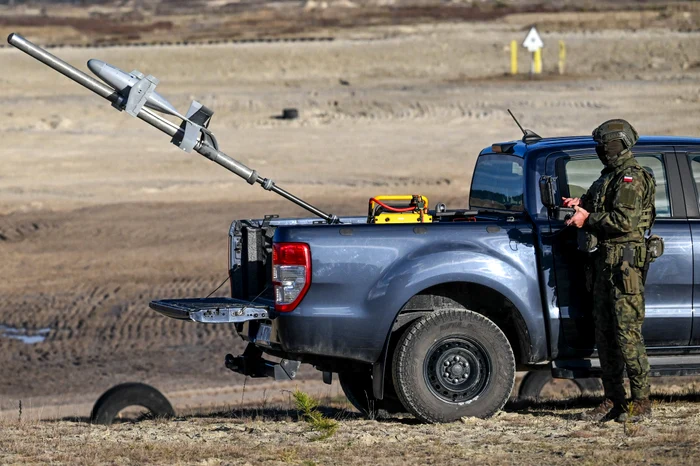
anti-drone system merops photo epa-efe
Poland and Romania have acquired the Merops system to protect Eastern European airspace after a series of Russian drone incursions prompted Ukraine's NATO allies to move quickly to equip themselves with cheap and effective air defense systems.
Recently, Business Insider journalists witnessed training sessions by US, Polish and Romanian forces on the US-made counter-drone system that launches “Surveyor” interceptor drones.
Speaking from a training range in southeastern Poland, US military officials explained that the Merops system is designed to intercept both reconnaissance and attack drones, including the newer, faster, jet-powered variants.
“This system is very reliable,” Sergeant Riley Hiner, an American pilot who has trained soldiers from NATO countries, told Business Insider.
However, despite its successes on the battlefield, the Merops system is far from perfect.
What is Merops?
Interceptor drones are currently among Ukraine's main air defense tools – they have gained momentum in recent months, allowing them to hunt down and destroy large numbers of cheap Russian Shahed drones at a relatively low cost per attack.
Developed by the American initiative Project Eagle, it is just one of the many anti-drone systems used by Ukraine to defend itself against Russian drone swarms.
Ukraine's defense industry now produces hundreds of interceptor drones a month, and Western military leaders interested in buying cheap air defense systems to counter the growing drone threat in Europe are taking notes, monitoring their success.
Interest turned into an urgent search in September after Russian drones violated Polish airspace. On that occasion, NATO fighter jets launched valuable air-to-air missiles, downing weapons worth a fraction of their cost.
Poland and Romania, which faced Russian drone incursions just days later, decided to acquire and deploy Merops systems as part of a new NATO initiative to defend its eastern border against potential attacks.
US Army Brigadier General Curtis King, head of the 10th Army Air and Missile Defense Command, described the anti-drone system as “highly lethal”, “highly effective” and also “cost-effective”.
Merops is composed of a ground control station, the Surveyor interceptor and launch platforms. Operated by a crew of four – commander, pilot and two technicians – it can be deployed to a fixed or mobile location, making it a flexible asset.
The Polish, Romanian and American troops completed the two-week training course on Tuesday. King, in an interview with reporters, said the system is easy to use, so soldiers can quickly learn to operate it.
US Army Europe and Africa said the Merops exercise reflects efforts by Poland and Romania to rapidly deploy battlefield-tested systems and bolster NATO's new Eastern Flank Deterrence Line, which aims to protect the alliance with a mix of low-cost drones and layered defenses.
What capabilities does the Merops system have?
During a demonstration, Polish soldiers launched the Surveyor from the back of a pickup truck. The interceptor drone attempted a direct hit on the target – a drone mimicking a Shahed drone – but after several borderline tries and misses, it opened a parachute and returned to the ground.
The parachute function allows troops to reuse the interceptor drone, saving costs in training cycles.
U.S. military officials explained that the Surveyor drone was not armed during Tuesday's demonstrations, but in actual combat conditions it would carry a small warhead capable of destroying a hostile drone by exploding near it without having to hit it directly.
The propeller-driven Surveyor interceptor drone can be remotely piloted or operate autonomously, and uses radio frequencies, heat signatures or radar sensors to track its target. It is capable of speeds of over 280 km/h and is resistant to electronic warfare, a constant threat to drone operations in Ukraine.
Military officials pointed out that the Surveyor drone is designed to shoot down high-altitude kamikaze attack drones, such as Iran's Shahed model, as well as reconnaissance drones. Ukraine has already used it to record over 1,900 successful interceptions in combat.
Surveyor can also be effective against jet-powered drones, which travel at a higher speed than propeller-driven drones. Russia began using these advanced variants in combat earlier this year.