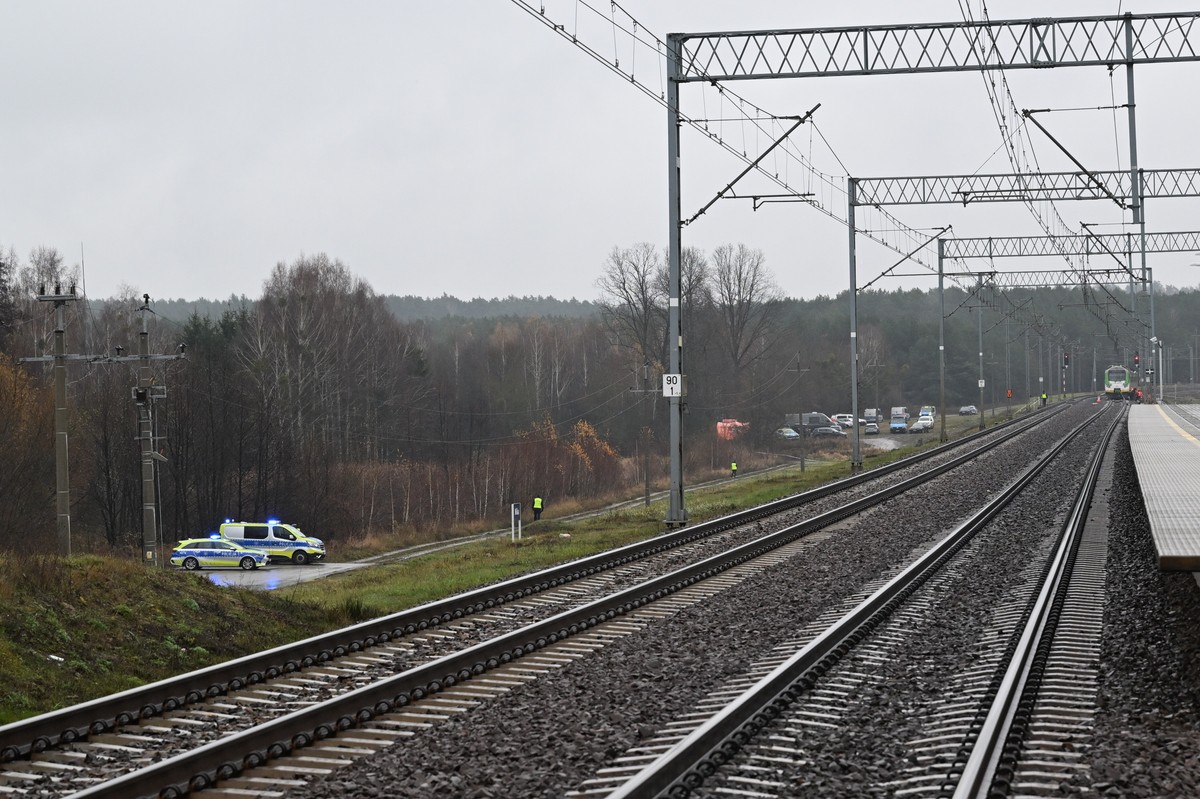
On Sunday morning, the train driver reported irregularities in the railway infrastructure near the Mika PKP station in the Garwolin district. Initial inspection showed that a section of the track was damaged, which led to the train stopping.
The rest of the article below the video:
On site, officers discovered that the tracks had been destroyed by an explosion of explosive material. A camera and a second device that did not detonate were also found nearby.
New findings in the case of saboteurs
As “Rzeczpospolita” found out, the SIM card left in the phone used by the perpetrators to record the effects of sabotage enabled investigators to quickly determine the identity of the saboteurs. Analysis of connections and logins to various devices allowed the card user to be traced within 70 hours.
Additionally, fingerprints belonging to a man recorded in Ukrainian criminal databases were secured at the scene of the incident. Prime Minister Donald Tusk confirmed that it was a Ukrainian citizen from Lviv who was previously convicted of sabotage.
Read also: Railway diversion. Is it possible to save the tracks from attacks?
The combination of data from the SIM card and fingerprints enabled the identification of the first perpetrator, and then the second one – also a Ukrainian citizen from Donbas. According to “Rzeczpospolita”, both men came to Poland through Belarus, and after sabotage, they escaped to Belarus through the border crossing in Terespol.
Operational work of the services and support for allies
Not only the analysis of traces left at the site, but also the operational activities of the services were of key importance. Investigators assumed that even if the perpetrators did not have their phones with them when planting the charges, they could have previously observed the area using devices logging into nearby BTS stations. The officers analyzed the data of phones that appeared in this area in the two weeks before the incident and did not belong to local residents.
Prime Minister Donald Tusk emphasized that the Polish services received support from allies in the investigation, although he did not reveal the details. According to the daily's findings, the Internal Security Agency had to verify phones not registered in Poland, which was made possible by the Americans who had the Echelon system for global analysis of electronic communications.. ABW also uses its own data search system, but its capabilities are limited compared to its American counterpart.
The course of sabotage and the threat to passengers
The perpetrators placed two explosives at a distance of approximately one meter from each other. The services are not sure whether there was a third charge or whether only the remains of the devices were found. Only the first charge exploded, causing a crack in the rail. According to Onet's information, as many as 12 trains passed on the damaged tracks.
The trains did not derail solely because they were traveling at over 100 miles per hour. However, with each subsequent pass, the damage to the rail increased. It was only in the morning on Sunday that the driver noticed a hole in the tracks and decided to stop the train.
Read also: Russian traces on Polish tracks. Experts warn against 'crime as a service'
The explosive material used by the saboteurs came from military resources, and a 300-meter-long electric cable was used to initiate the explosion. The choice of place was not accidental – the perpetrators chose a curve on the route on an embankment, where in the event of a train derailment, the centrifugal force could push the train down with great force, which could lead to tragic consequences.