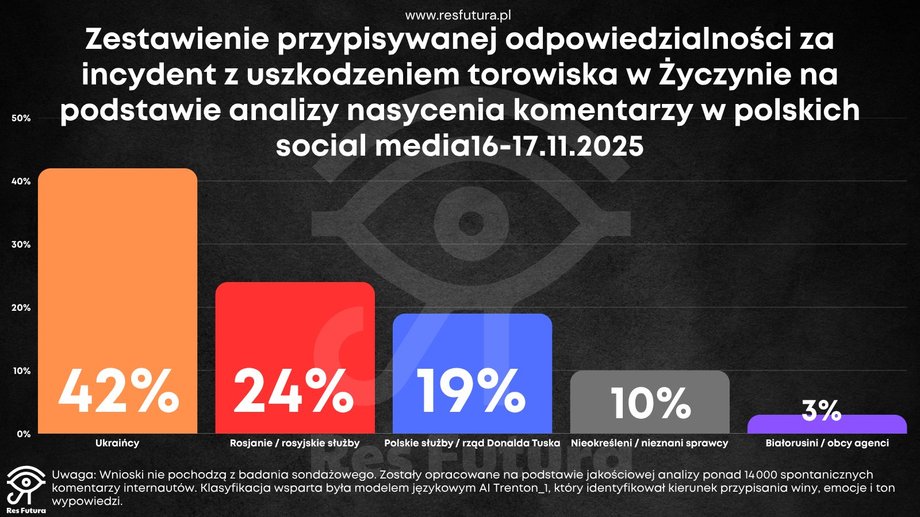
As the authors from the Res Futura Data House research collective emphasize, the presented conclusions are not a survey or a representative survey of public opinion. They are based on qualitative interpretation of online comments and are intended to show the dominant narratives and moods in the online space. The analysis was carried out with the support of the Trenton_1 AI language model, which allows the classification of comments in terms of tone of expression, indication of guilt and emotions. Each comment was assigned to one category based on its main message, and the percentage indicates how often a given theme appeared in the discussion.
Read also: Mark Rutte: we remain in contact with the Polish authorities
Anti-Ukrainian comments predominate
The largest group, 42 percent, were comments incriminating Ukrainian citizens. Internet users referred to, among others: to previous cases of fires in buildings in Poland, vandalism or the presence of Ukrainians near strategic infrastructure. There were hypotheses that these actions were retaliatory or provocative in nature to draw Poland into conflict with Russia. Some commentators also suggested that the Ukrainian agents could use such situations to force additional military and financial assistance. It is worth noting that the accusations were collective in nature, referring to the entire ethnic group and not specific people, despite the lack of hard evidence.
The second largest group of comments (24%) pointed to Russian services. Internet users argued that such an incident fits into the pattern of a hybrid war, comparing it to Russia's previous actions, including the events in Crimea in 2014. There were suggestions that citizens of other countries, e.g. Ukrainians, could be used as contractors for the operation. There was also no shortage of critical opinions emphasizing that the Russian narrative can be politically convenient, but in the discussion Russia was most often treated as the most logical suspect in the strategic context.
Summary of assigned responsibility
|
Res Futura Data House / Res Futura Data House
Accusations against the government
A significant percentage of comments (19%) suggested that the incident could have been the result of actions or omissions of the Polish services and government. The entries indicated that the incident could have been used for propaganda purposes – to distract public opinion from political scandals, problems with state security or social tensions. Internet users drew attention to the alleged negligence of the services and the decline in their effectiveness after the change of government in 2023, and criticized the Prime Minister for the late reaction and lack of transparent communication. There was also the motif of a “set-up” – a staged act of sabotage.
Some commenters (10%) took a cautious stance, emphasizing the lack of sufficient evidence. Attention was drawn to the possibility of technical errors, infrastructural negligence or natural damage to the track. These entries called for expert opinions and investigations, emphasizing the need to verify facts before making clear accusations.
Polarization is deepening
A marginal category (3%) included comments regarding the potential involvement of Belarusians or other foreign agents. Internet users in this group pointed to previous cases of sabotage activities on the Polish-Belarusian border, although such statements were rare and often supported other theories, e.g. the Russian one.
The Res Futura Data House report clearly shows that there were both emotional and unambiguous accusations online, as well as cautious voices emphasizing the need to wait for the facts and results of the investigation. The online debate surrounding the incident in Życzyn is an example of deep polarization of opinion, in which strong emotions coexist with skepticism, and different narratives compete for Internet users' attention, shaping the image of the event in the public space.