Math at the edge: DeepMind has discovered new singularities that could make flights smoother in the future


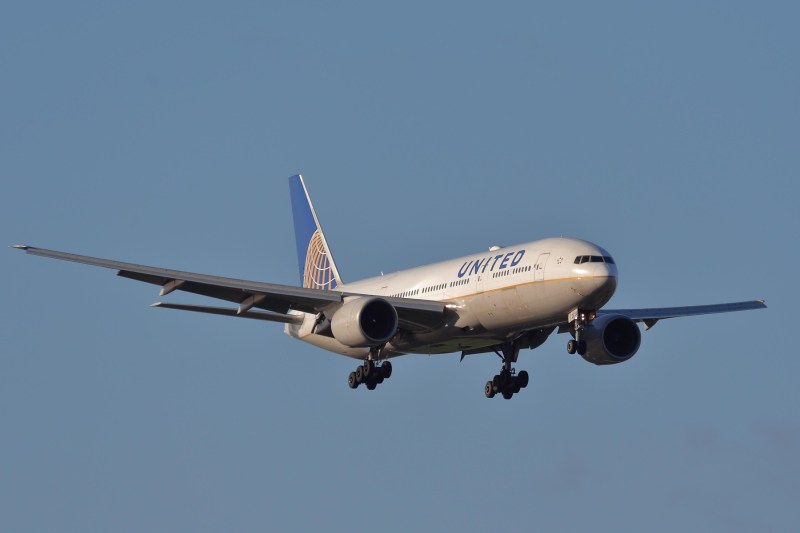
A Boeing 777 of United Airlines, PHOTO: Uwe Deffner / Alamy / Profimedia Images
For more than a century, mathematicians and physicists have grappled with the chaotic nature of fluid motion—the way air swirls around the wings of an airplane or water swirls in a pipe. But Google's DeepMind lab just announced a major breakthrough in the field, one made with the help of artificial intelligence (AI), reports Business Insider.
Fluids are so unpredictable that the equations used to model their behavior are impossible to solve completely. As a parenthesis, in physics fluid is considered a continuous medium in its structure, which continuously deforms and flows. Thus, including gases and plasma are considered fluids, not just liquids.
To use fluid equations, physicists must use assumptions such as constant viscosity or a smooth change in pressure.
Entering even simple scenarios can lead to “explosions”—situations where the equations predict extreme results, such as infinite pressure or an incredible increase in speed. These are called singularities and represent the moments when mathematics can no longer predict the physical behavior of fluids.
Singularities can be stable or unstable. Stable singularities are easier to find, while unstable ones are much harder to identify. Using machine learning and specialized physics-centric AI models, DeepMind researchers have now discovered new families of unstable singularities in three distinct equations of fluid dynamics.
What DeepMind researchers have done with AI
By embedding the structure of the equations directly into these specialized AI models and optimizing them in stages, the team achieved near-machine-level precision, enough for mathematicians to formally verify the results.
“This work provides a new set of instructions for addressing persistent challenges in mathematical physics,” the DeepMind researchers wrote in their Science paper. An associated blog also wrote: “This discovery represents a new way to do mathematical research.”
DeepMind is a laboratory considered a pioneer in AI research, having been acquired by Google more than a decade ago.
The lab is led by Demis Hassabis, a math and gaming ace who has quickly risen through Google's ranks as AI technology has grown stronger and more important. Last year, Hassabis became a Nobel Prize laureate after creating an AI model that was able to predict the structure of the 200 million proteins considered the “building blocks of life”.
Why the DeepMind discovery is important
Discovering these new unstable singularities could help scientists better understand how turbulence—the unpredictable, energy-hungry behavior of fluids—occurs in nature and in engineering.
This paves the way for a deeper understanding of areas such as aircraft drag, weather systems, blood flow and energy distribution. Perhaps these discoveries will make future flights less turbulent.
The advances could help monitor “turbidity,” a state in which fluids are governed by momentum rather than physical properties, making them difficult to predict.
“Much of the software we use to monitor turbidity starts from the assumption that these equations are completely accurate in all values,” a source told BI.
Now that DeepMind has discovered new unstable singularities, scientists could better monitor turbid flows, “because we have a better understanding of the ranges over which these equations are valid,” she added.