Hidden between mountains and clouds, on the southern shore of Alaska, is Whittier, a small town with only 263 inhabitants, unique in the world in a surprising detail: its entire population lives, works and socializes in the same building.
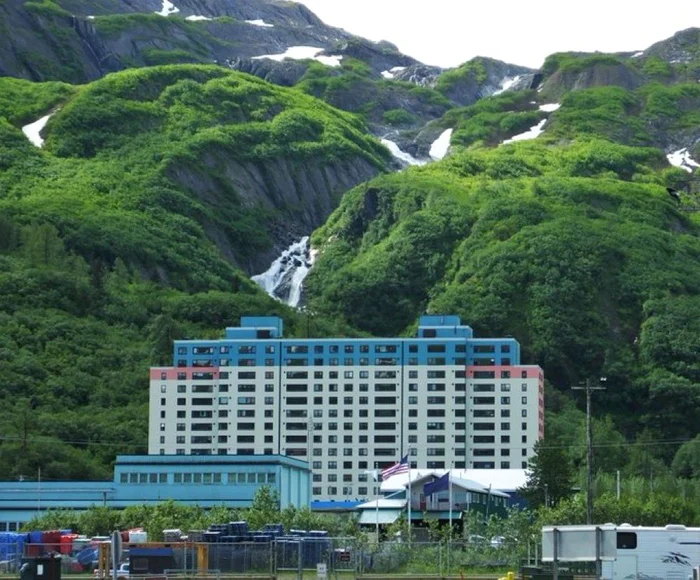
Begich Towers houses all 263 inhabitants of the city/ PHOTO: X
Begich Towers, a 14-story building built during the Cold War, today houses not only apartments, but also a grocery store, a post office, a medical clinic, a church and even a police station.
A community under one roof
For Whittier residents, life inside this multipurpose building is a combination of seclusion and closeness. Common spaces encourage interaction, and neighborhood events—from barbecues to local celebrations—maintain a close-knit community atmosphere.
The practicality of this organization is obvious. In a subarctic climate, where snow and high winds can block access outside the building for weeks, having all essential services within walking distance is more than a convenience – it's a necessity.
A strategic past
The story of Whittier begins long before Begich Towers. The area was used by the Chugach Natives as a crossing point between Prince William Sound and interior Alaska, an essential natural route for trade.
During the Second World War, the US Army discovered the strategic potential of the place. Surrounded by mountains and frequently shrouded in cloud, Whittier was an ideal harbor – almost invisible from the air – for military operations.
The construction of the Federal Railway in 1943 strengthened the city's importance, turning it into a logistical hub for the transport of troops and materials.
Two buildings remain symbols of that era: the now-abandoned Buckner Building, once called “a city under one roof,” and Begich Towers, today's center of community life.
The earthquake that changed everything
In 1964, Whittier was hit by the Good Friday earthquake, the most powerful earthquake in North American history. Followed by devastating tsunamis, it destroyed much of the city.
Despite the damage, the community has recovered. Five years later, in 1969, Whittier was officially incorporated as a civilian city, leaving behind its military status.
Between the mountains and the sea
Sitting at the end of the Passage Canal, Whittier offers spectacular views of the Chugach Mountains and the waters of Prince William Sound. The area is part of the Chugach National Forest, the second largest in the United States, populated by sea otters, seals and humpback whales.
With an annual average of nearly 5,000 millimeters of precipitation, the city is one of the wettest places in the US. Winters are cold but mild thanks to the ocean, and cool summers attract tourists who enjoy hiking, kayaking and wildlife watching.
The tunnel to the world
Access to Whittier is through the Anton Anderson Memorial Tunnel, a 4-kilometer engineering feat that connects the city to the rest of Alaska. The single-lane tunnel is the longest road tunnel in North America and alternates train and automobile traffic on a strict schedule.
Opened to vehicular traffic in 2000, it has completely transformed the accessibility of the town, attracting over 700,000 visitors annually. Today, Whittier is a major departure point for Prince William Sound cruises and an essential port for fishing and commercial shipping.
Isolation and belonging
For locals, Whittier is more than an architectural curiosity—it's a way of life. In Begich Towers, neighbors share not only their roof, but also a common identity, in a place where the boundaries between privacy and community blur.
From the native port of yore, to the strategic military base and to the modern city of today, Whittier remains a story of resilience, adaptation and solidarity – a microcosm of the Alaskan spirit.