Absurd situation: The criminal record issued online by the MAI is not recognized at the car permit counter, a department subordinate to the MAI


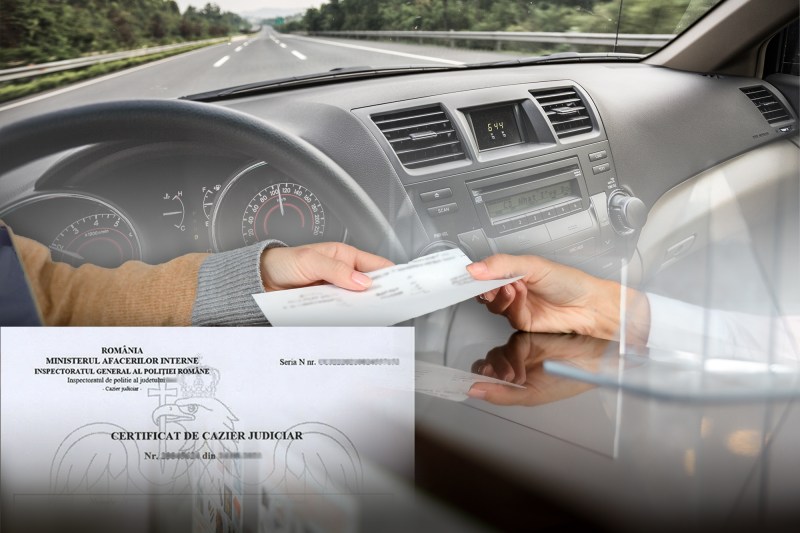
Criminal record certificate. Illustrative image. Collage: Ion Mateș. Photo: Dreamstime, Shutterstock
Several citizens of Bucharest complain that the officials at the counters of the Driving Permits and Vehicle Registration Regime Directorate (DRPCIV) refuse to accept criminal record certificates issued in electronic format. The situation is signaled in a document sent to the MAI by PNL deputy Sebastian Burduja, former Minister of Digitization, in whose mandate the online release of the record was implemented.
“It is absurd that a structure under the direct authority of the Ministry of Internal Affairs (DRPCIV) does not recognize the validity of an official document issued through a platform developed and guaranteed by the same ministry”, says Burduja in the question submitted at the beginning of September, in which he asks his party colleague, the Minister of Internal Affairs, Cătălin Predoiu, for explanations.
According to the minister, the reason given by the clerks at the counters is “an unfounded presumption of forgery”. “Instead of verifying the document and, in case of real suspicion, notifying the criminal investigation bodies, they choose the easy way of refusal, forcing citizens to resume the bureaucratic procedures to obtain a physical document”, states the minister.
In the document to Predoiu, the deputy also invokes the law in force which provides that “criminal record certificates issued in electronic form are signed with a qualified electronic signature and are assimilated to authentic documents”.
Finally, it asks the MAI to say what administrative measures it will take to ensure, with immediate effect, the unconditional acceptance of electronic criminal record certificates at all DRPCIV counters in Bucharest and in the country, and to sanction officials who do not comply with the legal provisions.
What did the MAI answer?
The Ministry of Internal Affairs responded, last month, to the questioning and specifies that steps are being taken for the permit and registration services to automatically extract their criminal record extracts from the ROCRIS database, without asking for them at the counter.
“All due diligence has been done by the General Directorate of Driving Licenses and Registrations in order to ensure a uniform way of working, by sending guidelines and organizing work meetings, so that all community public services driving license and vehicle registration regime obtain the extract from the criminal record through the ROCRIS application and do not request it, under any circumstances, from the citizens who present themselves to submit the documents necessary to carry out specific operations”, says the MAI's response.
The ministry invokes a ministerial order from 2010, based on which the criminal record issued at the counter is required, but states that steps are being taken to amend and supplement this.
The necessary steps have been initiated in order to amend and supplement the Order of the Minister of Administration and Interior no. 268/2010, with subsequent amendments and additions, in the sense of replacing the obligation to obtain the extract from the criminal record with the verification of the fulfillment of the conditions provided for in art. 24 para. (6) of the Government Emergency Ordinance no. 195/2002 regarding traffic on public roads, republished, with subsequent amendments and additions, through automated computer procedures”, says the MAI.
The changes will enter into force after the publication of the order in the Official Gazette.
Sebastian Burduja: “Digitalization also requires a change in the mentality of civil servants”
Contacted by HotNews, MP Burduja says that the MIA's response “reflects an institutional approach”. Sebastian Burduja PNL MP Sebastian Burduja is a former Minister of Digitalization in whose mandate the possibility was launched that citizens could obtain the criminal record certificate online.
“I understand that there is still tertiary legislation that requires adjustments, although the law “beats” such regulations. It is clear that digitization requires, beyond legal and technical instruments, a change of mentality, in the case of public officials who interact with citizens. I am convinced that this is not about ill will, but about an adaptation process”, declared the deputy.