Dozens of armed Hamas fighters are believed to be stuck in tunnels beyond the Yellow Line, the Israeli-controlled part of the Gaza Strip after the end of a US-brokered truce between the parties, the WSJ reported.
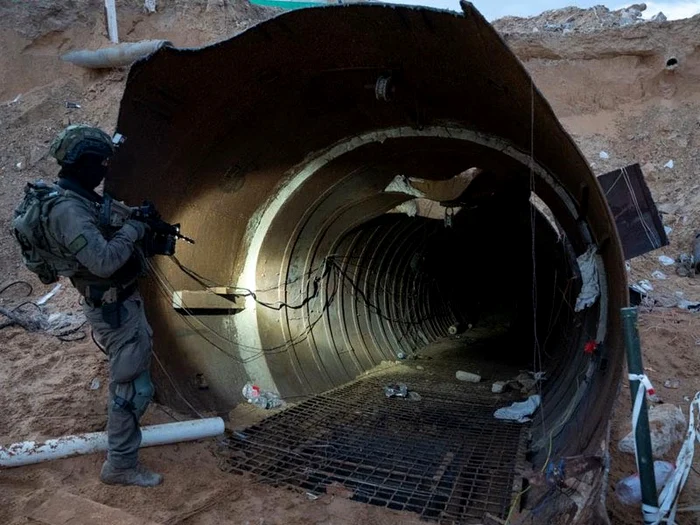
Israel has begun destroying the tunnels in Gaza photo x/israel war room
In May, the Israeli military launched a campaign to flush out militants and destroy Hamas' vast tunnel system, where the group has hidden fighters, hostages and weapons throughout the conflict.
Israel's strategy:: to cut communication between different sections of the underground network. Israel's partial withdrawal under the US-brokered truce last month meant some of the militants remained behind the yellow line. They would be stuck underground, with no means of escape and with dwindling supplies.
The situation of Hamas fighters and possible new clashes between them and Israeli troops are the most important threat to the ceasefire. Arab officials said the decision on the beleaguered militants had become a hotly contested issue in the negotiations.
The group wants Israel to give the fighters safe transit into Hamas-controlled territory.
Israel demands that they surrender, or it will kill them.
“Israel's policy in Gaza is clear: The IDF is acting to destroy the tunnels and eliminate Hamas terrorists without any restrictions in the yellow zone under our control,” Israeli Defense Minister Israel Katz said in a post on X on Wednesday.
Conflicting information about Hamas fighters being holed up underground
Israeli and Arab officials estimate that between 200 and 300 fighters are in the tunnels.
The Hamas group told the mediators that the number is much lower, about 100 people. Arab officials speculate that some of them may have starved to death in the meantime due to lack of food supplies. Most of them are believed to be stuck in the southern city of Rafah, and others are in areas of central and northern Gaza where Israel has partial control, Israeli and Arab officials said, including neighborhoods east of Khan Younis, Beit Hanoun and Shuja'iyya.
Those fighters staged an ambush that killed three soldiers, an incident that triggered waves of airstrikes that killed 145 Gazans, Palestinian health authorities said.
Hamas said it lost the ability to communicate with these fighters in March. At the same time, he claimed that he did not order the attacks on Israeli troops. Then on Sunday, as talks to evict those militants advanced, Hamas said it had found a way to communicate with them, according to Arab officials.
Israeli military officials say that's not true: Hamas would, in fact, have been able to communicate with the trapped fighters all along, but only because the tunnels are equipped with communications systems.
Negotiations on the release of Hamas fighters began last week after the US mooted the idea of providing them with safe transit, Arab officials said. One proposal was that they be evacuated by the Red Cross. Israel initially agreed, but made it a condition that the fighters give up their weapons and Hamas return more of the bodies of the hostages.
“For several months, the Israeli army has surrounded and pursued Hamas terrorists who are hiding in a “pocket” in the Rafah area, terrorists who killed three of our heroic fighters in the last few days,” Israeli Finance Minister Bezalel Smotrich wrote on Monday, X. “To let them go safely even when the Israeli military is closing in on them and taking them out is security and moral insanity.”
Israel fears that killing the trapped Hamas fighters could halt the process of returning dead hostages remaining in Gaza, said Yaakov Amidror, a former national security adviser under Netanyahu.
For this reason, troops would try to find militants and capture them rather than kill them, said Amir Avivi, a former senior Israeli defense official close to the security establishment.
“They're trying to map the underground area,” Avivi said. “If they find out exactly where they are, they'll have to surrender.”
The bodies of six hostages remain in Gaza, and Israel claims Hamas is prolonging the trial to buy time to continue consolidating power in the enclave under the cover of a ceasefire and without any external force deployed in the Strip. The return of all hostages remains the main issue preventing the ceasefire agreement from progressing to the next phase.
In the next phase of the truce, the Trump administration hopes to begin providing temporary housing to displaced Palestinians in areas of Gaza no longer under Hamas control, according to the US official.
The Israeli-controlled part of the Strip is already home to hundreds or thousands of militia members and their families who oppose Hamas, according to various estimates by Israeli military officials, Arab officials and senior anti-Hamas militia commanders.