DOCUMENT Sole candidate for the headship of the PSD, Sorin Grindeanu, says, in the motion with which he wants to win, that “we have to build a culture of competition”

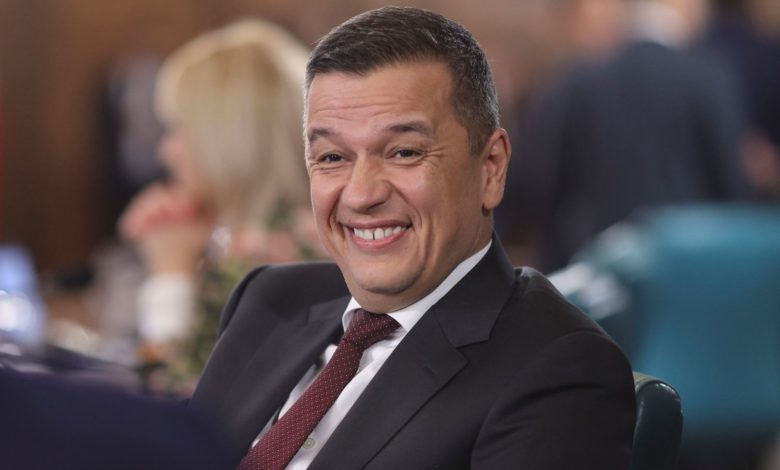
The motion with which Sorin Grindeanu is running for PSD presidency, during Friday's extraordinary congress, is entitled “United for Romanians. Strong, only together”. “We need to build a culture of competition, based on ideas and not just people,” he writes in the text, published Thursday evening, of Grindeanu's team's motion at Friday's Extraordinary Congress, in which he is the only candidate for the leadership of the social-democratic formation.
Grindeanu states in this text that we live in an era of paradoxes – “we have the greatest freedom in history, but also the deepest mistrust, we have the highest level of connection between people, but also the greatest social loneliness”.
“The Social Democratic Party was, in the last three decades, the architect of Romanian stability. It was called to restore the country and manage the crises, it defended the institutions, developed the economy, offered coherence and security. A party does not live only by remembering the successes, but by the power to identify new objectives, adapted to the present, but also oriented towards the future. Romania has constantly evolved, in the last 35 years, and the PSD has kept pace with this evolution”, says Grindeanu in the text of his motion for Friday's congress.
“Romania needs a force that restores a common goal – to show that modernity and solidarity are not mutually exclusive, that the economy can be efficient without cynicism, that progress and morality are not mutually exclusive, that new technologies can increase social cohesion. This political force must be PSD – the party that has proven that it knows how to govern, and now it must prove that it knows how to inspire again. This motion is a rational and deep reform – a change of approach. The Social Democratic Party must be a space of merit, of competence and of ideas. It must open the doors to the young generations, to the academic environment and to the civil society. Change does not mean replacing inertia with inspiration. PSD has the resources, the people and the structure to remain the central political landmark of Romania.”
The motion of the Grindeanu team starts from the conviction that “Romania can be part of the European construction without losing its identity, it can be competitive without sacrificing solidarity, and it can be modern without forgetting its roots”.
Also, the interim leader of the PSD also states that Romania must not be the “obedient student” of the European Union, but the “lucid partner” that brings balance and solidarity.
What else is written in Grindeanu's motion:
- “This motion is a call to accountability. The motion is not just a political document, but a commitment. We will govern more effectively, we will still listen to all opinions, but we will decide with moderation. We will be with Romanians, we will promote social-democratic values. We will continue to do politics together with the Romanians and for the Romanians. A united PSD is needed, which has a clear identity and well-defined objectives. This motion is the beginning of the road to balance, dignity and responsibility. In recent years, Romanian politics has become radicalized. In such a climate, balance becomes a political virtue. Balance does not mean indecision, but discernment. It means the ability to hold together two fundamental values: freedom and protection. The PSD must represent the voice of the moral center of Romania, that center that does not identify with the ideology of austerity, nor with radical populism
- PSD is the largest political force in democratic Romania. (…) PSD is the pillar of Romanian stability – a party with roots, structures, people and experience. Behind this administrative force there is a need for doctrinal clarification. PSD is a centre-left party, it promotes social and economic progress, but not progressivism – in the form currently perceived by Romanian society. (…) PSD must once again have the courage to talk about dignity and equity as legitimate political objectives. PSD organizations are among the most stable in Central Europe: they have continuity, expertise and a unique infrastructure. Unfortunately, focusing only on efficiency has made us lose contact with new generations, with professionals from various fields, with the diaspora. Our branches functioned well as electoral machines, but rarely as civic laboratories. PSD must rediscover the internal debate. We need to build a culture of competition, also based on ideas and not just people.“
At the same time, Grindeanu proposes that party leaders be evaluated by the real impact of their work: “We must introduce an internal evaluation system based on a set of indicators: public participation, electoral impact, community visibility, civic involvement. Let's promote a culture of acceptance and feedback – success is recognized, failure is analyzed, but not hidden. Each local organization must have an annual political and civic action plan, monitored at the regional level and national”.
State reform
A chapter of the motion is dedicated to state reform.
“PSD proposes a reform that is not measured in organizational charts, but in the quality of the relationship between the state and the citizen. The state must be more efficient, that is why PSD proposes a balanced state, built on four pillars: 1. Functionality – institutions with clear attributions, with simple procedures, and competent employees 2. Transparency – data made available to the public, the possibility of real civic control 3. Digitization – a quick access to information and procedures, the elimination of unnecessary bureaucracy, and increasing speed of the authorities 4. Professionalism – decent and fair behavior towards citizens. PSD supports a reform of the public function based on competence, merit and continuous training. We must continue the real depoliticization of technical and ethical positions for all public sector employees, the document states.
According to the motion, Romania needs a new generation of decentralization, based on local competence, fiscal autonomy and regional solidarity.
“PSD will promote a National Pact for Decentralization, which will clearly establish competences between the levels of administration, reducing overlaps and bureaucratic blockages. The state thus becomes an unstable normative architecture – a complex but incoherent system. PSD supports a systematic verification of legislation, by codifying the major areas (work, health, education, environment), eliminating redundant norms, standardizing administrative procedures and introducing the social impact test for any bill. The State Romanian must move from an authoritarian attitude (the state that demands) to one of partnership (the state that serves)”, the text of the motion reads.
Congress with a single candidate
PSD will elect its new president on November 7, and Sorin Grindeanu is the only one registered in the race for party leadership. Among the names that will be part of Sorin Grindeanu's team are MEP Claudiu Manda, Gabriela Firea or Daniel Băluță, the mayor of Sector 4.
General secretary, practically, the second most important person in the party will be Claudiu Manda, MEP. On the other hand, Lia Olguța Vasilescu, mayor of Craiova, who until now held the position of vice-president of the party, will no longer be part of the leadership.
PSD is to have five first vice-presidents, instead of two. The positions will be held by Bogdan Ivan, Minister of Energy, MEP Victor Negrescu, Ionuț Pucheanu, mayor of Galați, Corneliu Ștefan, president of Dâmbovița County Council.
The fifth position of first vice-president will be occupied by Marius Oprescu, president of CJ Olt. He is close to Paul Stănescu, who for 6 years held the position of general secretary of the party, but decided not to run.
Until now, there were 16 positions of vice presidents in the PSD leadership.
Grindeanu proposed a team of 20 vice-presidents:
- Daniel Băluță, the mayor of Sector 4
- Dragoș Benea, MEP
- Gheorghe Cârciu, MEP
- Francisk Iulian Chiriac, president of Brăila CJ
- Mihnea Costoiu, rector of the Politehnica University of Bucharest
- Vasile Dîncu, MEP
- Andrei Dolineaschi, deputy from Bucharest
- Marius Alexandru Dunca, senator from Brașov
- Doina Federovici, senator from Botoșani
- Gabriela Firea, MEP
- Adrian Gâdea, president of CJ Teleorman
- Aladin Gigi Georgescu, president of CJ Mehedinți
- Dumitrita Gliga, deputy for Mureș
- Romeo Lungu, deputy from Buzau
- Silvia Claudia Mihalcea, MP for Caraș Severin
- Laurentiu Nistor, president of Hunedoara CJ
- Constantin Rădulescu, president of CJ Vâlcea
- Gheoghe Șoldan, president of the Suceava CJ
- Adriana Diana Tușa, deputy from Bucharest
- Gabriel Zetea, president of CJ Maramureș.
In mid-October, on the day the day of the congress was set, Titus Corlățean, who represented the more conservative voices in the PSD, announced that he was withdrawing from the race for the party leadership. In the message in which he announced his withdrawal, Corlățean criticized the party and said that the project proposed by him and the team supporting him “is not feasible”.