Article by George Nistor – Published on Monday, 03 November 2025, 15:29 / Updated on Monday, 03 November 2025 15:31
The Romanian Football Federation submitted a bid for Bucharest to host Europa League final from 2028 or 2029, at the National Arena, but the first signals from UEFA do not give much hope. According to the information of Gazeta Sporturilor, the chances of obtaining the organization of the grandiose event are minimal at this moment.
In 2012, the capital of Romania also organized the last act of the second interclub competition on the continent, but the conditions were not as strict as those in the new regulations of the forum based in Nyon.
The infrastructure is not on Romania's side this time either. In the file submitted by the FRF, there are many promises instead of certainties, while the main competitors, France and Italy, put on the table the best facilities for spectators and broadcasting.
The National Arena, outside the standards for the Europa League final
If 13 years ago the focus was mainly on the stadium, broadcasting and security, UEFA provisions now impose a much more complex set of requirements, the old criteria being only a starting point.
The final on May 9, 2012, between Atletico Madrid and Athletic Bilbao (3-0), was considered a sporting success, but it also revealed Bucharest's organizational shortcomings.
Henri Coandă Airport was overtaken by the flow of races, and public transport was blocked several times, even though the municipality provided special bus lines, although in the documentation proposed by the Capital authorities it was mentioned that the mobility of the spectators will be ensured by a new section of the metro, which connects Otopeni with Piața Muncii. I'm running out of time, the new highway isn't ready even now.
UEFA officials noted local enthusiasm and hospitality, but internal reports noted infrastructure deficiencies and a lack of logistical coherence.
In fact, since then, Romania has never received a nomination for another major event, except for the four matches at the anniversary edition of Euro 2020, hosted by 11 cities in 11 countries.
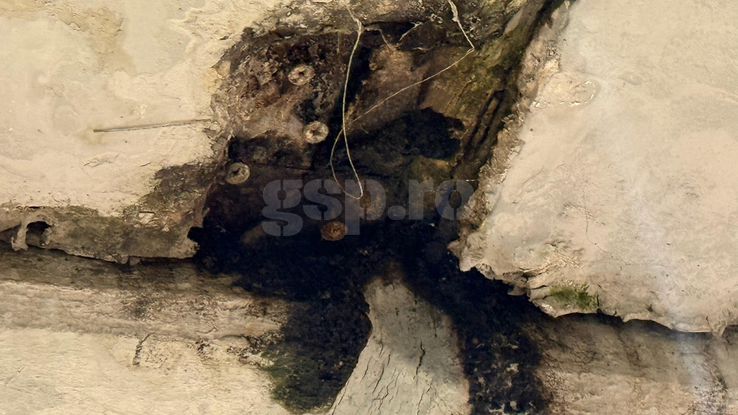
In the file for 2028 and 2029, FRF again proposed the National Arena, arguing through previous experience and existing infrastructure. The difficulty lies in the fact that, beyond the dilapidated stadium, as GSP has reported on several occasions, no other element of urban logistics has significantly evolved.
Metro line to the airportunder construction, will not be completed before the end of 2028. Therefore, road access remains complicated, and the National Arena parking lot, with 192 underground and 1300 above-ground spaces, could also be considered insufficient for current requirements.
2 billion eurosis the estimated cost of the M6 Highway project, section 1 Mai – Henri Coandă Otopeni Airport, which will include 12 stations.
35%is the current stage of the project, according to the latest data on the progress of the works on the M6 which will measure 14.2 kilometers. The estimated duration of a trip from May 1 to the airport will be approximately 25-30 minutes.
Accommodation standards represents another vulnerable point. The city does not have, according to estimates, the 6,000 four- and five-star rooms needed in an area no more than an hour away from the stadium. In addition, some of the large hotels do not have the security standard required for official delegations.
UEFA's technical report, more recently, gives an important score to sustainability: localities must present detailed ecological management plans, from electric transport to reducing energy consumption.
The conditions set by UEFA
The requirements are now mandatory, not optional, and are included in category 4 requirements, the highest possible.
In 2012, many of the provisions did not exist, and UEFA was assessing organizational capacity rather than the urban ecosystem. Here are the basic conditions set by the European forum:
-
typical gross capacity 40,000-60,000 seats, without closed sectors, and the playing surface to be natural or hybrid grass, according to Pitch Quality Guidelines;
-
rapid public transport network between the airport, the stadium and the city centre, with extended schedule on match day;
-
sustainability plan regarding the carbon footprint and recycling of waste generated by the event;
-
dedicated media areas for at least 600 journalists, including spaces for 4K and integrated 5G broadcast;
-
minimum 6,000 accommodation rooms verified to the UEFA standard, in the vicinity of the stadium (maximum 60 minutes of travel);
-
volunteer center and official fan-zones certified in terms of security and logistics;
Romania has demonstrated that it has the ability to successfully organize such major events, being a competitive partner for UEFA in the European football circuit, and now we want to use the legacy of the previous tournaments organized in our country to create an impressive new chapter in the history of Romanian football.
– Răzvan Burleanu, president of the FRF
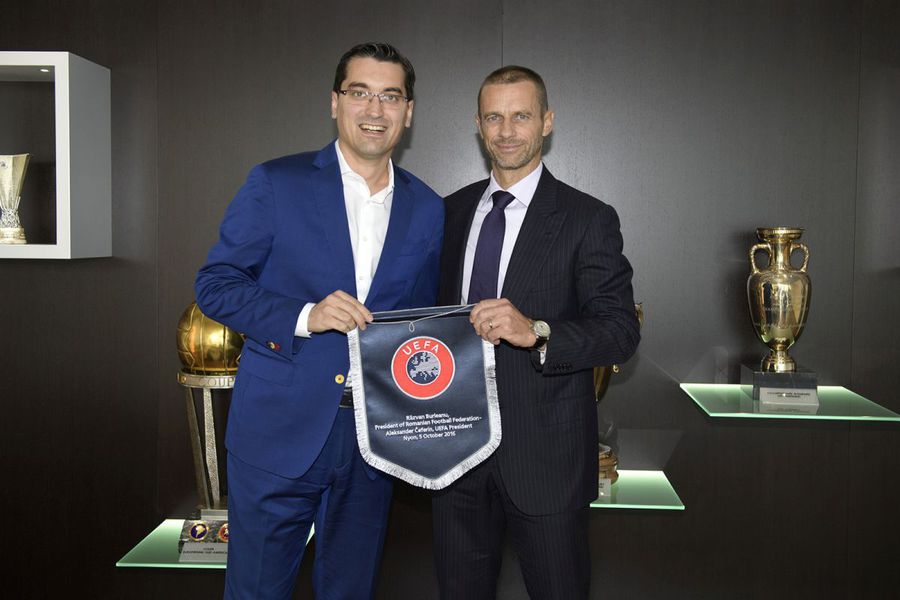
Răzvan Burleanu and Aleksander Ceferin, UEFA president
The selection is technical, not like in Mircea Sandu's time
In 2009, while the Arena was still under construction, the awarding of the Europa League final to Bucharest was done more on the basis of opportunity and influence, Mircea Sandu having been a full member of the UEFA Executive Committee for two years at the time.
Meanwhile, things have changed radically. The selection process has become a formalized, transparent and strictly technical one, under the direct supervision of the competitions department.
Starting with the 2025-2026 cycle, UEFA runs a standardized bidding process with clear stages and public deadlines. Interested countries submit a complete dossier more than a year before the designation, which is then reviewed by an independent committee.
It evaluates projects based on strict operational criteria, and political influence is greatly diminished. Romania still has time until the spring of 2026 to bring improvements and clarifications, but until then, the Nyon file looks more like a letter of intent than a guarantee.
30 million euroswere the total revenues generated by the event in Bucharest in 2012
We propose to use the entire application process for hosting the Europa League final as a trigger, which will contribute to building a reference organizational model for football clubs in Romania, in the context of Central and Eastern Europe, around the perspective of Football – Community – Business – Sustainability. With a large number of experienced and dedicated specialists, Romanian football is ready to offer the best conditions and reach the highest standards in organization.
– Răzvan Burleanu
One more chance against Serbia and Turkey
The arenas in Serbia and Turkey are ambitious projects, but both have major problems. First, the National Stadium in Belgrade is not yet finished. The project, which began in 2022, has encountered significant delays and controversies over cost and location.
Although the project envisages a capacity of around 60,000 seats and a UEFA category 4 classification, the deadline has already been postponed several times. At the same time, the infrastructure around the complex is insufficiently developed.
The situation is similar in Ankara, where the new 19 Mayis Stadyumu, announced with a capacity of around 51,000 seats, is in the same stadium. The Turkish authorities are promising a state-of-the-art stadium, but the realistic deadline for completion is dangerously close to UEFA's timetable for inspections (2026).
Also, beyond the security concerns, Ankara does not have the experience of organizing major events, which reduces the logistical credibility of the case against the much more established Lyon or Turin.
250 million euroswas the total cost of the National Arena in Bucharest. The works started in 2007, and the stadium was inaugurated on September 6, 2011, with the match Romania – France 0-0, from the Euro 2012 preliminaries
Candidates for the 2028 Europa League final:
-
France: Lyon-Decines, Parc Olympique Lyonnais or Paris, Parc des Princes (only a host city and venue will be confirmed upon application);
-
Italy: Turin, Juventus Stadium;
-
Romania: Bucharest, National Arena;
-
Serbia: Belgrade, National Stadium;
Applications for the last act of 2029:
-
France: Lyon-Décines, Parc Olympique Lyonnais or Paris, Parc des Princes (only one host city and one venue will be confirmed upon application submission);
-
Italy: Turin, Juventus Stadium;
-
Romania: Bucharest, National Arena;
-
Turkey: Ankara, Ankara Stadium 19 Mayis;
-
Serbia: Belgrade, National Stadium;
Where have the Europa League finals been played so far?
-
2010 – Hamburg Arena (Germany), 2011 – Dublin Arena (Ireland), 2012 – National Arena (Romania), 2013 – Amsterdam Arena (Netherlands), 2014 – Juventus Stadium (Italy), 2015 – Stadion Narodowy (Poland), 2016 – St. Jakob-Park (Switzerland), 2017 – Friends Arena (Sweden), 2018 – Parc OL (France), 2019 – Baku Olympic Stadium (Azerbaijan);
-
2020 – RheinEnergieStadion (Germany), 2021 – Stadion Gdansk (Poland), 2022 – Ramon Sanchez-Pizjuan Stadium (Spain), 2023 – Puskas Arena (Hungary), 2024 – Aviva Stadium (Ireland), 2025 – San Mames (Spain), 2026 – Beşiktaş Stadium (Turkey), 2027 – Walstadion (Germany);