The war in Ukraine is turning into a farce. But behind this curtain, Russia's true desperation is increasingly visible.
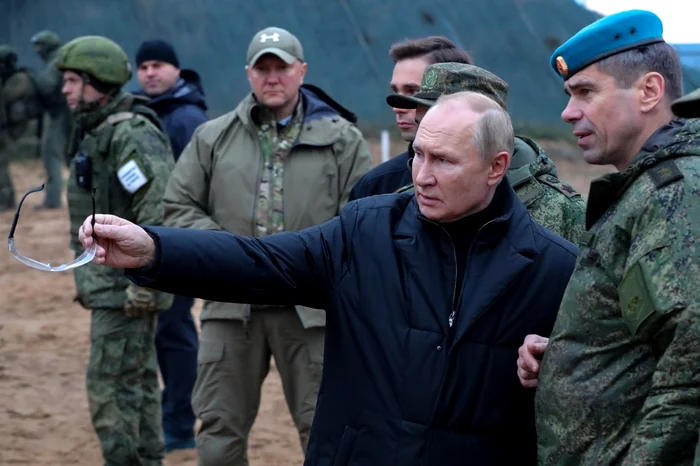
Russian President Vladimir Putin/PHOTO: Profimedia
Lord Palmerston once joked that in the war between Denmark and Prussia in 1864, only three men understood why it started: one died, one went mad, and the third forgot. If that conflict ever seemed like the height of strategic absurdity, Russia's war against Ukraine has surpassed even that, writes geopolitical strategist Mark Brolin in an article for The Telegraph.
Let's analyze the behavior of the main actors.
Let's start with Putin's team, which sought to demonstrate strength and strategic prowess by occupying Ukraine. And what did this turn out to be? Surrounded by 19th-century advisers, the Kremlin leader has become so out of touch with reality that Moscow's sphere of influence has shrunk from the Middle East to Central Asia and Europe. Finland and Sweden have joined NATO, and Russia itself is increasingly becoming a vassal state of China.
Losing Western oil markets, Moscow, for all its claims of “armed power”, managed to capture only a small part of Ukrainian territory — at the cost of colossal human and economic losses, with no convincing explanation as to why the world's largest country needed a few hundred square kilometers more.
Next is Ukraine and President Zelensky. There is nothing surprising in the heroic struggle of Kiev for the liberation of its own territory. Another question is how Ukraine tries to keep America in the game. Kiev often formulates its sharp demand: help now, otherwise the consequences will be catastrophic, up to the risk of World War III. But modern Russia is a dwarf compared to the United States in every way, except for nuclear warheads, which even Putin would not dare to use. The exaggeration of Russia's power does not help Ukraine in the American information space, notes The Telegraph.
Then there is Europe. For years, most European countries have disarmed, while deepening their energy dependence on one of their main adversaries, ignoring warnings from Poland or Ukraine. They gave others lessons in principles by buying Russian oil and effectively financing the military machine they condemned. And even now, with war on their own continent and stagnant economies, European leaders continue to moralize as if they have invented the recipe for peace and prosperity.
And finally, the United States and its president. Donald Trump began his quest for peace in Ukraine with a proposal that Moscow considered ideal: to ask Ukraine to give up the occupied territories and the prospect of joining NATO – even before the start of negotiations. Then came the Tomahawk episode: for several days, Trump hinted that he might supply Ukraine with long-range missiles. Just when it seemed that Putin was already reaching for the phone, the threat was suddenly lifted. The pressure lever was applied – and removed instantly.
All this creates a picture so absurd that anyone who values logic might go mad.
Yet despite all the zigzags and retreats, the forces of reason seem to be beginning to win. Step by step, Europe and the United States are acting more or less in concert for the first time. Europe rearms; its energy dependence on Russia is rapidly decreasing; frozen Russian assets are seen as a source of funding for Ukraine; and Washington's latest decisions increased the pressure on Russian oil. Chinese and Indian energy companies have become more cautious, worried about secondary sanctions. The West continues to provide Ukraine with essential technological, logistical and intelligence support.
Perhaps most importantly, the myth of Russia as a “great power” is finally being shattered. This myth allowed the Kremlin to walk with its head held high and Europe to behave like a coward. It allowed Moscow's apologists to demand that Ukraine “adjust to reality” while ignoring Russia's own reality. Here are some facts:
Russia's war economy is overheated
Inflation in September was around 8% year-on-year, and prices are rising again in the autumn. This is a typical symptom of wartime overspending, not a sustainable force. The central bank maintains the discount rate at almost 17%, a figure worthy of a banana republic.
Guns Replace “Oil”
The 2025 budget plan calls for defense to account for about a third of total spending and about 6 percent of GDP — a level that strangles other sectors and sets the stage for poverty in the future.
Moscow is running out of human resources
According to the most conservative estimates, over 200,000 Russians died between February 2022 and August 2025, with the total number of casualties (killed and wounded) exceeding 1.1 million by October. NATO estimates that around 100,000 people died in 2025 alone. Regardless of the numbers, the losses clearly exceed the capacity for recovery.
GDP growth is an illusion amid military spending
Positive economic performance is supported only by government orders and price spikes – fuel for today's inflation and tomorrow's decline. Even Russian bankers are warning of the threat as oil refinery strikes and falling oil prices hurt profits in the country's main asset.
The labor market is exhausted
Unemployment is at a record high—not because of success, but because of a lack of labor: About a million people have left the country after 2022, which has only worsened the shortage of personnel.
Intellectual emigration is reaching catastrophic proportions
Russians remain among the poorest and sickest people in Europe; the average life expectancy for men is ten years shorter than in the EU. Freedom of speech is a joke that is also an economic tragedy. No wonder the most educated and wealthy are fleeing – with their capital and talent.
Dependence on China is increasing
About 35-40% of Russian trade goes to China, which is the main energy buyer. But even this cooperation is hindered by payment restrictions, which demonstrates Moscow's weakness. Lack of access to competitive markets affects all sectors: airlines are dismantling their planes for parts, and by 2026 more than half of Western aircraft could be scrapped. This is technological isolation.
The fire returned to Russia
Even without the Tomahawks, Ukrainian long-range attacks—drones, Storm Shadow/SCALP, ATACMS—regularly hit Russian air bases, refineries, logistics centers, and the Black Sea coast. The Russian Black Sea Fleet was dispersed, weakened, and pushed eastward; Crimea has gone from a former refuge to a training ground. War has come back to life.
The Ukrainian military has tapped more than 20 percent of Russia's oil refining potential, the president said.
All this does not speak in favor of “rewarding aggression with territories” and does not mean that Russia can “fight calmly for years”. On the contrary, it is worth tightening the noose even tighter: respecting the oil price ceiling, hitting carriers and insurers, blocking the supply of machine tools and dual-use goods, and allowing Ukraine to hit Russian logistics more deeply. Fortunately, this is already starting to happen, the British publication points out.
The real danger for Ukraine is that Russia's situation is so critical that Putin may simply try to prolong the war – at any cost. After all, as soon as attention is turned inward, a picture of self-created chaos opens up: inflation, deficits, unemployment, and a kleptocracy incapable of modernization. If he continues to fight, the cost will rise, the number of casualties will also rise, and internal resentment will explode only when the guns fall silent. But at least it will delay the outcome for a while longer.
In other words, Putin no longer lives in the world of reality — he exists in a fantasy universe created for him by his flatterers. That is why the pressure must be maintained — to make this reality impossible to ignore, The Telegraph concludes.