
Russian hypersonic missiles could 'blind' the US before a nuclear attack. What are the gaps in NATO's defense?


Russian hypersonic missiles “Kinjal” and “Zirkon” could overcome the early warning systems of the United States and NATO in the Arctic region, experts cited by Defense News warned.
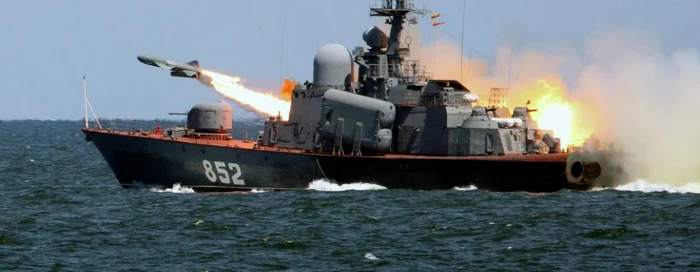
Russian ship, exercises with Zirkon hypersonic missile/PHOTO:archive
Specialists from the Center for Arctic Security and Resilience at the University of Alaska say that the radars located on the territory of Greenland – an essential part of the North American missile defense system (NORAD) – cannot effectively detect modern hypersonic weapons.
Gaps in Greenland's air defenses
During the Cold War, Greenland's radars were key elements in the ICBM launch warning system. But the advent of hypersonic weapons, capable of flying at speeds above Mach 5 and changing trajectory in flight, has made the current infrastructure obsolete.
“The United States currently lacks a permanent integrated air and missile defense layer in Greenland. The hypersonic missile threat has completely changed the equation, and existing systems cannot provide effective protection,” said Troy Buffard, director of the research center.
The region's extreme climate — with low temperatures, ice and strong winds — makes it difficult for radar systems and optical sensors to operate. Additionally, the US Air Force's 831st Air Defense Squadron, responsible for the area's security, has no anti-aircraft systems or specialized aircraft.
Proposed solutions
Among the measures analyzed are the use of polarimetric radar, adaptive optics and the development of a multilayer defense around the Thule (Pituffik) air base, located approximately 1,100 km north of the Arctic Circle.
Patriot systems, NASAMS, but also mobile close defense platforms, such as Vampire or experimental laser systems, could be used as means of interception.
Analysts at Defense Express warn that the current deficiencies put at risk one of the most sensitive components of the global early warning system of a possible nuclear attack — a major vulnerability for NATO.
Political factors and the regional context
In addition to technical challenges, strained relations between the US and Denmark over the status of Greenland could slow the modernization of military infrastructure in the region, experts say.
The issue takes on added significance amid the intensification of Russian weapons testing in the Arctic. In September, the frigate “Admiral Golovko” of the Russian Northern Fleet launched a hypersonic missile “Zirkon” during the “Vest-2025” military exercises held in the Barents Sea.
Russia is testing new strategic weapons
On October 26, Moscow announced the testing of the “Burevestnik” cruise missile, equipped with a nuclear propulsion system. President Vladimir Putin declared the test “successful” while Russian state media broadcast footage of a missile being loaded aboard a Tu-95MS strategic bomber.
Independent analysts have noted inconsistencies between official statements, alleged test locations and released images, suggesting the “Burevestnik” may be launched from the air, not from the ground.
Washington reacted cautiously. US President Donald Trump said the United States was monitoring the situation closely and called on the Kremlin to “focus on stopping the war in Ukraine, not testing nuclear-powered missiles.”
What is known about “Burevestnik”
According to estimates, the missile has a length of 9–12 meters, a speed of about 800 km/h and a weight of more than 2.5 tons — which raises questions about the possibility of carrying it under the fuselage of a Tu-95MS.
The missile would have been previously tested in the Novaya Zemlia archipelago in the Arctic Ocean. Possible flight distances theoretically place it within range of the US (4,000–7,000 km, depending on trajectory), but there is no independent confirmation of test success.
The Russian Defense Ministry did not provide further details, and international OSINT monitoring organizations reported no abnormal activity in the region.
The revelations about Greenland's radar vulnerabilities come at a time of heightened tension between Russia and the West. Modernizing anti-missile defense in the Arctic thus becomes a priority for NATO, given that Moscow's hypersonic missiles and new strategic systems pose unprecedented risks to global security.


