Life with disabilities in Romania. The story of Teodora, the young woman who fights the system every day: “Why it's not okay to use the h word”


Have you ever wondered what it's like to be a disabled person in Romania? A difficult exercise is the reality that hundreds of thousands of Romanians face daily. Teodora Dumitru is one of them. An intelligent and ambitious young woman, for whom life has been full of obstacles.
Not only those put by the diagnosis, but also by people. In addition to the inadequate infrastructure, the educational system was for her the point where she encountered the most difficulties. “At the Baccalaureate, in the Romanian Language and Literature test, I was told to shorten my essay from the third subject, on the grounds that the person writing it had a sore hand and that the pens I had brought were uncomfortable”Teodora remembers. As for the rights of people with disabilities, they must be demanded, says the young woman, although the law guarantees them.
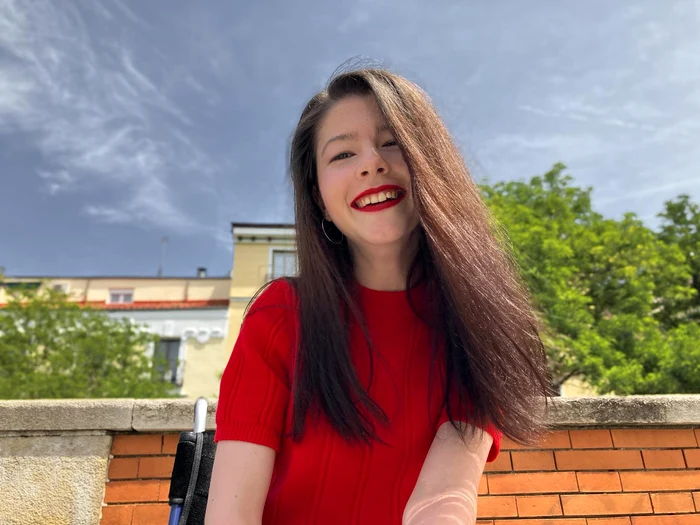
Teodora Dumitru PHOTO Personal archive
Life beyond labels
“I used to talk about myself as if I got through everything with a smile on my face. I felt that if I shared how many times I felt discouraged, I was seeking attention, drawing pity, and misrepresenting the community. Because the life of a disabled person extends much further than the difficulties we face every day. As I've matured, especially in the last two years, I've realized how important it is to admit that it wasn't easy for us to get where we are and achieve what we've achieved. Should we feel proud of our achievements? Absolute. Should it be so difficult to live our lives as close as possible to that of a typical person? Definitely not.”
This is how Teodora, known online as “Teo on the wheels”, begins her presentation. The young woman was born 25 years ago. Her umbilical cord was wrapped around her neck, and the lack of oxygen affected her motor skills, from speech to hands and feet. One year later, she was diagnosed with cerebral palsy and spastic tetraparesis.
The life of a disabled person in Romania is not easy, says Teodora. On the contrary.
“From infrastructure to basic rights, all must be demanded, even if in theory they are guaranteed to us by law. I was born and grew up in Bucharest. Here, accessibility is not at all what it should be. Curbs must be climbed, access ramps do not exist everywhere (and where there are they are impossible to climb), adapted toilets are not found in all establishments and restaurants”.
The way people with disabilities are viewed by society is another problem, says the young woman.
“There are only two labels that we “fit into”. On the one hand, we are infantilized, underestimated and should be content with the minimum we get. Here we will always hear phrases like >. On the other hand, we are considered superior simply for having the courage to live our lives beyond our disability. We're missing the middle ground, where we need to be seen as 'normal' (I hate that word) people who are part of a truly inclusive society where these labels have no place.”
The problems he faced in school and in exams
He felt the first pain of discrimination at school, in Romania 18 years ago. There, however, he also met the beautiful side of people, embodied by a teacher for whom a child meant more than a diagnosis.
“I entered first grade in 2007. My parents were recommended to enroll me in a state school, following psychological evaluations. I was refused by the first teacher my mother went to talk to, on the grounds that she didn't know how to grade me if I couldn't write by hand. I can't say I'm sorry, because I ended up at another school, where I was lucky enough to be in the class of a teacher who saw my academic potential, so to speak. He came up with solutions where the other one told me it couldn't be done; I would do my homework on my laptop and print it out. Instead of notebooks, I had files,” Teodora remembers.
Not all teachers were like the teacher. Some caused deep wounds to a young woman who wanted nothing more than to learn. A right theoretically held by all students in Romania.
“Throughout my school years, I faced underestimation and bullying from teachers (a substitute English teacher laughed at the way I cried after she refused to listen to me because she couldn't understand what I was saying.). At the Baccalaureate, as I cannot write by hand, a special committee was organized for me, consisting of two supervising teachers, another to write after dictation what I wanted to write on the exam paper and another interpreter. In the Romanian Language and Literature test, I was told to shorten my essay on the third subject, on the grounds that the person writing had a sore hand and that the pens I had brought were uncomfortable. To me at the time that sounded like >. If you ask me now, the problem is much deeper and has to do with the education system, which does not know how to adapt the exams to the needs of each type of disability.”
Solutions can exist, Teodora believes:
“In my case, it would have been much easier if I had been provided with an electronic device on which I could write by myself. That way, I wouldn't be dependent on anyone anymore, and my future would be in my hands alone.”
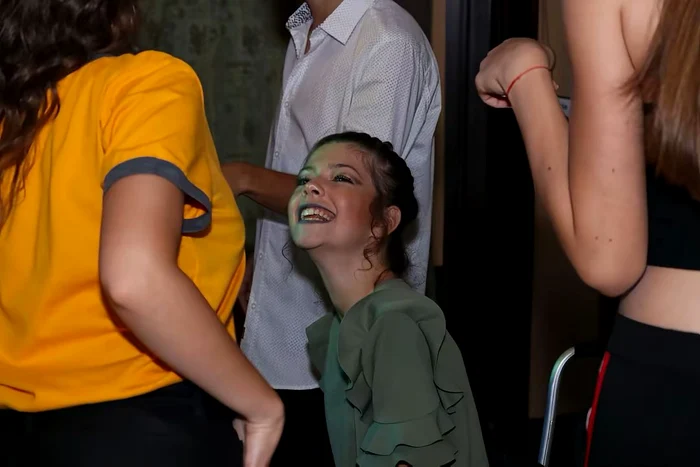
PHOTO Personal archive
Accessibility, normality in other countries; with us, challenge
We asked Teodora what she thinks is the easiest aspect to change that would improve the lives of people with disabilities, but which still doesn't happen. Her answer is accessibility.
“There are things that can be done quickly, cheaply and efficiently, but they remain ignored. I believe that we cannot be visible in a space where we are not allowed to perform. Proper ramp at the entrance to buildings, enough space for a wheelchair between tables in restaurants, signage adapted for the blind, audio announcements on public transport, websites accessible to screen readers. It's simple things that can make a huge difference. We have models in countries in Europe where these things are standard and seen as normal. Here, we still get stuck in the > mentality, although changes are extremely easy to implement if the will is there“, draws the young woman's attention.
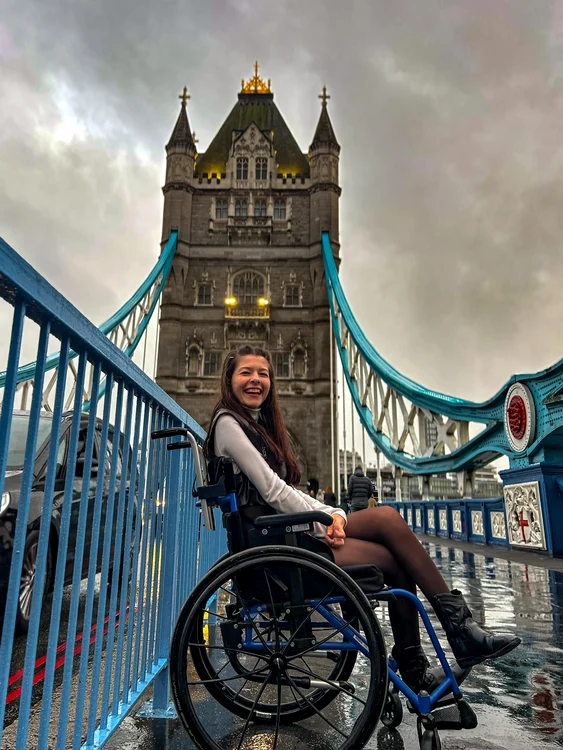
Teodora in London PHOTO Personal archive
The improvement in recent years is that people with disabilities have started to be more vocal and make their problems heard.
,What is a bit frustrating is that the rights exist on paper, but we have to pull our teeth to get them respected. Oftentimes, it's necessary to go with the law in hand to get what should come naturally.” Teodora explained.
The word that hurts
Beyond what can be implemented at the state or local government level, there are also the simple things that can be done by every member of society. And language can be worked on easily, with a little willpower and empathy.
A word still used by many, either to describe people with disabilities or as an insult, it can seem like just a string of letters to those who say it. On the other side, things feel different.
,I am reminded of a topic that I recently addressed on TikTok. We talked about why it's not okay to use the “h” word after it was recently used as a “joke” in a Romanian movie. The term has a negative historical charge, used for years as an insult, not as a neutral description of a condition. It ends up dehumanizing, reducing a person to their disability and automatically suggesting worthlessness, dependency or 'defect'. Society still feels the reflex to associate this word with inferiority, and this perpetuates prejudice, shame and exclusion. There are fair and respectful terms, like disabled person, that put human identity before condition and allow for mature, stigma-free discussion.” attracts Teodora's attention.
December 3, International Day of Persons with Disabilities
Since 1992, December 3 has been dedicated to people with disabilities and their rights. The young woman believes that those who have such people in their lives,they have the opportunity to see everything from a different perspective. I can learn about patience, adaptation, creativity and solidarity. Disability is not a tragedy, and society benefits when it views its members with respect and curiosity, not pity or fear.”
Teodora also thinks about those who tend to isolate themselves, due to lack of accessibility and poor integration.
“I wish with all my heart that all people with disabilities find the courage to come forward, to speak loudly about their experiences, to say bluntly “We exist!” Disability is not a shame, it is not a sign of inferiority, it is not a defect. It's just a different way of living our lives. We are much more than we are told, and even if the world tends to limit us, barriers are built to be broken.” says Teodora.
At 25, he has something to be proud of. With the help of parents who believed in her, she received a solid education, wrote a book, and is engaged in civic activism on social media.
“I want it to be known about me that I am a woman who has fallen so many times, that she lost her way, but got up just as many times. That I learned to be vulnerable, but to keep my optimism at the same time. And that I will always want to make a change in how people with disabilities are seen.”
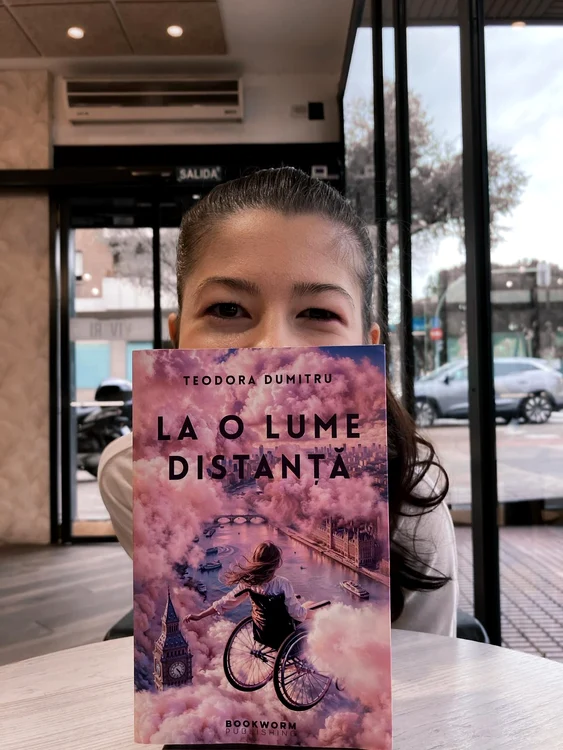
Teodora and the book she wrote, “A world away” PHOTO Facebook