Hill with TV tower. Birobidzhan
Photo: State Archive of the Jewish Autonomous Region
October 29, 1991
October 29 can be considered a truly historical date for our region. It was on this day in 1991 that the regional Council of People's Deputies adopted the Declaration on the state and legal status of the Jewish Autonomous Region. Thus, the process of transforming the Jewish Autonomy into an independent subject of the Russian Federation, launched almost a year after this event, was finally completed.
Let us recall that the Jewish Autonomous Region was part of the Khabarovsk Territory with autonomy rights. However, against the backdrop of political events taking place in the Soviet Union, the Third Congress of People's Deputies of the RSFSR in October 1990 introduced an amendment to the text of the republican Constitution, which significantly changed the administrative structure of the RSFSR. In particular, it was proclaimed that from now on the autonomous regions will be directly included in the Federation. Soon, by the Resolution of the Presidium of the Supreme Council of the RSFSR, the Jewish Autonomous Region was separated from the Khabarovsk Territory into an independent subject of the Russian Federation. The regional Council of People's Deputies put an end to this process.
The autonomy of the autonomy entailed the need to make a number of decisions related to the formation of public authorities. In a short period of time, the region had to build new relations with the center: ministries, departments, party structures, etc. And after the collapse of the Soviet Union, it also developed its own legislative framework, the crown of which was the Charter of the Jewish Autonomous Region, adopted by deputies of the regional parliament in 1997.
October 29, 1932
Also on this day in 1932, by decision of the Birobidzhan Workers' Village Council, the names of the first streets of the regional center were approved: Oktyabrskaya, Postyshevskaya (now Lenin), Partizanskaya (now Sholom Aleichem), Valdgeymovskaya (now Sovetskaya).
October 29, 1935
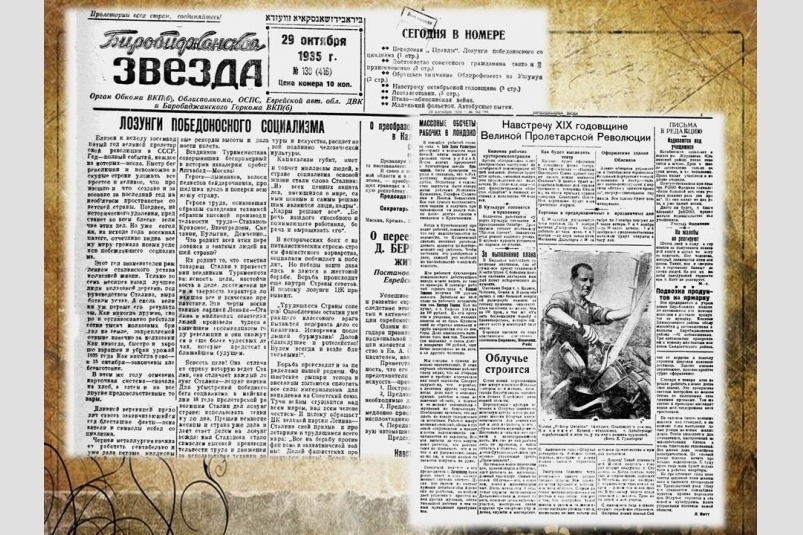
Day in the history of the Jewish Autonomous Region. Photo: Photo: Regional Library
The newspaper “Birobidzhan Star” (12+) on October 29, 1935 writes from Obluchye that the bulk of the migrants who come here go to work on the railway. Handicraft migrants founded a sewing and leatherworking artel in Obluchye. Several dozen immigrants work in the gold industry, many have dispersed to the mines.
They also talk about large construction:
“A four-story high school building has been built. This building is the subject of admiration for all irradiated people. Old railway workers say with joy and pride that the construction of such a school in a distant taiga village clearly convinces everyone how great the concerns of the Soviet government are about the needs of the population.
A new station has also been built. Now a wide stone staircase is being built from the platform to the station. The station building is two-story, beautifully architecturally designed.
The mechanics and turners of the depot moved to work in the new depot building. This is a beautiful, light-filled reinforced concrete building with continuous glass openings. The new railway power station also looks light and spacious.
In recent years, entire streets of new residential buildings have been built along the slopes of the hills towering above the station. The house of the Stakhanovites stands out especially, built from cinder blocks and very carefully decorated. Construction of a water pipeline has begun along the main street of the village.
The Obluchye transport hub is becoming the most important point for receiving migrants. Obluchye is being built and is becoming a cultural, comfortable village in our region.”