13th edition of the CFO Congress of SEG Listed Companies – 5 topics that dominated the event

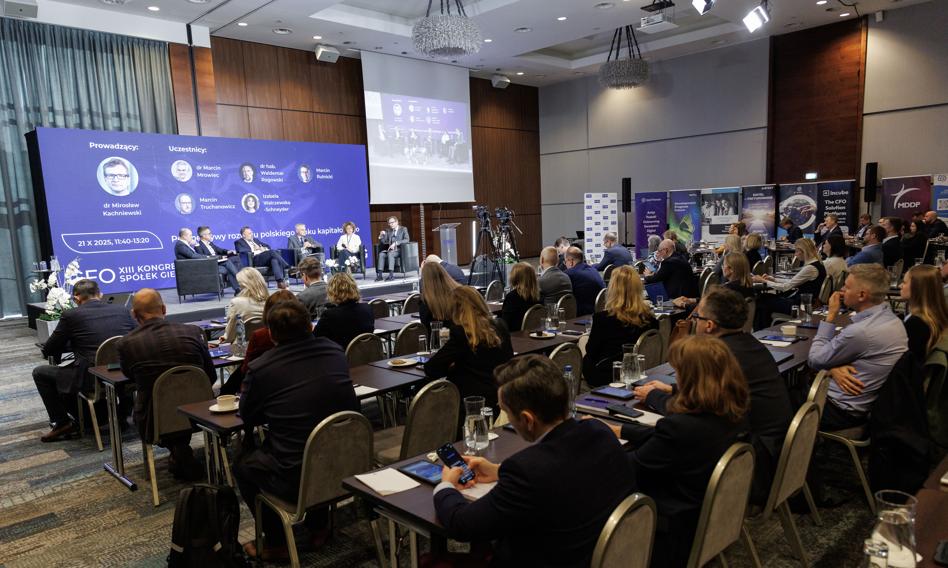
The 13th CFO Congress of SEG Listed Companies in Jachranka proved that financiers face pressure from all sides. In the thicket of discussions about AI, public debt and KSeF, five areas clearly stood out, which really dominated the experts' conversations and will set the agenda of CFOs for the coming months.
The first day of the Congress was filled with three discussion blocks, two of which were divided into several smaller expert talks. During the first block, entitled “Prospects for the development of the Polish capital market”, Dr. Mirosław Kachniewski (President of the Management Board, Association of Stock Exchange Issuers), Dr. Marcin Mrowiec (Chief Economist, Grant Thornton), Dr. Waldemar Rogowski (Professor of the Warsaw School of Economics, Chief Analyst of the BIK Group), Marcin Rulnicki (Member of the Management Board, Warsaw Stock Exchange), Marcin Truchanowicz (Member of the Management Board of the National Depository for Securities and KDPW_CCP) and Izabela Walczewska-Schneyder, MBA, FCCA (Oryx Group, Co-Founder) talked about global changes and their impact on the Polish economy, the macroeconomic situation and future forecasts, and the implications for the Polish capital market.
“Here and now” GDP growth is “boosted” by additional demand, but – high deficits mean debt accumulation. According to the official forecasts of the Ministry of Finance, the public sector debt is expected to increase by over PLN 320 billion this year, by almost PLN 390 billion next year, and by almost PLN 1 trillion in the next three years. This creates consequences in the form of, on the one hand, rising interest costs – and, on the other hand, the risk that these costs may get out of control, especially in the global environment of inflation and rising government bond yields. Politicians should take this challenge seriously – and for now, entrepreneurs will have to live with the risk growing on this scale – said Dr. Marcin Mrowiec, Chief Economist, Grant Thornton.
A stable and predictable macroeconomic environment is crucial for the capital market, as it fosters the confidence of investors – both domestic and foreign. Transparent fiscal policy and responsible management of public finances reduce investment risk, supporting the long-term development of the stock and bond markets. At the same time, the capital market remains sensitive to the scale and structure of public investments. Well-planned investment projects – especially those supporting energy transformation, digitalization or infrastructure – can attract private capital and stimulate investor activity. The stock exchange, as a development financing platform, has an important role to play here, including: through the Catalyst bond market. However, it remains crucial to maintain a balance between the pace of investment and the stability of public finances, which in the long run best serves the economy and the capital market. – said Marcin Rulnicki, Member of the Management Board (CFO), Warsaw Stock Exchange.
Today, heads of financial departments of listed companies face extremely complex challenges. The unstable geopolitical situation, trade tensions and rising energy costs require more careful planning and greater flexibility in capital management. At the same time, demographic changes in Poland – aging society and shortage of qualified workers – affect the labor market and wage pressure. Today, CFOs must not only count, but also predict, combine analytics with intuition to maintain the company's value in an increasingly unpredictable environment. – said Izabela Walczewska-Schneyder, Oryx Group.
During the first debate in the second block, titled “AI Transformation. How to finance the implementation of AI in your company”, Magdalena Raczek-Kołodyńska (Vice-President of the Management Board, Association of Stock Exchange Issuers) in a conversation with Piotr Frankowski (Managing Director, Ayming Polska) discussed the challenges related to the implementation of AI, financing these implementations and a map of tools financing and the impact of AI on company innovation.
The second discussion concerned the path to modern consolidation and reporting. From the conversation between Małgorzata Szewc (Vice-President of the Management Board, Association of Stock Exchange Issuers) and Grzegorz Mozol (Sales and Marketing Director, Incube CPM), the participants learned, among others: when there is a need for a consolidation system, where to look for advantages and return on investment, and practical tips on what to consider when choosing solutions.
The next debate was devoted to KSeF. In this part, Robert Wąchała (Vice-President of the Management Board, Association of Stock Exchange Issuers) in a conversation with Tomasz Kuciel (President of the Management Board, EDITEL Polska) talked about the proper preparation of systems, translating XML into profits and KSeF as part of the EU ViDA agenda.
During the next panel discussion, experts raised the issue of automation in the ESG reporting process, including AI. Magdalena Raczek-Kołodyńska (Vice-President of the Management Board, Association of Stock Exchange Issuers), Adam Dobek (Vice-President of the Management Board, App Trend Product Development Department, Consolia ESG Processing & Reporting Platform System) and Kacper Dobek (AI Specialist, Consolia AI Team, MSc in Artificial Intelligence, Poznań University of Technology) discussed, among others: the role of integrated systems in ESG reporting, directions of work automation, and benefits and problems of implementing AI in ESG reporting.
The second block was closed with a debate entitled “ESG reporting and the management maturity of the organization”. Małgorzata Szewc (Vice-President of the Management Board, Association of Stock Exchange Issuers) and Paweł Zaczyński (Partner, Chartered Auditor, Grant Thornton) raised issues such as: the biggest problems in the reporting and internal control system of companies; when an expert may challenge a dual materiality analysis or data in the area of Environmental Taxonomy; simplifications in reporting or greenwashing.
After a short break, the last thematic block began, at the beginning of which Robert Wąchała (Vice-President of the Management Board, Association of Stock Exchange Issuers) and Magdalena Danilczuk (Insurance Broker, International Risk & Corporate Advisory) talked about mitigating the effects of cyber incidents through risk transfer. The speakers presented the reactionary and proactive role of insurance in cyber risk management, cyber incidents in the context of AI and how insurance can help in the event of a cyber attack.
Cyber policy provides protection against the financial consequences of cyber incidents by compensating for the costs of removing IT system failures and recovering data. The insurance also protects in the event of a leak of personal data and claims of third parties after a cyber attack – it covers the costs of legal assistance in the event of violation of the provisions of the GDPR, including administrative penalties imposed by the supervisory authority (UODO). It is very important that the insurer is involved in the process of limiting the extent of the damage and repairing it – cyber policies usually provide for the establishment of the so-called incident manager who coordinates the work of a team of experts in the field of personal data protection law, computer forensics, negotiations, fraud, public relations, etc. – said Magdalena Danilczuk, Insurance Broker, International Risk & Corporate Advisory (IRCA).
Then, the topic titled “Next-gen capital strategies” was introduced. Listeners
During the debate, Dr. Mirosław Kachniewski (President of the Management Board, Association of Stock Exchange Issuers), Yizhaq Cohen (CEO, IBI Investment House Polska) and Ofer Grinbaum (CEO, IBI Underwriting) learned, among others, o: diversifying corporate financing across borders, available funding, eligibility criteria. The debate was conducted in English.
Today, various sources of financing are the basis for the safe development of companies. The combination of loans, bond issues and private debt financing gives enterprises greater independence and stability in difficult market conditions. It is crucial to create an appropriate mix of sources, adapted to the strategy and stage of development of the organization – said Yizhaq Cohen, CEO of IBI Investment House Polska.
In the next part, Magdalena Raczek-Kołodyńska (Vice-President of the Management Board, Association of Stock Exchange Issuers) and Jakub Warnieło (Head of the tax and court proceedings team, Tax Advisor, MDDP) explained what 24/7 tax monitoring is, in particular: the most important trends and risks related to tax audits, ways to prepare for systemic changes in tax authorities' audits and mechanisms to increase security taxation of companies and their representatives.
Then, Małgorzata Szewc (Vice-President of the Management Board, Association of Stock Exchange Issuers) and Anna Łozowska (Legal Counsel, Manager, Olesiński and Partners) discussed tax reliefs as competitiveness tools, starting from market competitiveness in the context of the tax relief system, through non-obvious forms of tax savings, to the scale of savings.
The third thematic block was closed with a debate entitled “Changes in the management of confidential information”. Robert Wąchała (Vice-President of the Management Board, Association of Stock Exchange Issuers) in a conversation with Piotr Wojnar (Attorney, Managing Partner, act legal Poland) and Łukasz Świątek (Attorney, Senior Lawyer, act legal Poland) talked about multi-stage processes and delays in the publication of confidential information, transactions in closed periods and sanctions
and risk minimization procedures.
The day ended with an evening gala, the special guest of which was Otylia Jędrzejczak – multiple Olympic champion, president of the Polish Swimming Association. During the evening part, there was also a games tournament – probability calculation in practice.
The program of the second day of the Congress was filled with practical workshops on issues such as:
- Liability of management board members – obligations, risks and legal consequences. What does the data say?
- KSeF: compliance is only an entry threshold – how to unlock real cost advantage?
- Workflow and audit trail in creating ESG reports
- Financing development through issue of shares without a prospectus
- Next-gen capital strategies
The two-day meeting closed with a panel discussion titled: “The most important challenges facing CFOs”, during which Magdalena Raczek-Kołodyńska (Vice-President of the Management Board, Association of Stock Exchange Issuers), Dr. Mirosław Kachniewski (President of the Management Board, Association of Stock Exchange Issuers), Małgorzata Szewc (Vice-President of the Management Board, Association of Stock Exchange Issuers) and Robert Wąchała (Vice-President of the Management Board, Association of Stock Exchange Issuers) Stock Exchange) discussed changes in the regulation on disclosure obligations and the scope of ESRS simplifications, and also answered participants' questions.
13th edition CFO Congress of Listed Companies took place on October 21-22 this year. at the Warszawianka Hotel in Jachranka. The organizer of the Congress was the Association of Stock Exchange Issuers. The media patron of the event was the Bankier.pl portal.