How the pride of Romanian socialist agriculture was born. The legendary machine for which comrades gave themselves the hour of death to “steal” models from the West


A pride of the Romanian motorized industry from the communist period, the U 650 tractor has become a respected veteran of Romanian agriculture. It was also appreciated internationally, being exported all over the world. Although it was far from top of the range, the U 650 had its own irresistible qualities.
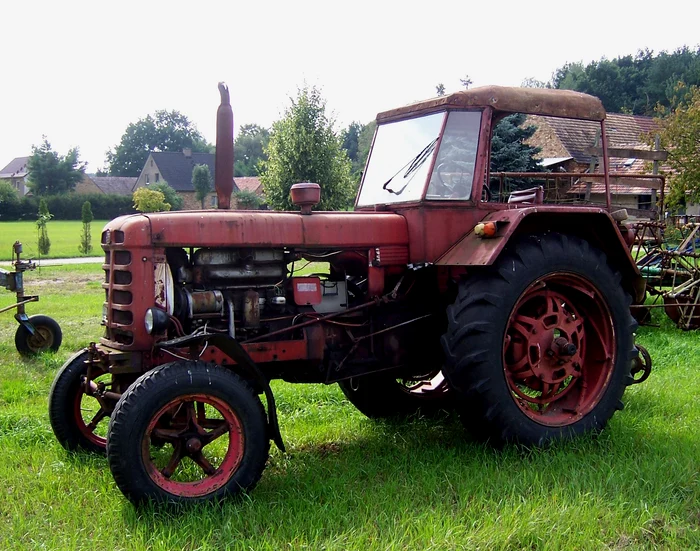
A variant of the U 650 tractor PHOTO wikipedia
In 1963, the first tractor models U 650 or UTB 650, as the model was actually called, came out of the gates of the Uzina Tractorul Brașov factory. It was one of the most successful motorized stories of communist Romania and with an enviable longevity. It was produced for 43 years, being a particularly popular model, especially in developing or poor countries where farmers could not afford very expensive machinery. In Romania, the veteran U 650 has become a legend of Romanian agriculture, viewed with sympathy by the vast majority of farmers who had the opportunity to work with this machine. “Everyone else learned their trade on the U650. I ate bread with these tractors for 30 years. For what was required then they were good. There are enough that still use them today, they do the job. Especially on small holdings”confesses a villager from Ungureni, Botoșani county. The realization of this tractor, which became known on five continents, represented a party task, including the work of less orthodox information of the cadres in charge of finding a suitable model.
From the fighter plane factory to the tractor factory in the city of “Stalin”
The story of the legendary U 650 tractor actually begins with an equally famous factory. It is about the Romanian Aeronautical Enterprise from Brașov. At first glance, everyone might wonder what aeronautics has to do with agricultural machinery. Well, he had. Especially through a post-war reconversion aimed at “building socialism” in Romania. But before tractors there were airplanes. The Romanian Aeronautical Enterprise (IAR) from Brașov was founded on November 1, 1925 as a joint-stock company, following a Romanian-French collaboration. Basically, the shares belonged to the Blériot-Spad and Lorraine-Dietrich plants and the AstraArad plant. The Romanian state contributed with the land, with the development of an airfield and with substantial funds. In 1938, the Romanian state managed to buy all the shares of the French factories, IAR returning to autonomous state management. The aircraft factory in Brașov was synonymous with performance in the aeronautical field.
It produced airplanes and airplane engines. The first Romanian aircraft bearing the name IAR was produced in 1930, after the factory had previously honored various orders for aircraft under French license. The first IAR was a fighter plane IAR-11 CV, made by the engineer Elie Carafoli in collaboration with the Frenchman Lucien Virnoux. At the time it was one of the best aircraft in the world in that category. Until the end of the Second World War, IAR Brașov produced 21 aircraft models, 15 of which were designed within the factory. The most famous were the IAR-80 fighter and the IAR-81 fighter-bomber. The IAR-80 was the aircraft used by air ace Dan Vizanty, achieving great performance with it.
The IAR-80 could fly at 500 kilometers per hour and had maneuverability comparable to that of a Messerschmitt BF 109, one of the flagships of the era. The IAR factories were among the most prestigious in interwar Romania, producing including installations and accessories for on-board armament. During the war, the factory was bombed and partially destroyed. After 1945, it was rehabilitated. With the establishment of the communist regime in Romania, it was transformed into a tractor factory. Fighter planes were no longer a priority, instead “building socialism” and establishing CAPs required numerous agricultural machines. In August 1949, IAR Brașov became the headquarters of Sovromtractor, i.e. a Romanian-Soviet joint venture. A year before, in 1948, the plant was no longer called IAR, but had become Uzina Tractorul Orasul Stalin, because by the decree of 1950 the city of Brasov became “Stalin City” to please the Soviets.
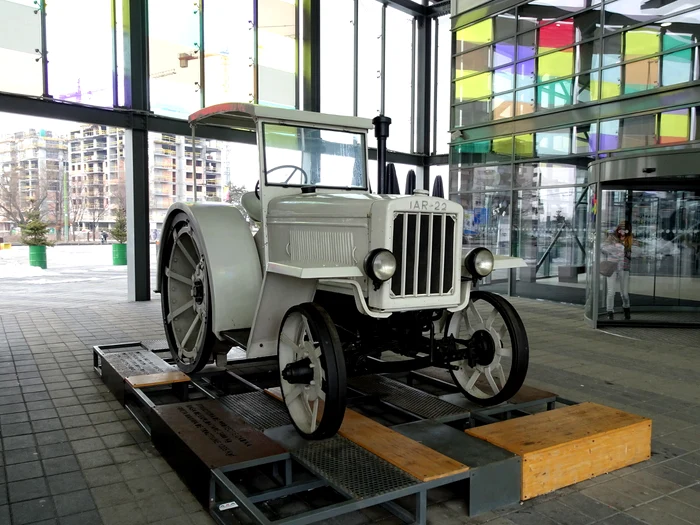
IAR 22 PHOTO wikipedia
The city at the foot of Tâmpa bore this name until December 1960, when, after Stalin's death, Romanian communism began to distance itself from the Soviet one. The stage of Romanian national communism was beginning with an apogee during the time of Nicolae Ceaușescu. So after 1960 the factory was called Uzina de Tractoare Brașov (UTB). The first tractor produced under the auspices of IAR was the IAR 22 model, in 1946. It was a model copied from the Hanomag R 40, a German tractor, at the suggestion of director Ion Grosu. Therefore, it is difficult to say that it was the first Romanian tractor, given that it was an almost faithful copy of the German machine.
The struggle of comrades to find good models to “steal” for a better performing tractor
From 1960, the comrades in charge of the agricultural and industrial sectors, but especially those who dealt with the Brașov Tractor Factory, were given the mission to make a tractor that would correspond to the communist agricultural plans. That is, it can be produced in large quantities, quickly and be quite resistant. As there was no national experience in making own models, nor the time needed for research, the party leaders started looking for good models to copy from abroad.
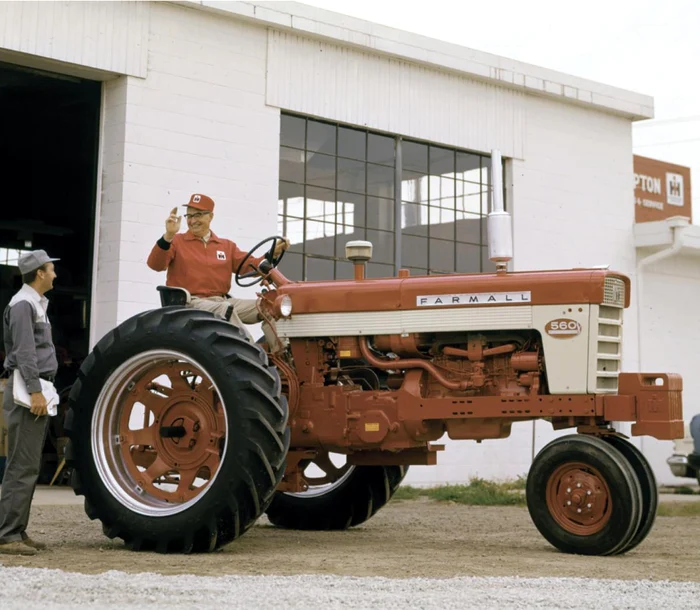
Farmall 560 PHOTO Wisconsin Historical Society/octanepress.com
Obviously, Western models were preferred. The Soviet ones were either not to the liking of the engineers, or, from an ideological point of view, they were looking for a distance, a path of their own, specific to communist nationalism. In short, they were looking for models to buy and then send to be analyzed and possibly copied by engineers at UTB and other parts companies. “In Romania, the colloquial phrase “to put the caliper” on an appliance, an engine, an aggregate, a device, etc. means trying to illegally reproduce a product, after finding out its main characteristics through various measurements”stated Petru Opriș in “The Romanian universal tractor and the problems that arose in the Council for Mutual Economic Assistance because of it (1960-1962)”. Several models were considered, including the American “Farmall 560” tractor, but also the Renault, with a 60-horsepower Perkins engine.
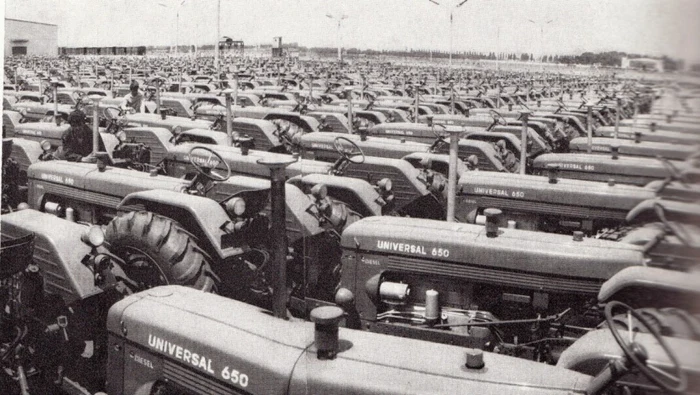
Universal 650 PHOTO wikipedia
“For the realization of the new tractors, it is decided to urgently import different tractors from the 60-65 HP group (on wheels and on tracks) with the respective aggregates in two copies each. The “Farmall 560” tractor was mentioned as the tractor that meets the complete needs of the Ministry of Agriculture and which was ordered for import. It was also recommended to bring two 60 HP “Renault” tractors with Perkins engines. The Comrade President of the Council of Ministers recommended that a prototype workshop be established at the Tractor Factory, which would be equipped with the machine tools necessary to execute the prototypes. Also, the newest types of tractors will be brought every year for UTOS (Stalin City Tractor Factory – note P. Opriş) that will serve to improve the tractors in current production. For the study of the new 60-65 HP engine, it was indicated to see the 63 HP Perkins engine mounted on the self-propelled combine from ICEMEA (Research Institute for Agricultural Mechanization – note P. Opriş). It is necessary for ICEMEA to give such an engine to UTOS for disassembly and study”states Petru Opriș in the same work, with quotes from a new document discovered in the archives. It is about an analysis made in 1960 regarding the manufacture of 60-65 horsepower tractors. There were several attempts, with failed prototypes, mainly because of the parts manufactured in Romania.
The birth of a Romanian agricultural legend
To produce these more powerful tractors, the Communist Party expanded the factory to an area of 10 hectares. Finally, in 1963, the Universal 650 appeared. It had a D-103 diesel engine with direct injection and electric start, with 65 horsepower at 1800 rpm and a cylinder capacity of 4760 cubic centimeters. The transmission had 10 gears and reached a maximum speed of 27 kilometers per hour. The tractor was equipped with an automatic locking mechanism, had independent double disc brakes and a hydraulic system for agricultural attachments. It had a 5 plus 1 gearbox with reduction gear.
With these specifications, the Universal 650 was a medium-powered tractor that managed to get the job done in the fields of communist Romania. What made it popular was its reliability. It was easy to repair and maintain. With the help of the hydraulic steering system, it also became easy to handle for the tractor driver. In addition, it had a wide range of applications. Variants such as the U 651, which had four driven wheels, but also modernized models over time, such as the U 650 M, U651 M or U 650 DT Super, with D-110 engines, appeared over time. The first batch of 5000 U 650 tractors equipped with plows and seeders was bought by the Romanian state.
A successful Romanian product for export
The U 650 tractors quickly became quite well known abroad as well. In fact, this Romanian industrial product was among the few that enjoyed export success. Between 1963 and 2006, more than 760,000 U 650 tractors were sold in more than 100 countries. Obviously, the most numerous were sold in Asia, over 300,000 pieces, mostly in communist countries and in developing countries that did not benefit from more advanced technologies. More than 70,000 also reached Africa. To top it off, over 90,000 U 650 tractors were bought in North America. Another 6,000 were bought in Australia. Communist Romania's tractors reached countries such as China, Russia, Congo or Brazil. According to the propaganda media of that period, UTB produced one tractor every 10 minutes due to the high demand.
Obviously, we should not trust too much in the propaganda organs of that period. It is certain that the U 650 has remained a legend and the old tractors of communist Romania still have fields in the country's villages. Obviously, they are mostly used for smaller holdings. For large agricultural areas, modern tractors are, as expected, preferred. The U 650 was also manufactured under license in countries such as Pakistan or Turkey. After privatization, the tractor factory in Brașov lasted until 2006.