Data from the Central Statistical Office for the first half of 2025 show dramatic disproportions in the development of housing construction in Poland. Developers received permits to build approximately 75,800 apartments and houses – a significant decrease compared to the same period a year earlier, when there were approximately 102,100 permits. But the real shock is in the details.
As many as 73 poviats are development counties white spots – places where from January to June 2025, not a single permit for the construction of a house or premises was obtained by the developer. Interestingly, it is not only about the eastern regions of the country. Among the white spots we can find, among others: Pyrzyce County in the West Pomeranian Voivodeship, Międzyrzecz County in the Lubuskie Voivodeship and Turkish County in the Greater Poland Voivodeship.
On the other side of the coin, we have extreme concentration of investments. Only twenty leading counties and cities with county rights have every second house and residential premises for sale with a new permit received in the first half of 2025.
Private investors also avoid the same areas
“You don't have to buy a house or apartment from a developer, many people build a new house on their own if they don't want to choose on the secondary market” – such an argument could appear in a discussion about developer white spots. But analysis of permits for private houses shows that the problem is deeper.
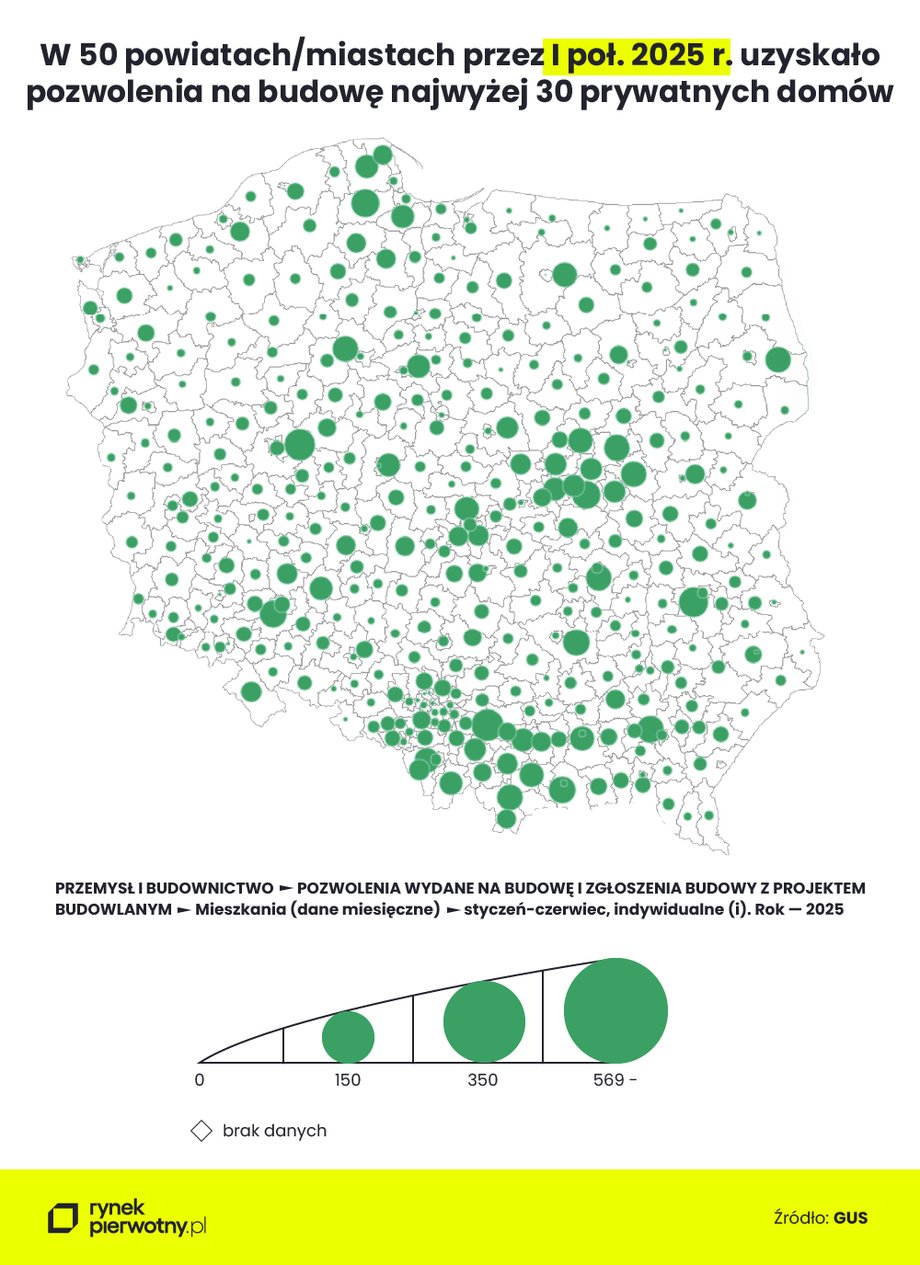
In many districts of the Lublin, Podlaskie and Warmian-Masurian Voivodeships, neither developers nor private individuals are building practically anything. A large part of the West Pomeranian and Opole voivodeships also fares poorly. The lack of both private and developer investments is a clear signal that the areas are not attractive for settlement.
Building permits – private houses
|
RynekPierwotny.pl / RynekPierwotny.pl
In the first half of 2025, Poles obtained permits for approximately 41,000 private houses. Fortunately, the concentration here is lower than in the case of development construction – twenty leading counties have 19 percent. the number of private houses with new permits. There is a clear dominance of agglomerations around the six largest cities and some other provincial centers, such as Rzeszów, Białystok and Lublin.
Poznań is breaking records, the province is standing still
The phenomenon of agglomeration of housing construction is not new, but its scale in recent years has been spectacular. Data from the decade 2014-2024 show real construction miracles in four suburban counties.
Poznań County increased the total usable area of existing houses and premises by 5.05 million square meters. — this is more than the total area of all houses and premises in Olsztyn, which is 4.97 million sq m. The Krakow poviat increased by 3.04 million sq m, which is more than the total area of Elbląg. The Wrocław district increased by 2.91 million sq m, thus exceeding the total area of Włocławek. The Piaseczno district near Warsaw has expanded by 2.83 million square meters, which exceeds the size of Słupsk.
In contrast, in the Hrubieszów and Siemiatycze poviats that close the ranking, the number increased throughout the decade only approximately 20,000 sq m of space usable houses and premises.
Why everyone wants to live in agglomerations
There are many reasons for the concentration of construction around the largest cities. According to the OECD Regional Outlook 2023 report, in 2020 the differences between the level of GDP per capita for 20 percent The best and worst performing regions in Poland were the third highest among the OECD countries surveyed.
Research also shows that in the years 1998-2017 there was a significant difference in the pace of development of former and current provincial cities. — to the detriment of centers that lost the status of a voivodeship city. In turn, a CBOS study from July 2025 confirms that residents of large cities with a population of over 100,000 people most often indicate that it is easy to find a job in their area – a situation also observed in previous studies.
The territorial distribution of building permits may therefore have much to do with conditions that go far beyond housing alone – with the economy, demography and social development prospects.