
The Middle East weighs heavily on stock exchanges. But the S&P500 is still close to the top of the bull market


2026-04-21 22:05
publication
2026-04-21 22:05
The uncertainty related to peace negotiations with Iran contributed to slight declines on the New York stock markets. At the same time, rising profits of listed corporations mean that the S&P500 index remains only slightly below the recent peaks of the bull market.
The industrial average gave up 0.59% on Tuesday and ended the day at 49,149.60 points. The S&P500 index dropped by 0.63%, reaching 7,064.02 points. This is just 1.1% below Friday's all-time record. The Nasdaq Composite retreated by 0.59% and finished with a score of 24,259.96 points.
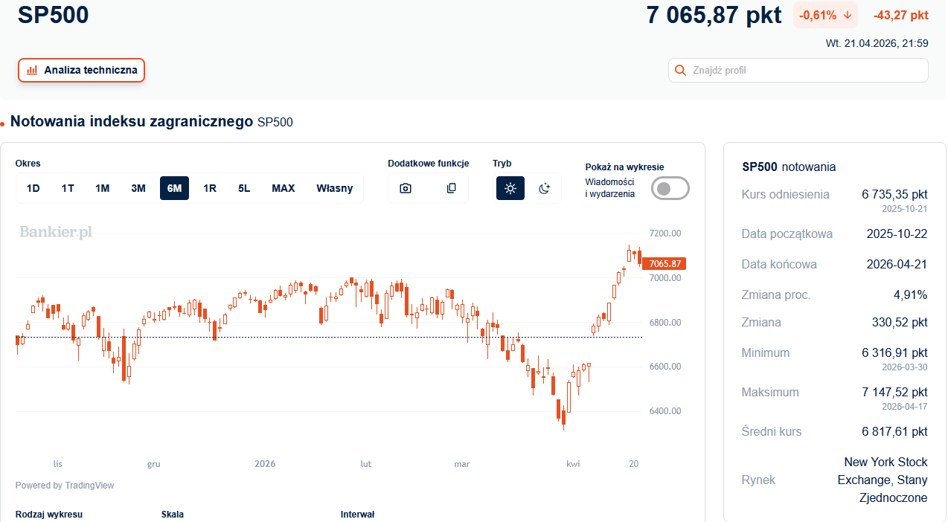
Media headlines focused on the Iran issue. The 10-day ceasefire with Iran expires on Wednesday, and until the end of Tuesday's session on the cash market, it was not known whether it would be extended. Or whether delegations from the US and Iranian governments will meet for a second round of negotiations in Islamabad. Tension increased after US President Donald Trump said on CNBC on Tuesday that he expected to bomb Iran if the parties failed to reach an agreement.
Advertisement
– Iran is such a wild card now and no one knows what will happen. But I think people think it will be OK, Thomas Martin, senior manager at GLOBALT Investments, admitted to Reuters.
The second important (and actually more important) issue for investors is the quarterly results of American corporations. LSEG estimates assume that in the first quarter, company profits attributable to the S&P500 index were 14% higher than a year ago. This was supposed to be the sixth consecutive quarter of double-digit EPS growth, driven by corporations profiting from the AI boom.
On this front, investors could be reassured by the news from Amazon, which decided to invest $25 billion in the recently famous Anthropic company. This is a signal that the chain of mutual admiration (and cash flow) is holding strong, and the management boards of listed corporations valued at trillions are still ready to finance the AI business.
Good news also came from the real economy, which was highly feared in March due to a sharp increase in fuel prices. Meanwhile, the latest data from the Department of Commerce suggested that the American consumer – although still in a bad mood – is spending quite generously with cash. March retail sales increased by as much as 1.7% m/m, clearly exceeding economists' expectations of 1.4%. Yes, this result was largely influenced by higher expenses at gas stations (Americans report retail sales in nominal terms), but even after excluding fuel and car sales, retail sales increased by a solid 0.6%.
The third event was Kevin Warsh's hearing before the Senate Banking Committee. It is true that its level at times resembled the standards known from the Polish Sejm, but Warsh openly announced his intention to make a revolution in monetary policy. It is primarily about the Federal Reserve's communication with the financial market, but also about a tougher fight against inflation. Let us recall that CPI inflation in the United States has exceeded the Fed's 2% target for 5 years.
K.K
The publication contains affiliate links.


