Addiction treatment, deadlocked. Prevention doesn't work, integration doesn't exist. “What do we do with patients from the moment of discharge?”


Specialists point out that the treatment of addicts in the acute and post-cure phases is nowhere near enough and that the circuit must be closed with effective social integration services. “One talk a year in a school we have no evidence that it works”the head of the new anti-drug agency drew attention.
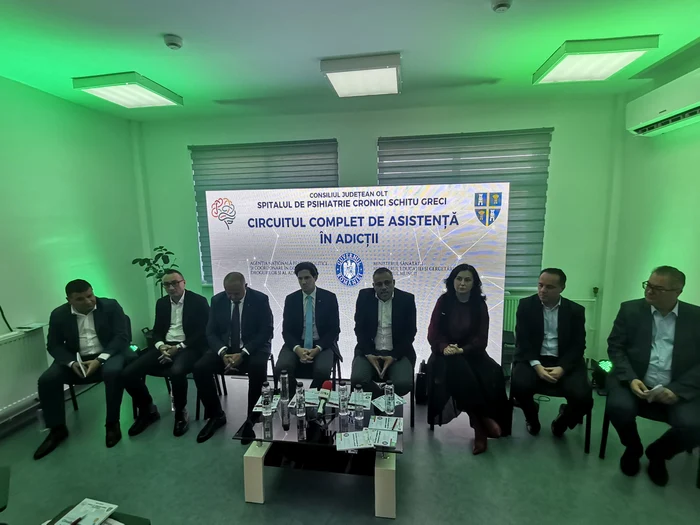
Treatment must be followed by integration services – the conclusion of the discussions PHOTO: AM
Specialists from all over the country, gathered in Schitu, in Olt county, where the only post-cure addiction treatment section for adults in the public system operates within the Chronic Psychiatry Hospital, drew attention to the need for efficient services to reintegrate patients into society, otherwise all the effort to treat them becomes useless.
In the framework of the national workshop with the theme “The complete circuit of assistance in addictions”, the strengthening of the support network for people affected by addictions was discussed.
The National Agency for Policies and Coordination in the Field of Drugs and Addictions (which took over the duties of the former National Anti-Drug Agency) was represented by the president Rareș Achiriloaie and the vice-president Luciana Elena Buliga, and managers of psychiatric hospitals from Bucharest and Brașov, doctors from Timiș, Iași, but also local authorities and county.
“This is where we will have to focus our attention, to keep them away from unhealthy behaviors”
The first post-cure addiction treatment department for adults, in the public system, which has been operating for about two months in Olt county, has a capacity of 24 places and all are occupied on this date. “I'm convinced that even if it was two or three times the capacity, it would still be full”said the manager of the Chronic Schitu Psychiatry Hospital, Liviu Voiculescu. By the end of the year, the approval of the Ministry of Health is expected for the authorization of another 16 beds in the Addictions section, the manager also stated.
All the specialists who work in the field of addiction treatment are aware of the fact that the need is very great, but even if such units were to operate in every county or in every region of the country, the situation would not be resolved, because the biggest challenge is actually the integration of patients who underwent treatment during the crisis and later post-crisis.
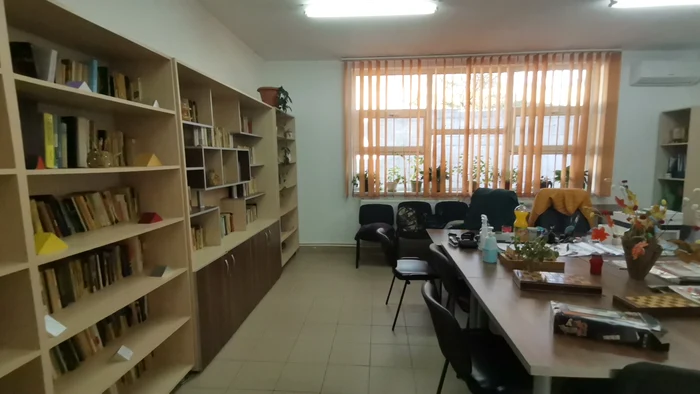
The library within the occupational therapy center, Schitu Hospital PHOTO: AM
“I have a request to my fellow parliamentarians, to the authorities, to take this issue into account as well, namely: what do we do with patients from the moment of discharge so that we have a closed circuit? Because, really, acute treatment is OK, we took this pioneering step, but think, for example, about heroin. With treatment the success rate is 1 in 10,000. It's a shame about the money we spend so that we don't even have this success”drew the attention of the medical director of the Schitu hospital, doctor Sorin Brătoi.
Patients treated in the post-cure ward have overcome withdrawal (the acute stage), but are still in an extremely vulnerable phase of stabilizing and rebuilding their lives without the substance of abuse. “As goals, we aim to maintain abstinence, to adjust doses and medication where necessary, where there are problems – to resume contact with the family, but although the length of stay in our hospital is longer, we need ways to collaborate with the other institutions so that these patients can continue their lives without these substances governing their entire existence”, the head of the Addictions department, doctor Mihaela Antonie, reinforced the idea.
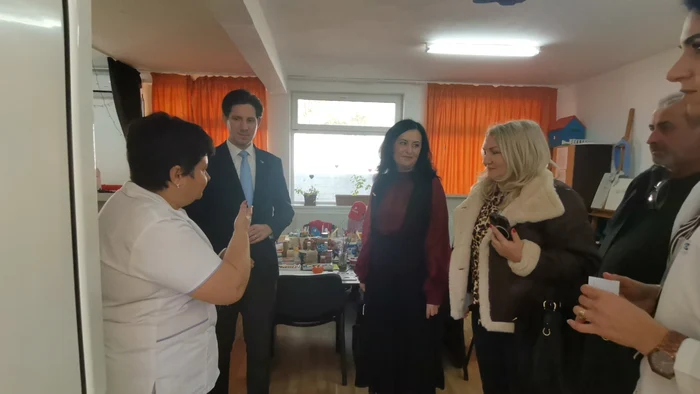
Visit to the occupational therapy center PHOTO: Alina Mitran
The director of the General Directorate of Social Assistance and Child Protection Olt, Rădița Piroșca, stated that the institution has in its strategy the development of counseling services, services to be offered in day care centers, both for children and adults. However, the social assistance system faces another problem: the specialists are leaving.
“The very important issue for success is the human resource. It needs to be trained, specialized, and funds should be allocated, projects should be found, for the specialized training of human resources that work with people for prevention, but especially for counseling. We (…) on the side of already trained specialists, you know that we have a problem: they leave the system or there are no resources for their training in targeted therapies for this segment of beneficiaries of social resources”Piroșca pointed out. In the case of administrative-territorial units, the problem of the lack of qualified personnel is even more acute, Piroșca emphasized.
On the other hand, the existence of centers and specialists in the community is a necessity, said the president of the National Agency for Policies and Coordination in the Field of Drugs and Addictions (ANPCDDA), Rareș Achiriloaie.

The hospital chapel was painted by the priest together with the patients PHOTO: Alina Mitran
“We must also change the way we do prevention and prevention, because with every euro invested in prevention we know very well that we save 10 euros in long-term social costs and we have all the arguments, here, also economic, to develop this infrastructure, once for assistance, but also for reintegration”, Achiriloaie said. “I'm sorry to say that we've been doing it wrong for 10 years. One talk a year, in a school, in a classroom, in a classroom, unfortunately we have no evidence that it works. And seeing the growth trends today, it kind of confirms it.”the ANPCDDA chief added.
Prevention must start at home, from communication with the family. It is also necessary for young people to have access to activities in the community, and Achiriloaie mentioned the Icelandic model that changed a disastrous statistic of 42% substance use among young people (up to 6%) by providing them with sports fields and gyms and infrastructure for cultural activities. “This is where we will have to focus our attention, to keep them away from unhealthy behaviors and other things that can be harmful. (…) Fortunately, I don't think we are at the point where we can say it is a national tragedy, but we can get there very quickly. I think we are at a crucial moment, a moment when we can no longer afford to wait another 10 years to develop wards across the country, and hence our appeal to the authorities and to our partners in central public administration. There is no more time to wait, we must develop this type of service throughout the country and starting from certain fixed points. Hence the presence of colleagues from Brașov, Timiș, Iași, tomorrow we will also see colleagues from Constanța and Dolj in Bucharest. We're trying to start from somewhere,” Achiriloaie also said.
Insufficient staff in specialized hospitals: “There is one psychologist for 70 beds”
Although things are better for the segment treating patients with addictions, psychiatric hospitals also have constraints, pointed out the manager of the Obregia Hospital in the capital. The signal comes at a time when Romania was criticized in a recent report of the European Committee for the Prevention of Torture.
“I hope, even if it is very unpleasant for Romanian psychiatry, at least we will wake up to reality and understand that an investment in psychiatry is needed and the first step in which the authorities could help us would be to standardize the staff in psychiatric hospitals. I have said it before and I repeat it: we cannot standardize in an acute psychiatric ward, or in a hospital with safety measures, the staff as is standardized in a department of medicine internal medicine or gastroenterology. We are dealing with a different type of patient, who at any moment may become aggressive, at any moment may need counseling or intervention, my fellow psychiatrists know better than I do. Likewise, the regularization of psychologists in psychiatric hospitals. There's a psychologist on 70 beds today. It's not very ok, especially since we rely on the psychotherapy, recovery part of these patients, of ergotherapy, and then we should have enough specialists in all psychiatric hospitals and in the wards belonging to the county hospitals”, said the manager of the “Prof. Dr. Alexandru Obregia” Clinical Psychiatry Hospital, Adrian Țâbârnă.
“They go home and most often start over”
The idea of establishing a post-cure treatment department at the Chronic Schitu Psychiatric Hospital took over a decade to be put into practice. The medical director Sorin Brătoi stated that it was born with the explosion of the consumption of ethnobotanicals, which more than a decade ago could be consumed legally. “Knowing the effect they have, I thought that when those people reach the age of 18 they will have this problem fixed. They will be full of addiction, full of dependence. (…) Considering the specifics of our hospital, the only option we had at hand was to provide post-cure addiction services. We followed this line and did the post-cure addiction. At the moment, the problem is that although we managed to open this ward, which is the first in Romania, it still exists o problem in the addiction circuit, namely – what do we do with patients after they receive psychological counseling and everything we do in post-cure addiction? Unfortunately, they go home and most often start over. However, the relapse rate is very high for most psychoactive substances. If you don't have family support and you don't have strong personal motivation, the success rate is very low”explained doctor Sorin Brătoi.
There are cases where family support is provided and family members succeed in supporting their loved ones, but there are also families where the knowledge to provide real support is lacking, and those cases are lost. “I'm sorry to say it, but after discharge the relapse rate is very high, because they go right back into the same equation, in the same environment, with the same friends, and then they start all over again,” Brătoi also said.
Effective prevention could reduce the phenomenon, the doctor believes. It is necessary, on the one hand, to increase the level of awareness among young people, and on the other hand, to drastically limit access to such temptations.