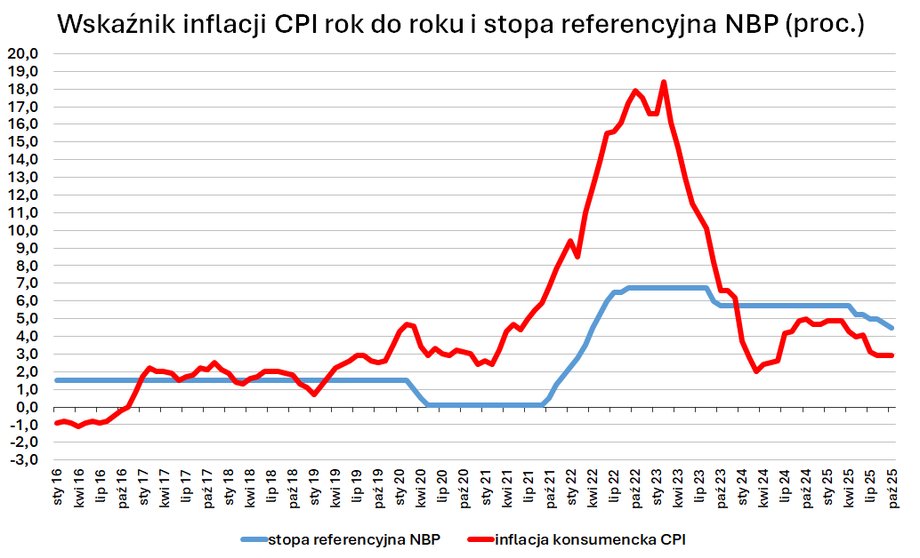
These data may be important for monetary policy. At its meeting in early October, the Monetary Policy Council reduced interest rates by 0.25 percentage points, which brought the NBP reference rate to 4.50%. This was the fourth reduction in the cost of money this year. Let us recall that in May, the Monetary Policy Council resumed rate cuts and since then the reference rate has fallen by 1.25 percentage points. In December, the Monetary Policy Council rarely adjusts rates, so the question is whether the cut will take place in November.
Will the Monetary Policy Council decide to cut rates in November?
“In the context of the November decision of the Monetary Policy Council, in our opinion, today's data support a pause in rate cuts – they do not indicate either a significant slowdown in wage growth or excessive wage pressure. It seems to us that a strong rebound in industrial production would probably need to be confirmed in subsequent readingsbefore it could be considered a factor influencing the Council's approach, especially since it does not entail a clear upward pressure on PPI inflation,” wrote economists from Santander Bank Polska.
They added that the September data published in the following days, in their opinion, would also show an improvement in economic activity and thus also advise the Monetary Policy Council to refrain from further rate cuts for now. “In our opinion, the time for rate cuts will come at the beginning of next year,” they wrote in a comment on Monday.
On Tuesday, the Central Statistical Office will publish statistics on construction and assembly production, and forecasts indicate a decline of 2%. year to year. Retail sales data will be released on Wednesday; the average forecast assumes that the growth in September amounted to 6.8%. year to year.
“A solid increase in activity in processing and increased wage growth in this sector are factors that may persuade the Monetary Policy Council to refrain from cutting interest rates again in November, pending more data from the economy. At the same time, weakening wage pressure in services and unfavorable prospects for the industrial sector leave room for further easing of monetary policy in the future,” wrote economists from ING Bank Śląski.
They expect that the interest rates of the National Bank of Poland will remain unchanged until the end of 2025, and in 2026 the Monetary Policy Council will reduce the reference rate by a further 0.50 percentage point, to 4.00%. at the end of next year.
|
Central Statistical Office, National Bank of Poland, own study
According to PKO BP experts, MPC members have recently been paying more attention to data on wages than on employment. “We estimate that the September reading should not provide an argument against reducing interest rates at the November meeting. The data was also in line with our average annual expectations – we maintain that wage growth will not exceed 8% until the end of the year and on average annually. year to year, and next year we have a chance to see an average result with the top six,” they wrote in a comment.
In this respect, mBank analysts are skeptical, they wrote on the X website that it may not be possible to permanently reduce the rate below 7%. “Higher GDP growth will increase the demand for labor. The supply (with appropriate qualifications) will remain limited. This is one of the elements of our scenario that will not allow for a permanent reduction in inflation in services,” they added.
See also: When will the next interest rate cuts in Poland be next? He co-decides and cools expectations
According to Bank Millennium analysts, today's set of data has a rather positive tone. “The industry is emerging more and more boldly from stagnation, and wage growth remains above the long-term average, accompanied by stabilization of inflation. The picture of the labor market in September is in line with our expectations, and the industry turned out to be a positive surprise. This information is consistent with our baseline scenario assuming that there will be no further interest rate cuts this year“- they wrote.
They also paid attention to construction and retail sales data: they expect strong readings. “If this forecast comes true, then in our opinion The Monetary Policy Council may want to wait for new data before deciding to cut interest rates, pointing to accelerating economic growth and a risk to wage dynamics. Although the set of data for September is important, in our opinion the macroeconomic projection with key forecasts of wages and core inflation will be more important for Council members. At the moment, we do not see any strong arguments for the need to reduce interest rates in November” wrote Bank Millennium economists.
However, they emphasized that these expectations are uncertain and the Monetary Policy Council may decide to cut rates at the beginning of next month, which could end this cycle of easing monetary policy. “Nevertheless, this is not our baseline scenario and we believe that next year will bring at least two more interest rate cuts,” they added.
Accelerating GDP growth does not necessarily mean the end of rate cuts
Bank Pekao economists wrote a few days ago that we will see another rate cut of 0.25 percentage points in November. Were they in a hurry with this forecast? In today's comment they indicated that they did not. “Today's surprise doesn't change that much — is worth slightly less than 0.1 points. percent in GDP growth in one quarter. So how much does it increase the chances that Poland's GDP increased by 4% in the third quarter? year to year, that's all the train to the average-year-old front four left some time ago. With additional refinements to the GDP growth forecast in the third quarter, we will wait for the publication of data on construction and assembly production and retail sales for September. Here we also disagree with the consensus – our forecasts are lower and higher than it, respectively,” they wrote.
Bank Pocztowy economists estimated that the quarterly dynamics of industrial production amounted to approximately 3.7 percent in the third quarter. year to year compared to an increase of 1.9%. and 0.9 percent in the second and first quarter of 2025, respectively.
“The data therefore suggest an acceleration in the GDP growth rate. Other data are still missing for the full picture, such as retail sales or construction and assembly production, but it can already be estimated that GDP dynamics in the third quarter of this year. was at least 3.6 percent. year to year. Thus, the scenario of a gradual acceleration of the economic growth rate would be realized and, in my opinion, we will know the peak of this acceleration next year, when it may periodically exceed 4%. year to year,” they wrote. In the second quarter, our GDP grew by 3.3% year to year.