On November 7, 2023, in Paris, at the opening of the 42nd session of the UNESCO General Conference, all 194 member states spoke the same name. Simona-Mirela Miculescu, the ambassador of Romania, was elected, by unanimous vote, President of the supreme forum of the organization, for a period of two years (2023-2025).
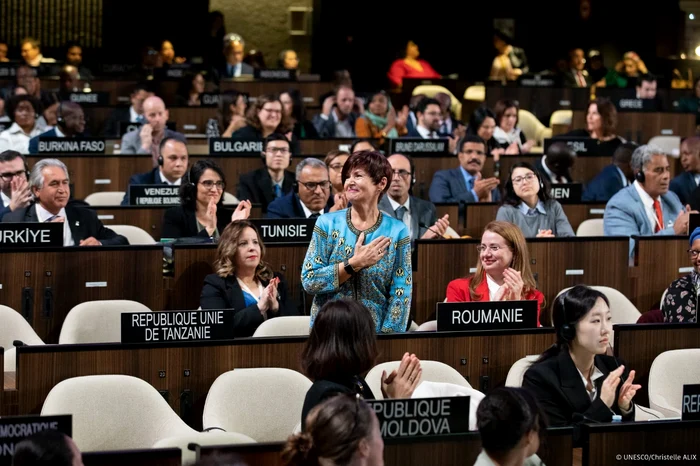
PHOTO UNESCO.org
It was a historic moment: for the first time in almost seven decades of Romania's membership in UNESCO, our country presided over a governing body of the organization. At the same time, Simona-Mirela Miculescu became the first female Romanian diplomat and the fifth woman in the history of UNESCO to take this position.
It must be said, without hesitation, that this vote was, at the same time, a personal success of Simona-Mirela Miculescu – for and on behalf of Romania -, but also a demonstration of professionalism, respect and credibility, which honored our country more than any festive speech. In a world where diplomacy is increasingly confused with image, a Romanian diplomat brought balance, competence and intellectual elegance back to the fore.
It was a choice that says something essential about the dignity of representation. Simona-Mirela Miculescu proved that you can have authority and be listened to without looking for the center of the stage. Ambassador Miculescu practices neither the diplomacy of silence nor that of stridency, but the diplomacy of measure – that rare art of speaking clearly, listening carefully, acting with discernment and building bridges instead of walls. This is, in fact, the essence of his profession and the distinctive sign of a career that has crossed, with the same elegance, all levels of representation: spokesperson of the Ministry of Foreign Affairs, presidential adviser, ambassador of Romania to the UN and UNESCO, high official of the United Nations and diplomat of balance in the Western Balkans.
I remember a scene that says more than any official portrait. After a meeting of the General Conference, I accompanied Simona Miculescu through the long corridors of the UNESCO headquarters. The building is vast, but that day the walk to the exit seemed longer than usual. At every step, someone greeted her: ambassadors, officials, members of the UNESCO Secretariat, administrative staff. Everyone wanted to say a word of appreciation to him for that day's interventions or for a recent success. And his lordship, with the same calm courtesy, stopped, listened, answered, often with a precise, personalized remark. There, in those corridors, I saw concretely what prestige built on competence and respect, not on formal power, means.
Romania has had, over time, exceptional ambassadors to UNESCO. Nicolae Manolescu, the great critic and literary historian, brought elegance to the humanist spirit and promoted the idea of culture as a living heritage. Adrian Cioroianu, historian and teacher, continued this line through a modern intellectual presence, connected to the younger generations. And Simona-Mirela Miculescu carried this tradition forward, turning it into a unique opportunity for Romania – taking over the presidency of the UNESCO General Conference, the highest position representing our country in this global institution.
In these two years (2023–2025), UNESCO has been led by three remarkable women – Audrey Azoulay, Director General; Vera El-Khoury Lacoeuilhe, President of the Executive Council; and Simona-Mirela Miculescu, President of the General Conference. This triad did not start from scratch, but continued a tradition of female leadership inaugurated by Irina Bokova, Director General between 2009 and 2017 – a friend of Romania and one of the most respected figures in the history of UNESCO. Under this succession of visions, the organization has maintained its coherence and demonstrated that it can be, through dialogue and lucidity, a space of global balance in a world where imbalance has become the constant.
But what differentiates the mandate of Simona-Mirela Miculescu is the concrete and generative vision. He understood that an institution lives not only by decisions, but also by memory, and made possible, by mobilizing international partners, the largest digitization program in the history of UNESCO – a contribution of 6 million dollars, offered by the Sharjah Book Authority (United Arab Emirates), to transform the organization's archive into a digital heritage accessible to the whole world. In the context where only 5% of the UNESCO archives were digitized, this project became an act of saving the intellectual memory of humanity.
More than 2.5 million pages of documents, 165,000 photographs and thousands of hours of audio and video recordings will be restored and digitized. Among them is the famous epistolary dialogue between Albert Einstein and Sigmund Freud, conducted in 1932 under the auspices of the League of Nations, a reflection of a rare intellectual force on the causes of war and the possibility of lasting peace. Einstein invoked the power of reason and education as an antidote to the instinct of violence, and Freud responded that only civilization can transform the destructive drive into creation. UNESCO would later consider this exchange of ideas as a founding act of its own mission: peace through knowledge and culture.
In the same intellectual circles of the 1920s and 1930s was also Martha Bibescu, present in the International Committee for Intellectual Cooperation of the League of Nations, alongside Henri Bergson, Albert Einstein and Paul Valéry, advocating, ever since, for peace through education and culture. Along with her, for sure, other Romanian names will be found that, in Bucharest, we often forget too easily.
Through this project – or, more precisely, through the vision and efforts of Simona-Mirela Miculescu – Romania became an active part in restoring the memory of humanity. What had been, for decades, an inaccessible archive is today transformed into a laboratory of universal knowledge, where the past and the present dialogue under the sign of reason and culture. It is, at the same time, a gesture of modernity and a form of gratitude towards history, through which a global institution like UNESCO rediscovers its own founding identity.
As Simona-Mirela Miculescu herself said: “Nature and our intellectual heritage are the most valuable assets of humanity. They are our passports to a sustainable future. If they disappear, we disappear too.” And on the International Day of Education, in 2025, he added – evoking Aristotle – that “educating the mind without educating the heart is no education at all”. In these words his whole vision can be found: a call for an alliance between reason and conscience, between science, ethics and culture.
In another register, I remember another symbol of this Romanian cultural participation on the global diplomatic scene: the Cucuteni bowl, one of the oldest pieces in the UNESCO collection, dating back over five millennia and offered by Romania, in 1971 – the year when the Ministry of Education was led by the great professor and diplomat Mircea Malița. I first saw the Cucuteni vessel in 2007, displayed on the 6th floor, near the office of the Director General at the time, Koïchiro Matsuura. I found it, last week, in the office of the President of the General Conference, restored with the care and direct involvement of Simona-Mirela Miculescu and other exceptional Romanians, about whom the media or politicians do not have time to talk. That vessel is no longer just an artifact, but a metaphor: civilizations disappear, but the spirit of creation remains, if someone brings it back to light. Around that object – watched by hundreds of ambassadors and delegates from all over the world – Romania became, without ostentation, present through culture.
All this would not have been possible without a special kind of understanding of diplomacy. Simona-Mirela Miculescu belongs to a rare, almost forgotten school of diplomacy as an art of the senses: historical, cultural, legal, moral, aesthetic and, above all, human. Knowing how to listen is a sense. Knowing when to speak – another. Knowing how to act, to delay a gesture or to hurry it up – also a special quality. Knowing how to recognize in another's culture a form of dignity equal to your own – another sense, which few have understood to cultivate, through education and tolerance. This mastery of the senses makes the difference between a “official” diplomat and an exceptional diplomat.
Simona-Mirela Miculescu – obviously – possesses and naturally uses all these “diplomatic senses”. Over time, numerous heads of state and government, ministers, ambassadors, world-renowned intellectuals have addressed the plenary of the UNESCO General Conference, giving symbolic and cultural weight to their presence. Romania had, for its part, opportunities to make this gesture with a special charge; unfortunately, sometimes they were missed. Instead, Simona-Mirela Miculescu's voice was heard clearly, with a remarkable intellectual depth and ethical force.
On October 23, 2025, in Paris, in Hall 1 of UNESCO, the concert “The Soul of Romania: Celebrating Together the Cultural Heritage” will take place – an event organized under the auspices of the Presidency of the General Conference. It will be a Romanian evening in the heart of the world, a synthesis between art and diplomacy, between identity and universality. For Romania, this moment is not only a symbolic culmination of the two years of mandate at the head of UNESCO, but proof that, when you represent your country with intelligence, the world listens to you. I know that many passionate Romanians, young and not so young, will participate in this event, who will vibrate to every musical note carrying the echo of authentic Romanianism – the one that is not affirmed by slogans, but by sensitivity, intelligence and respect towards the world – and who will play the role of “good hosts” for guests from all over the world.
In the end, perhaps this is the true lesson of Simona-Mirela Miculescu's mandate: that diplomacy is not just a profession, but a form of spiritual culture. It does not mean the absence of conflict, but the mastery of balance. It does not mean silence, but the force to speak with meaning. It does not mean imposing, but convincing through clarity and calmness. In these two years, through Simona-Mirela Miculescu, Romania has shown that it can be present where the future of culture, education and peace is decided – not through noise, but through the refinement of conviction. And this refinement, once proven, is never lost.
* * *
Obviously, Ambassador Simona-Mirela Miculescu's two-year mandate at the head of UNESCO was much richer and more complex than I could cover in a single editorial.
In just two weeks, in Samarkand (Uzbekistan), where the 43rd session of the UNESCO General Conference will be held (30 October – 13 November 2025), Simona-Mirela Miculescu will hand over the baton to her successor – Ambassador Khondker M. Talha, the representative of Bangladesh. It will be a symbolic moment, not only of institutional transition, but also of the continuity of a noble mission: that of building peace in the minds of people, through education, science and culture.
I am convinced that, in Samarkand, we will hear numerous national delegations and representatives of partner organizations talking about the achievements of Ambassador Simona-Mirela Miculescu at the head of the UNESCO General Conference. I hope that this success of Romanian diplomacy will be talked about more – in the months and years to come – and here in Romania, not only to honor an exceptional moment, but also to give the new generations of diplomats and politicians the opportunity to learn from those who have really performed in this field. In fact, those who want to know more about the two-year work at the head of the UNESCO General Conference can do so now, by consulting the official UNESCO page: https://www.unesco.org/en/general-conference/42/president.
I am also convinced that Her Excellency, Mrs. Ambassador Simona-Mirela Miculescu, will publish, at the right time, a series of reflections and documents that will add to the intellectual and symbolic capital of Romanian diplomacy, enriching our archive of institutional and human memory.