The White House is focusing on talks with Moscow instead of weapons for Kiev. Washington is burning with accusations of “appeasement policy”


The meeting, completely subordinated to Trump's vision of immediate peace, revealed some gaps in US-Ukrainian relations and caused a violent storm among Democrats in Congress.
Instead of a declaration to provide modern weapons, Zelensky heard a demand – a determined one a call for peace talks.
Layout instead of strategy
After the meeting, Trump announced on his Truth Social platform that he had called on both the Ukrainian president and Vladimir Putin to end the conflict. “It's time to end the killing and make a DEAL!” – he wrote.
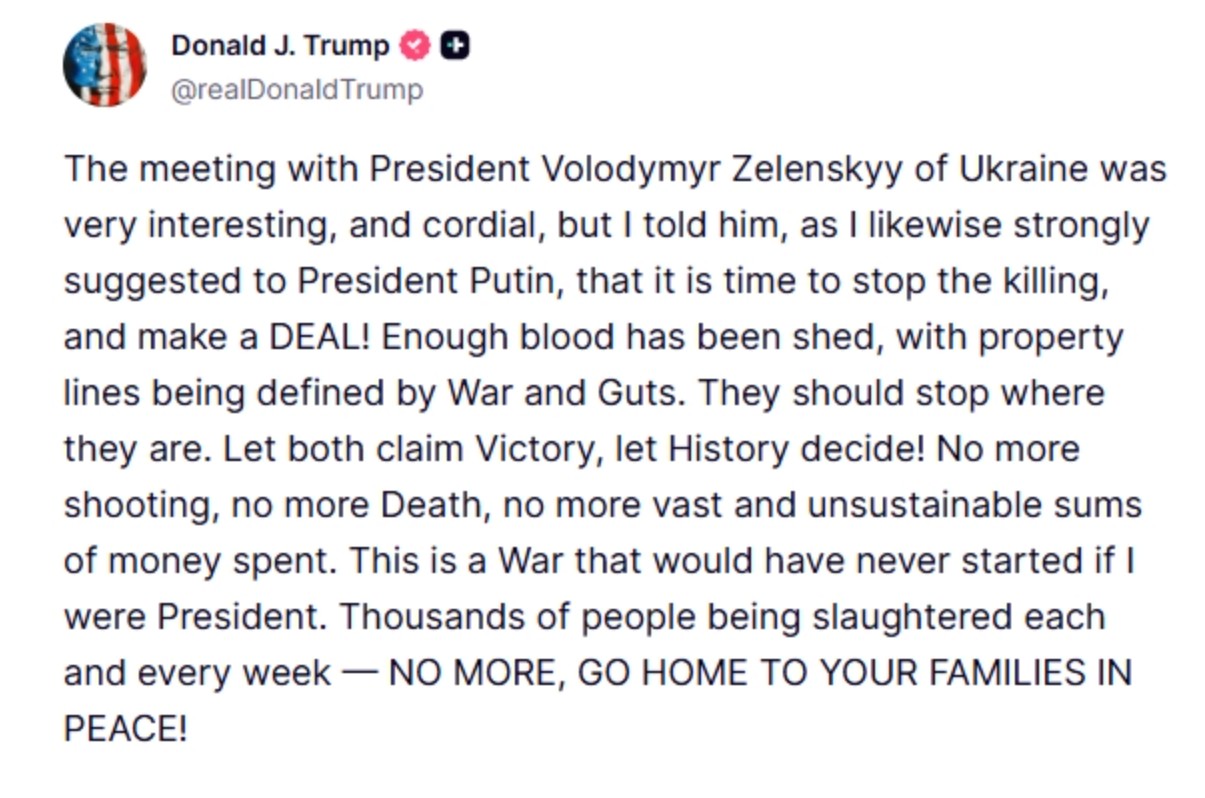
A screenshot of Donald Trump's post on Truth Social.Donald Trump/Truth Social/Truth Social
The US president's tough stance on diplomacy was exactly what military analysts expected.
Jennifer Kavanagh, senior analyst and director of military analysis at the Washington think tank Defense Priorities, told the Kyiv Post that Trump is “focused on ending the war” and “strongly prefers negotiations and diplomacy to further military action.”
Her assessment highlights the transactional thinking typical of the Trump administration – viewing military aid not as a strategic obligation but as a bargaining chip.
The lack of mention of Tomahawks didn't surprise her. As she emphasized, these weapons carry a “serious risk of escalation” and the US currently has neither the appropriate number of launchers nor sufficient supplies.
Kavanagh also revealed that Zelensky proposed some kind of exchange – drones for Tomahawks, or more realistically: exchanging Ukrainian drone know-how for other key weapons. In her opinion, a much more reasonable direction would be to strengthen anti-aircraft defense, which provides a real return on investment, instead of the risky transfer of cruise missiles.
However, the debate about military aid quickly turned into a discussion about the US diplomatic advantage over Russia.
According to Kavanagh, the essence of this advantage lies in Moscow's demands. In her opinion, only Trump can meet some of these demands, especially regarding NATO expansion and the European security architecture.
Thanks to this, the American president gains a very important advantage that he will be able to use – not by making concessions to Putin, but by keeping him at the negotiating table. Kavanagh added that lifting some of the sanctions is another powerful economic card at the White House's disposal.
However, she noted that Trump has not publicly demanded territorial concessions from Ukraine, which may indicate that he still “remains a supporter of Ukraine” and does not intend to force its surrender.
The apparent pursuit of peace
However, not all experts were so optimistic. Some analysts considered Zelensky's visit a serious failure.
Yuri Boychenko, director of the American non-profit organization Hope for Ukraine, said in an interview with the Kyiv Post that the lack of a specific decision on the transfer of Tomahawk missiles is a “serious blow to Kiev.” In his opinion, there were earlier announcements about the possibility of delivering these weapons merely a diplomatic maneuveraimed at forcing Moscow to talk. This is confirmed by Trump's sharp change in tone after his telephone conversation with Putin.
Where he previously threatened to use Tomahawks as an ultimatum, he now cites the need to “preserve American stockpiles,” which in practice means putting the project on the shelf.
This public change of position left Zelensky leaving the White House without the breakthrough military support that could have helped end the war on favorable terms for Kiev.
Boychenko concluded that the meeting had dragged Ukraine into a “diplomatic black hole” — a negotiation process that could drag on for months and fail to produce real results. As the main goal now becomes the Trump-Putin summit, the burden of resolving the conflict shifts from the battlefield to the diplomatic halls, where what matters more is an apparent pursuit of peace rather than decisive action.
Democratic fury over 'concessions'
Democrats in Congress immediately took advantage of the unclear position of the White House, accusing Trump of undermining the credibility of the US and “giving a gift to the Kremlin.”
House Foreign Affairs Committee Chairman Gregory Meeks (Democrat from New York) issued a sharp statement in which he accused Trump of “appeasement instead of force.”
Meeks said the president “did not provide any real support to Ukraine today” and that his negotiating tactics “are as impotent as his alleged support for Ukraine.”
Similar voices were heard in the Senate – Jeanne Shaheen (Democrat from New Hampshire) stated that words alone will not be enough when Russia intensifies its attacks.
She demanded that Trump “immediately impose tougher sanctions on Russia” and provide long-range missiles to Ukraine.
— President Zelensky cannot leave Washington empty-handed while Putin escalates his brutal attacks
Shaheen said.
The article continues below the video
Zelensky's defense: avoiding escalation
Under pressure from the media and politicians, Zelensky explained that the lack of public discussion about Tomahawks was due to US fears of escalation. At the same time, he admitted that these weapons were of great strategic importance.
— I think Russia is really afraid of Tomahawks. It is a very strong weapon, Zelensky said.
The President of Ukraine confirmed that the main topic of talks was anti-aircraft defenseand both sides agreed to accelerate deliveries and develop joint production of equipment with the participation of American companies.
The Ukrainian president also revealed an outline of his approach to peace negotiations.
— First we need a ceasefire – to sit down, talk and understand where we are. We must stop… maintain the front line while talks continue, Volodymyr Zelensky said.
The tense atmosphere of the meeting at the White House is illustrated Zelensky's difficult position. Is forced to balance between the urgent need for military aid and political pressure from the American opposition, which demands a quick – if imperfect – peace.