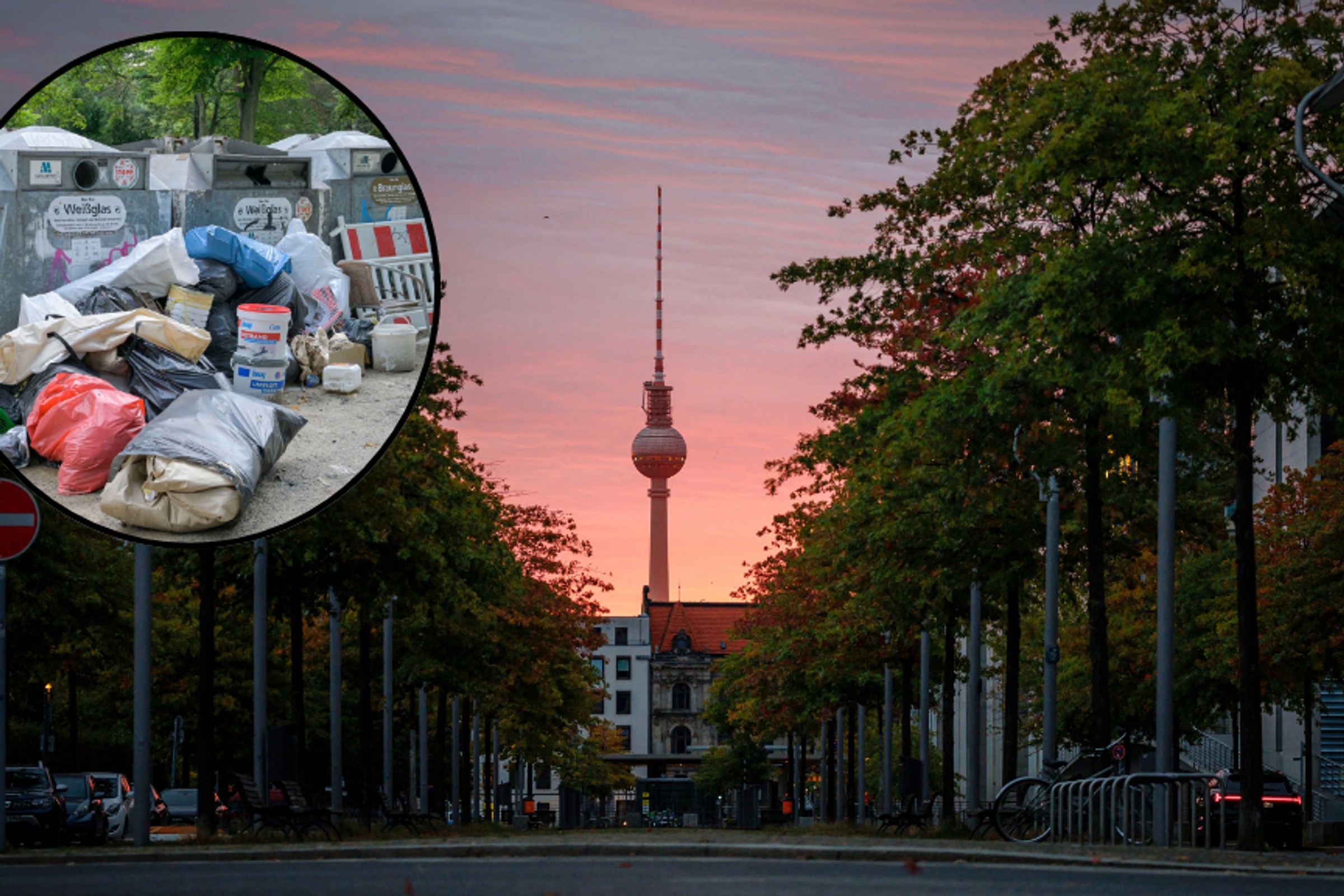
For a long time, Berlin was considered “poor but sexy”. Currently, however, he is primarily poor – he lacks cleanliness, prosperity, safety, education, kindness and, above all, a beautiful landscape. After German Chancellor Friedrich Merz expressed his justified criticism of the German urban landscape, it was Berlin Mayor Kai Wegner who attacked him most forcefully.
— Berlin is a diverse, international and open city. This will always be reflected in the urban landscape, he said.
Indeed, one could agree with him – if garbage were considered a mosaic and destruction a diversity.
Wegner should take a look at his yard – he'll surely find enough trash there. Since the beginning of his term, the number of illegal landfills in Berlin has increased by 25%. — up to 170 thousand 434 per year.
A modest contribution
The image of Berlin was changed by unrestrained migration. 188,000 people live in the capital. refugees. All issues related to illegal migration can be viewed here in XXL size. Instead of rhetorically denying reality, Berlin should start working on the image of its tomorrow.
There is no other city in Germany where there is so much talk about education and so little learning. In terms of its level, in the current INSM ranking Berlin ranks 11th out of 16 federal states. The “diverse and open to the world” city also clearly fails when it comes to integrating migrants into German society – in the Education Monitor 2025, Berlin took 13th place in this category.
The link between background and educational success is stronger here than elsewhere. The capital of colorful words is the place of gray results. Behind every façade of tolerance, the foundations of equal opportunities crumble.
The article continues below the video
In addition, there is also the Berlin urban landscape – it is not only littered, but also impoverished. The city's GDP in 2024 amounted to approximately EUR 207 billion (PLN 879 billion), which is only 4.8 percent. the total value of Germany's GDP. For comparison, Paris has 31 percent. share in France's GDP, Madrid 19 percent in Spain's GDP, London 23 percent in GDP in Great Britain, and Vienna 25 percent. in Austria's GDP.
An inglorious leader
State funds flow to the capital in disproportionate amounts thanks to subsidies – last year, with the amount of EUR 3.94 billion (PLN 16.7 billion), Berlin was again the largest beneficiary of the state equalization program. Nevertheless, the city, with a debt of EUR 76 billion (PLN 322 billion), is Germany's most indebted state. It is also at the forefront in terms of unemployment rate – it reaches 10.3%. Only Bremen (1.8%), also ruled by the left, overtakes it. Berlin is the city that lectures the rest of the republic on moral issues – and financially bleeds it dry.
Also in terms of crime, the city's image speaks for itself: with 14,000 252 crimes per 100 thousand inhabitants Berlin is the most dangerous city in Germany with a million people. More than half of those suspected of committing crimes are non-Germans.
As a result of uncontrolled immigration, Berlin also became the capital of anti-Semitism. Berlin police chief Barbara Slowik had to advise Jews and homosexuals to be especially careful in certain districts of the city. Too often the police seem overworked and left to their own devices. With a crime detection rate of 45.5%. Berlin has the lowest score of all federal states. In Munich, crime is half as high and the detection rate is 67%.
Most Berliners feel these problems and are unhappy. According to the Happiness Atlas SKL 2025, Berlin ranks 37th out of 40 German cities. This dissatisfaction also radiates externally – in a survey conducted by the Free University of Berlin Berliners were considered the most unsympathetic Germans. The image of the city that Wegner defends has long reflected the state of soul of its inhabitants: exhausted, irritable and resigned.
Berlin lacks many things: cleanliness, prosperity, safety, education and friendliness. However, he has way too much of one thing – moralizing lectures about what others might say.
I’m Ashley Davis as an editor, I’m committed to upholding the highest standards of integrity and accuracy in every piece we publish. My work is driven by curiosity, a passion for truth, and a belief that journalism plays a crucial role in shaping public discourse. I strive to tell stories that not only inform but also inspire action and conversation.