Miners under pressure: correction for KGHM and depreciation of JSW. The WSE shows solidarity with the world in the face of friction between the US and China


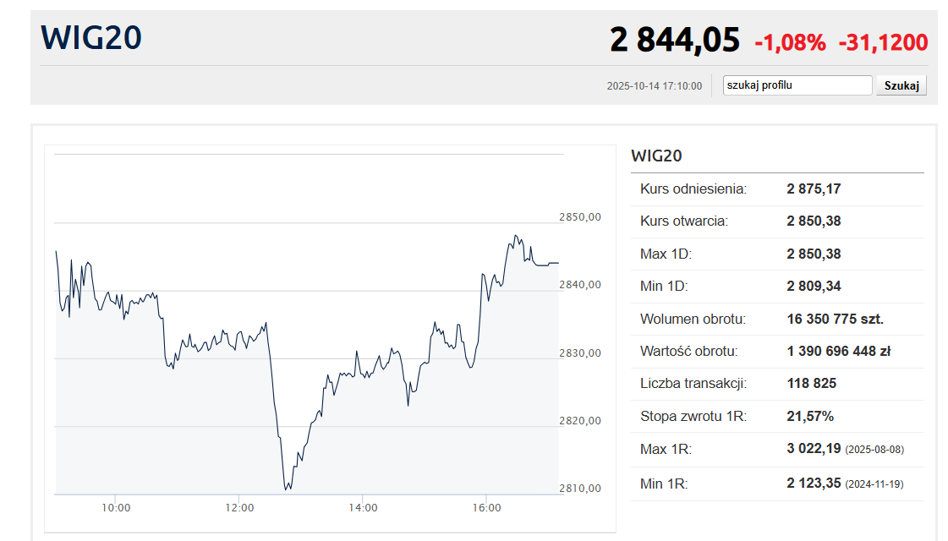
The session on the WSE was played to the beat of the trading floors of the largest stock exchanges in the world. The escalation of tensions between the US and China translates into greater caution among investors, including those operating on the Polish stock exchange. WIG20 was in red throughout the day, although it made up for some losses in the second half of the day. Supply even appeared in trading in KGHM shares.
The US and China on Tuesday began charging each other additional port fees from shipping companies, sparking heightened trade tensions. At the same time, Beijing is ready to “fight to the end” in this trade war, but leaves the “door open” to negotiations, the Ministry of Commerce said on Tuesday.
Much more was happening, especially on the Chinese side, which, after Trump's declaration that “everything will be fine”, initiated, for example, an investigation into the impact of US trade restrictions on the domestic shipbuilding sector and supply chains. In addition, China's Ministry of Commerce announced the imposition of “countermeasures” on US companies related to the South Korean company Hanwha Ocean. US Treasury Secretary Scott Bessent said in an interview with the Financial Times on Monday that China's recent actions demonstrate the country's economic weakness.
Due to the hardening of positions on both sides, we expect increased volatility in equity markets until the end of the month, Ulrike Hoffmann-Burchardi, global head of equities at UBS Global Wealth Management, wrote in the report.
After a day of relief, when the markets, following President Trump's declaration that “everything will be fine” with China, recorded increases, including a strong rebound on Wall Street, on Tuesday they succumbed to supply pressure in line with the well-known slogan “escalation of the trade conflict” and concerns about the deterioration of global trade conditions. At the end of trading in Warsaw, DAX was losing about 0.5%, which is approximately the same amount as the indexes on Wall Street.
However, the WSE performed worse compared to them, with declines on the WIG20 index reaching up to 2 percent during the day. The second half of the day brought a slight correction of the scale of weakness, which translated into the final result of the session with a decline in WIG20 by 1.08%. It is worth remembering, however, that the WSE did not take into account the new circumstances on the markets on Friday, and on Monday the main index ended in positive territory. Returning to Tuesday, WIG was down 1.11% that day. In turn, mWIG40 fell by 1.1% and sWIG80 lost 1.4%. Turnover amounted to PLN 1.7 billion on the broad market, of which PLN 1.39 billion concerned WIG20 companies.
“The last few days have been difficult, especially for those who invest in risky assets, mainly shares. Share prices are falling, and the direct trigger that has spoiled the mood is the renewed Sino-American trade conflict (…) Moreover, we still have problems in France, or regarding the shutdown of the United States,” Mariusz Adamiak, director of the Market Strategies Office of PKO BP, told PAP Biznes.
“In recent days, there was also positive news, such as the conclusion of peace in the Middle East, but the negative ones outweighed them. All this caused the mood on the stock markets to deteriorate significantly,” he added.
WIG20 session: KGHM correction
In WIG20, it is worth noting the first major correction in the KGHM share price (-3.12%). From approximately mid-September to Monday's closing, the company's shares increased in price by approximately 43%. In recent days, although there was a negative session (on Friday), the drawn white candle with a low opening and a higher closing had a demand-oriented nature. The last time the KGHM price decreased on a larger scale was on September 17 (-2.94%). On Tuesday, copper dropped by approximately 2.5%. After setting a new high, silver also corrected.
PGE's price dropped even further in WIG20 (-5.53%). Along with PGE, two other large “state-owned” energy companies listed in MWIG40 are declining. Enea went down by 2.68%, and Tauron dropped by 2.78%. Polenergia also lost by 1.3 percent, which indicates a broad sell-off of shares of energy companies, which in terms of sectors have so far been one of the workhorses of the bull market on the WSE.
Returning to WIG20, the prices of LPP (-3.05%), CCC (-1.99%) and CD Projekt (-2.43%) experienced even stronger depreciation. By 1.69 percent Orlen's price dropped, and 1.52 percent. gave the course to Pepco. In total, 13 companies from the WIG20 portfolio were in decline. The competition was completed by Dino, mBank, PKO, Peako, Żabka and Orange. The shares of Budimex gained the most among blue chips (1.93%). The company announced that the offer of the consortium led by it, worth PLN 2.59 billion net, was rated highest in the PKP Polskie Linie Kolejowe tender. Other growing companies in WIG20 gained no more than 0.9%.
JSW depreciation and weakness of the mining industry
On the so-called the broad market was most talked about in the context of JSW (-8.79%). Prime Minister Donald Tusk declared his readiness to provide assistance to JSW, and it is possible that state-controlled PGZ will also participate. In turn, Deputy Minister of State Assets Robert Kropiwnicki announced that a decision on the return of PLN 1.6 billion of the solidarity contribution to JSW should be made by the end of October. However, this did not help, because the prices of the raw material extracted by JSW are of fundamental importance. And according to the latest statement of the acting president of JSW, Bogusław Oleksa, “they are expected to remain unfavorable in the next two years.” In addition, miners at JSW have already started to protest against the restructuring plan involving employment.
As a result of the declines of KGHM and JSW, the WIG-Górnictwo index fell by 3.39% on Tuesday. and, next to WIG-Energy (-3.54%), was the weakest industry benchmark on the WSE. Only WIG-Media (0.73%) and WIG-Leki (0.07%) recorded growth in this respect.
Michal Kubicki