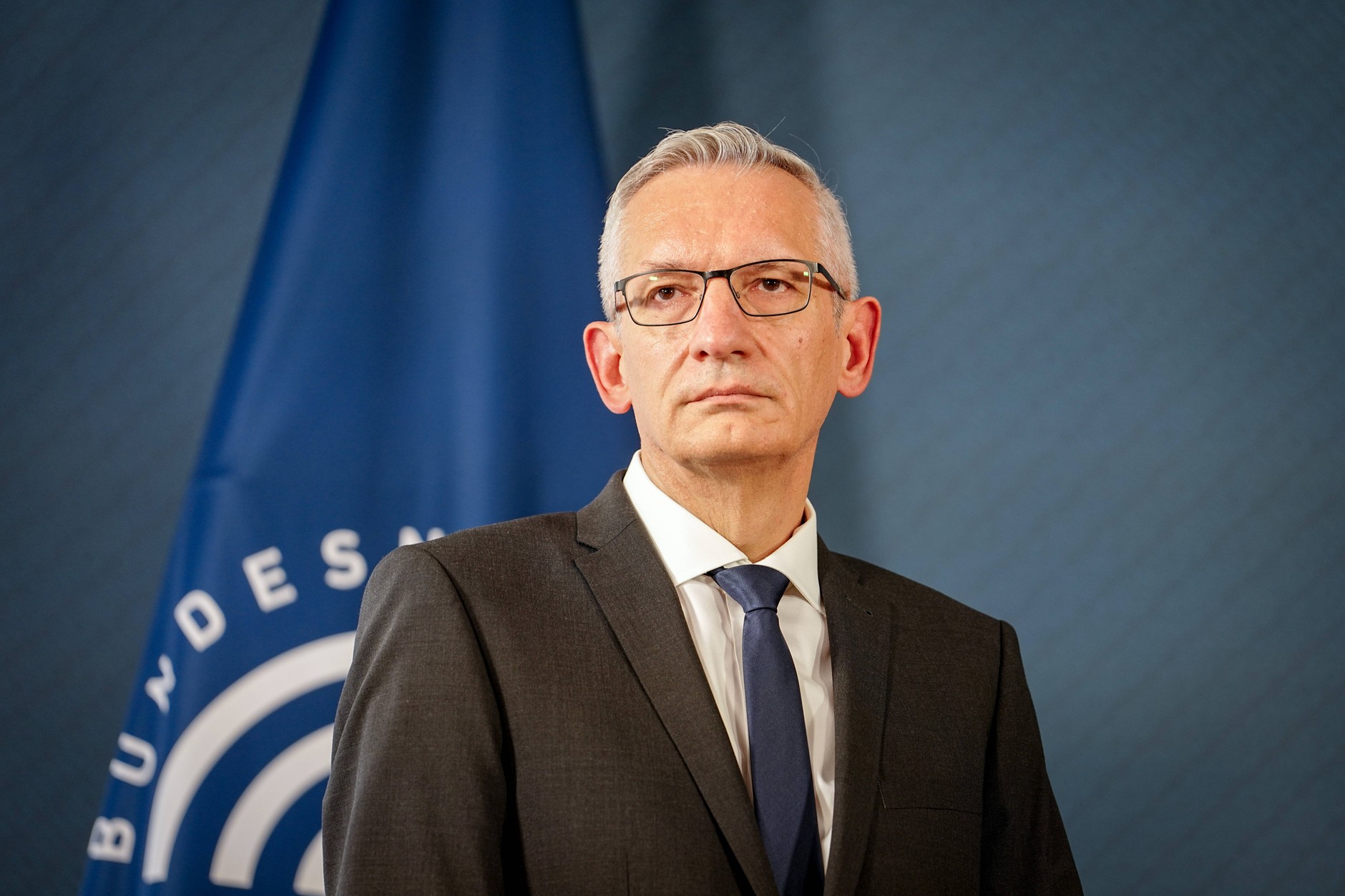
“Russia hides its intentions, but in reality it seeks to test our borders. At best, Europe is currently in a cold peace, which could turn into a heated confrontation anywhere at any time. We must prepare for further escalation,” Jaeger emphasized, speaking in the Bundestag on Monday during the annual public hearings of the heads of the German intelligence services.
Director of the Federal Intelligence Service of Germany, Martin Jaeger, photographed during the handover, Berlin, September 11, 2025.KAY NIETFELD / PAP
According to Jaeger, who previously worked as Germany's ambassador in Kiev, hybrid attacks aimed at weakening NATO, destabilizing European democracies, dividing and intimidating society have become “common.” “The frequency of such isolated incidents represents a new level of confrontation — a confrontation in which Russia sees us as an enemy and a belligerent,” Jaeger said, referring to regular air provocations, cyber attacks and espionage by Moscow.
The BND chief also stated that it is impossible to “sit on our hands” while “our adversary knows no rest or respite” in preparations for war. “We are already under fire today,” he emphasized, disagreeing with earlier assessments of German intelligence.
In the spring, the Federal Intelligence Service and the Bundeswehr predicted in their report that the Kremlin would be ready for a “wide-ranging conventional war” against NATO in the late 2020s. As the authors of the report pointed out, after the end of aggression against Ukraine, Moscow would move its forces to the borders with the Baltic states, from where it could launch an invasion of NATO territory.
“We must oppose our adversaries wherever necessary. To do this, we will take greater risks, but in a controlled and consistent manner,” Jaeger said in the Bundestag.
The article continues below the video
Incidents involving drones and violations of NATO airspace
From January to the end of September, 172 drone-related air traffic violations were recorded in Germany alone, compared with 129 and 121 for the same period in 2024 and 2023, according to data from Deutsche Flugsicherung (DFS), the federal company responsible for air traffic management and air navigation services.
At the beginning of October, at Munich airport, the second largest in Germany, dozens of flights were diverted or canceled due to the appearance of unmanned aircraft, which affected the plans of over 10,000 people. passengers. Last Sunday, German Chancellor Friedrich Merz said that Russia may be behind most of the drone launches over German cities and Denmark. According to him, the purpose of these activities is espionage and spreading panic among residents.
Not only Germany has recently been the target of sabotage activities attributed to Russia. On the night of September 9-10 this year. Polish airspace was violated by approximately 20 drones, some of which flew from Belarus. Just a week later, three Russian MiG-31 fighters entered Estonian airspace. In the following days, Denmark also struggled with disruptions caused by Russian drones, which affected as many as four airports. Romania and Norway also reported disturbing incidents.
I’m Ashley Davis as an editor, I’m committed to upholding the highest standards of integrity and accuracy in every piece we publish. My work is driven by curiosity, a passion for truth, and a belief that journalism plays a crucial role in shaping public discourse. I strive to tell stories that not only inform but also inspire action and conversation.