What are the largest investments planned in Poland? Hundreds of billions for energy, railways, CPK and ports


As the Polish spokeswoman for the Ministry of Infrastructure, Anna Szumańska, tells Business Insider, the total expenditure on infrastructure tasks in the 2026 budget is PLN 100 billion, for comparison in 2023 it was PLN 58 billion.
The construction of the first Polish nuclear power plant in Lubiatów-Kopalina is expected to cost nearly PLN 200 billion. Of this amount, PLN 60 billion will be provided by the state budget. Another approximately PLN 100 billion is to be borrowed by foreign export credit agencies, including the American Exim Bank. The investor, Polskie Elektrownie Jądrowe, wants to raise approximately PLN 30 billion from the financial market in Poland and abroad.
The construction of the power plant – i.e. the pouring of the so-called first nuclear concrete – is scheduled to start in 2028. Before this happens, Poland must obtain consent from the European Commission for public aid for this investment, which is expected in winter, perhaps later this year. In addition, the investor – Polskie Elektrownie Jądrowe – must negotiate a turnkey contract for the construction of a turnkey power plant with the American consortium Westinghouse-Bechtel. It can be expected in the middle of next year. These two conditions must also be met in order to order key elements for the construction of the power plant, i.e. the so-called long lead items (LLI). The first unit of the Choczew power plant is scheduled to start in 2036, the second one in 2037, and the third one in 2038.
Read more: The new program of Donald Tusk's government. We know the details
The government's goal, confirmed by the PEJ authorities, is to obtain approximately 40 percent in this investment. contribution of Polish suppliers and contractors (local content). In the next steps, the Polish state also plans to build a second large nuclear power plant, as well as so-called small nuclear reactors (SMRs).
Investments in power networks
Over the next decade, Polish expenditure on the development and modernization of transmission and distribution networks – according to various declarations – is expected to reach PLN 180-200 billion. From this pool, Polskie Sieci Elektroenergetyczne wants to spend PLN 64.5 billion, and distribution system operators – PLN 130 billion.
The sources of investment financing include: National Reconstruction Plan. It provides for over PLN 6.7 billion in subsidies for this purpose, with particular emphasis on enabling the connection of renewable energy sources, including in rural areas. The Energy Support Fund, financed from KPO and other EU funds, operated by Bank Gospodarstwa Krajowego, has approximately PLN 70 billion for preferential loans.
As for the planned investment outlays of Polish Power Grids, in individual years they amount to: PLN 3 billion in 2025, PLN 4.2 billion in 2026, PLN 5.1 billion in 2027, PLN 6.3 billion in 2028, PLN 7 billion in 2029, PLN 12.2 billion in 2030.
As Aleksandra Dziadykiewicz from the PSE press office informs us, the company's investments are planned in advance and described in the Transmission Network Development Plan. This plan is updated every two years, and its new version will be ready at the beginning of next year.
The Central Communication Port is a priority of the Ministry of Infrastructure
The government estimates the cost of constructing the CPK at PLN 131 billion. Of this, the airport part of the CPK will cost PLN 42.7 billion, and the railway part of the project, i.e. the construction of the High-Speed Railway (HSR), will cost approximately PLN 80 billion.. The money is to be obtained, among others, from: from the issue of bonds, loans and EU funds. In December 2024, CPK signed a letter of intent with Polish Airports (PPL), which is to become a minority investor in the new airport. It assumes that CPK will retain at least 51 percent. shares in the share capital of CPK.Lotnisko, and PPL will hold a maximum of 49%. Of the estimated cost of building a new port, 30-40 percent will be financed proportionally by the shareholders of CPK.Lotnisko, while the remaining part will be 60-70 percent. will be covered by funds from the bond issue.
The project schedule assumes the launch of the CPK airport and the high-speed railway between Warsaw, CPK and Łódź by the end of 2032, as well as the advancement of construction works on the HSR sections to Wrocław and Poznań. The HSR sections to Poznań and Wrocław are to be ready in 2035. The construction of the CPK Passenger Terminal is to start in 2026. The construction of the “Y” railway line is to start in 2028.
According to the Polish spokeswoman for CPK, Agnieszka Stefańska, in an interview with Business Insider, the approximate value of tender proceedings in 2025 will be approximately PLN 30 billion. By the end of August, CPK announced investment procedures worth approximately PLN 18 billion, and in the last quarter it is to launch, among others: executive proceedings regarding piling for the terminal building. In the years 2026-2028, CPK intends to launch almost 100 large proceedings, each worth over PLN 1 million net. In 2026, the approximate value of tenders will reach approximately PLN 40 billion. The largest of them will concern construction works on the Warsaw-Łódź railway line and the construction of roads and airport infrastructure.
PLN 180 billion is to be spent on the development of railways in Poland
During the conference “Poland. A year of breakthrough” at the Warsaw Stock Exchange in February this year, Prime Minister Donald Tusk announced that by 2032 PLN 180 billion would be spent on investments in Polish railways. They include, among others, improving the technical condition of railway lines, building collision-free crossings and implementing modern systems ensuring network interoperability. These programs concern: National Railway Program (PLN 79.1 billion); National Reconstruction Plan (PLN 9.5 billion – in terms of railways); Kolej Plus (PLN 13.4 billion, including local governments' own contribution); Central Communication Port (PLN 75.1 billion in terms of railway investments); government program for the construction or modernization of railway stops for 2021-2025 (PLN 1.1 billion).
Railway investments are financed, among others, by: KPO and other EU funds. The railway infrastructure industry is fighting to transform the Railway Fund at BGK, which is dependent on the inflow of EU funds, into the model of the National Road Fund, which is financed by debt. Without this – as experts argue – there is no chance of achieving the government's ambitious intentions regarding railway development.
PKP PLK informs Business Insider Polska that their largest ongoing investments are: Podłęże-Piekiełko, Rail Baltica, Maksymilianowo-Kościerzyna and investments in Silesia.
— We close 2025 with a record tender plan. Instead of the originally assumed PLN 16 billion, the total value of the announced proceedings will probably reach PLN 27 billion, emphasize the company's press service.
PKP PLK will soon publish the tender plan for 2026 on its website. In 2026, the company plans to announce over 30 tender procedures with an estimated value of PLN 11.9 billion. In 2027, it wants to announce 12 tenders with an estimated value of PLN 2.7 billion. For 2028, it assumes the announcement of nine tender procedures with an estimated value of PLN 1.9 billion.

Deputy Minister of Infrastructure Arkadiusz Marchewka talks to Minister of State Assets Wojciech Balczun before the government meeting
|
GRZEGORZ KRZYZEWSKI / FotoNews / Forum / Forum Polish Photographers Agency
The government also focuses on maritime economy, including investments in ports
The government also wants to invest billions of PLN in maritime economy, including the construction of ports. In 2025, the budget for the maritime economy sector is record-breaking – PLN 2 billion from the state budget. That's 37 percent. more than in 2024. In turn, expenditure on maritime economy is planned at the level of PLN 2.4 billion for 2026, i.e. PLN 400 million more than this year.
For the Ministry of Infrastructure, the priority is the construction of a container terminal in Świnoujście. It is to be put into operation at the turn of 2028 and 2029. The investment is expected to cost over PLN 10 billion.
Other planned investments include, for example, the expansion of the Gdańsk Baltic Hub T3 – a container terminal that will increase the port's annual capacity from 3 million to 4.5 million TEU. An external terminal is being prepared in Gdynia.
The most important investments planned last year include: construction of access infrastructure to the port of Świnoujście, including a new container terminal, construction of training and research ships for maritime universities – the successor of the Navigator XXI will go to the Maritime University of Technology in Szczecin, and the new sailing ship to the Maritime University of Gdynia, as well as the construction of access infrastructure to the FSRU gas terminal in the Bay of Gdańsk, which will increase the country's energy security and will cover 30%. Poland's annual demand for gas. In addition, there is the construction of a fairway to the port in Elbląg, thanks to which the Vistula Spit canal will become more useful, as large vessels will be able to enter there. It is also planned to improve access to the sea port in Szczecin by building the so-called passing lanes on the waterway that will allow large ships to have two-way traffic to and from the port.
Poland is also constantly investing in roads and offshore
In 2026, expenditure on national roads, including investments, maintenance and renovations, will amount to PLN 37 billion. These funds will continue to carry out preparatory work for large infrastructure investments, such as the Warsaw Agglomeration Bypass or the expansion of the A4 motorway on the Krzyżowa – Wrocław section.
As for new investments for which an implementation contract will be concluded in 2026, these include: widening of the A2 motorway on the section between Łódź and Warsaw with additional lanes; two sections of the S17 road connecting Lublin with the border with Ukraine in Hrebenne: section Łopiennik village – Krasnystaw Północ village (9.2 km) and section the village of Zamość Sitaniec – the village of Zamość Wschód (11.3 km); bypasses of towns, including: Wadowice, Ostrołęka, Zwoleń, Starachowice, Pisz and Kalisz.
Huge investments, but not so centralized, also include offshore. Their value over the next dozen or so years is estimated at up to PLN 250 million.
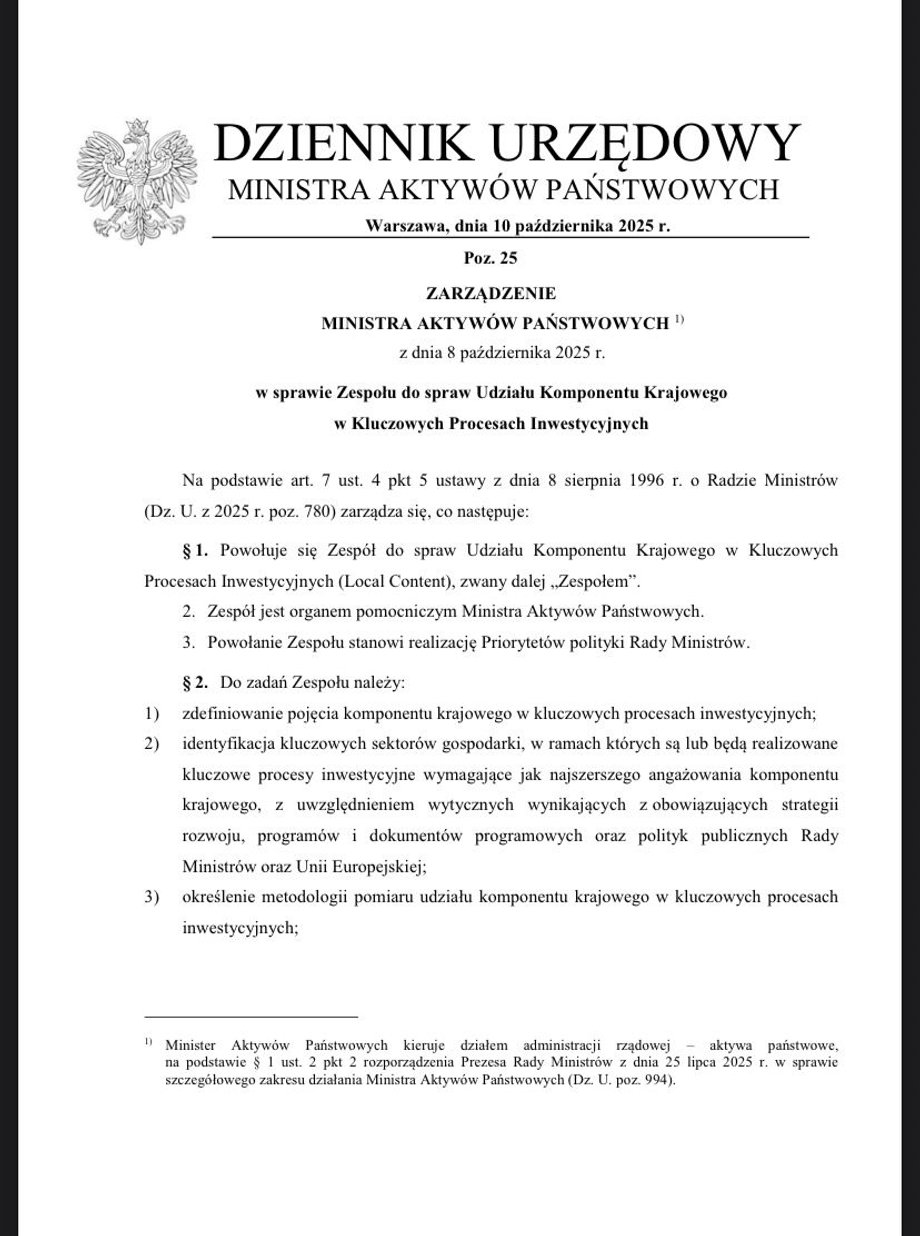
Order of the Minister of State Assets
In the context of key investments, the government is focusing on re-Polonization
The wave of public investments is a tasty morsel for companies operating in Poland, including: construction. To meet their expectations, this spring Prime Minister Donald Tusk announced a program for re-Polonization of the economy. It serves, among others, recent amendment to the Public Procurement Law. The new state purchasing policy currently being prepared – with the participation of the Public Procurement Office – is also intended to help in the implementation of this plan. State-owned companies include re-Polonization in their strategies, and the Minister of State Assets has just issued an order establishing a team for the participation of the domestic component in key investment processes.
However, under EU law, re-Polonization is rather a re-Europeanization of procurement. One of the key conditions for the success of the ambitious investment plans of the current team, apart from determination in this matter, is to ensure sources of financing. This requires, among other things, the above-mentioned change in the financing mechanism for railway investments.