The number of millionaires in crypto has increased substantially. Which place in the global top is Romania

The crypto has gone from an experimental technology to an recognized class of assets, and this trend was also close to the regulatory Nível. A 2024 analysis of 75 jurisdictions found that 76% of them now allow cryptocurrencies in defined rules, while only 23% maintain substantial restrictions.

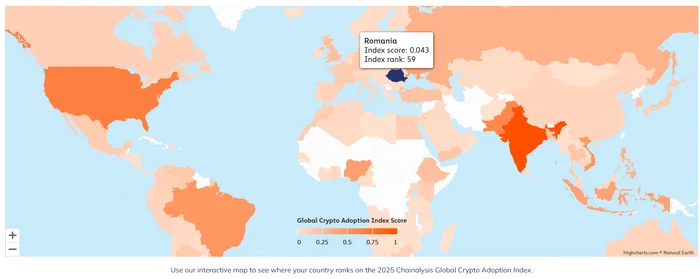
The crypto sector has created a new class of financially independent investors. On June 30, 2025 (end of semester 1), over 241,700 people from all over the world had crypto assets of at least $ 1, compared to 172,000 an earlier. In total, at a global level, over 590 million people hold crypto, a binance analysis shows, according to which Romania is 59th in the Global Cryptomonede's Cryptocurrency Index.
Financial Stability Board reports that 93% of member jurisdictions have committed to introduce or review crypto regulations by 2025, about 60% planning to implement its stable currencies and crypto assets.
Several countries now accept, explicitly or indirectly, investments in cryptocurrencies in the process of obtaining citizenship or residence. For example, Portugal considers that you know eligible “gold visa” if you have investments in sustainable funds supported by cryptocurrencies, such as the “Bitcoin Eco” fund.
Hong Kong accepts holders in Bitcoin and Ether as well as legitimate wealth certification criteria in the capital investment scheme, and El Salvador offers citizenship if you prove that you are investing $ 1 million in his economy. The common element is the structured integration of digital assets in global mobility tools.
How much the regulation matters
Evidence is increasingly suggesting that when governments establish reasonable, risk -based rules for cryptocurrency, people use them more.
The Global Cryptocurrency Adoption Index of Chainalysis also provides accurate data. The countries that clarified in 2024 and 2025 The way in which digital assets integrate into their financial architecture have climbed into the standings, and this evolution is based on real activity in the respective states, not just the feeling of the population.
Chainalysis builds countries based on on-chain and off-chain signals related to how users and institutions interact with cryptocurrencies.
United States: Clarity stimulates confidence
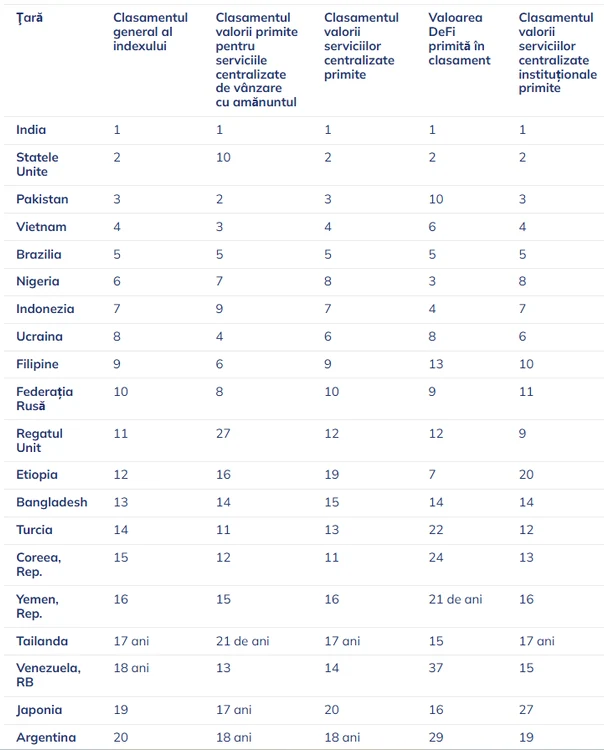
The United States is the most visible example in which regulation and adoption support each other. In 2024, the country climbed the fourth place in the standings, after the appearance of Bitcoin Spot trading funds on the crypto scholarships that opened the door to the participation of a wider audience. In the 2025 standings, the US climbed to the second position, reflecting not the deeper institutional allocation, but also a larger presence of retail investors.
The political context was essential: the key developments included the approval of ETFs on Bitcoin, progress for a federal framework of stable currencies and active debates in Congress on market structure legislation. When the policy goes from ambiguity to a functional framework, the use extends and matures, another analysis shows.
Brazil: constructive rules, impulse at local level
Brazil adopted a fundamental law for virtual assets at the end of 2022, implemented it in 2023 and spent 2024 coming with detailed standards for licensing and supervision of digital assets through the central bank and the authority for regulating securities. This constructive approach coincided with a constant climb in the adoption ranking, with Brazil now occupying the fifth place in the 2025 Chainalsis index.
The local context helped. The national instant payment system, PIX, has become accustomed to consumers and traders with fast digital money flows. In 2025, PIX has over 165 million customers, more than 75% of the population, and processed over 63 billion transactions in 2024.
South Korea: Users protection is used as a catalyst
In South Korea, the Law on the protection of users of virtual assets, which entered into force this year, has tightened crypto standards, including the obligations of service providers.
The effect is reflected in the standings: Korea climbed from 19th to 15th between 2024 and 2025. The law has contributed to maintaining onshore participation and aligning with surveillance expectations, improving both safety and sustainability. Retail institutions and users now have a clearer image of what “good” means, and digital assets prepared to meet these standards benefit from this confidence.
Adoption is not beneficial for retail only
The clear and predictable rules reduce the risk of compliance for institutions and provide industry operators with a stable basis for investments in custody, market integrity and consumer protection. It also offers a benefits at the macro level: more efficient cross -border payments than a healthier mix of saving vehicles for households and small businesses.
For the decision makers, it confirms that only the application of the law does not build safer markets, the clear standards do it. The countries that have passed to concrete licensing regimes, reporting requirements and protection for consumers are those that climb the standings.
The risks that consumers may face in case of crypto transactions:
• extreme fluctuations of prices (even in the case of regulated cryptoactive);
• liquidity risks (possible difficulties in selling cryptoactives at the price or time desired, due to some Ilichide markets);
• misleading information (especially on social networks);
• fraud, scams and cyber attacks;
• Limited protection: the protection offered by the Little (eg access to comprehensive information, uniform and transparent procedures for solving complaints) is narrower than the one offered in the case of classic financial products, as there is no losses compensation scheme. At the same time, for the cryptoactives and services provided by companies outside the EU, there may be no protection for consumers or that it is much lower than that offered in the EU;
• The complexity of the product (makes it difficult to understand the risks involved or to know the value of crypto or related investment products).