What is about to happen in the San River is what the district heating industry has been indicating for a long time as one of the main directions of its transformation – heat production for residents will be based on the use of electricity from renewable energy sources. Technologies such as electrode boilers, energy storage and heat storage will help in this, and the source of energy will be a large photovoltaic installation. The electricity from the panels will also be used for electrolysis – the production of zero-emission, green hydrogen. The municipal company responsible for the project counts on long-term stabilization of heat prices and budget savings thanks to avoided purchases of emission allowances, and also hopes to attract further investments and stimulate local development. The whole thing will not cost Sanok a single zloty. How is this possible?
Read also: “We want to create an alternative.” Will the energy cluster stimulate the development of the district in the Łódź province?
Panels adapted to work in winter
The idea to decarbonize the Sanok heating plant was born in 2021, when rising heat prices were already visible, resulting primarily from the increase in prices of CO2 emission allowances, high fuel costs (primarily coal), inflation and electricity costs incurred by the Sanok heating plant. – Before installing the biomass boiler, which cut costs by half, the city paid PLN 10 million annually for emissions from the municipal budget – says Anna Kornecka, president of the Hydro Sanok special purpose vehicle, which is currently responsible for the electrification investment, in an interview with Business Insider Polska.
Electrification based on own energy sources is intended to ensure price competitiveness. – Energy purchased from the grid would be much more expensive and would not allow for achieving adequate cost stability. The construction of our own generation sources for the Sanok heating district was considered necessary at the very beginning of the project – explains Aleksander Naumann, a technology expert at Hynfra, a company co-responsible for the investment, and a member of the management board of the Hydrogen Poland Association and vice-chairman of the Hydrogen Technologies Committee at the National Chamber of Commerce. In 2022, Hynfra was selected through a tender as the contractor for the decarbonization project of the City of Sanok and acquired a minority share in the Hydro Sanok special purpose vehicle established to implement it.
The Sanok concept of electrification of heating is based on photovoltaic sources. The city has extensive investment areas that enable the installation of panels with a total capacity of 94 MW. As Naumann says, a hybrid with wind turbines complementing photovoltaics was out of the question due to restrictive distance regulations. However, the solar sources themselves are expected to provide an impressive amount of heat, reaching over 70%, for consumers connected to the city network.
Naumann explains that Thanks to its size, the PV installation will be optimized for operation in the winter months, when the demand for heat is greatest. – The 113 MW we applied for at the beginning would cover up to 100%. heating needs. However, there was enough land for 94 MW. The current coal boilers in Sanok have approximately 30 MW of power. Together with a 60 MW electrode boiler that “converts” electricity into heat, battery energy storage units that optimize electricity production itself, and a large heat storage facility (in the form of a water tank with a temperature of 90 degrees Celsius) – we will be able to cover over 70%. heating needs of the city – explains our interlocutor.
The remaining sources in the city will be the (already operating) biomass boiler and the gas unit under construction. As we hear, Hynfra also recommends leaving coal sources “just in case” that could cover peak demand during extremely cold, but unlikely, winters.
Hydrogen for industry
The production of green hydrogen, which requires significant amounts of energy from renewable sources, is an idea to use photovoltaics in the summer, when the demand for heat is much lower. – For several years, during the summer months, the market has been facing an oversupply of PV sources, which results in, among others, negative prices, when the manufacturer has to pay extra for the consumption of the energy it produces. From the beginning, we assumed that the electrolyzers would be powered by panels that would produce pure hydrogen, says Aleksander Naumann.
The sale of the produced raw material is to enable Hydro Sanok to achieve a return on the investment, which is to be entirely financed from private funds and subsidies. The total expenditure estimated in 2024 will amount to PLN 726 million, but the city's direct contribution will be limited to the lease of land for the photovoltaic installation. Naumann adds that costs could fall further as components such as electrolyzers become cheaper.
The target recipient of green hydrogen from Sanok will be the industry, which must use it for the decarbonization of its own production processes, forced by the EU climate policy. Potentially, the raw material can also be transported to public transport, although the matter is more complicated.
Read also: 15 years for experiments. How to green the energy-intensive industry?
– In towns such as Sanok, where there are large differences in altitude, hydrogen drive in buses may be more competitive than direct electrification, which today seems to dominate the zero-emission transport market. You also need to remember about proportions. Assuming that hydrogen would be used 100%. city bus fleet, the demand would be approximately 13 tons per year – a maximum of 2%. our minimum production capacity, which will be over 600 tons – Naumann points out. – – Hydrogen as a fuel for vehicles is an option, but the primary recipient will be industry – sums up.
The expert says that the rising costs of the ETS, including the complete withdrawal of free allowances for industry after 2035, should reduce the cost gap between gray hydrogen (produced from natural gas, and therefore emitting emissions) and the more expensive green hydrogen. It also ensures that Sanok, located in the foothills, has sufficient water resources to produce the raw material.
– We want to draw water from the city intake. The capacity of the Sanok water and sewage network reaches approx. 12,000. cubic meters water per day, our needs for the production of approximately 600 tons of hydrogen will amount to approximately 60 cubic meters. per day – he justifies.
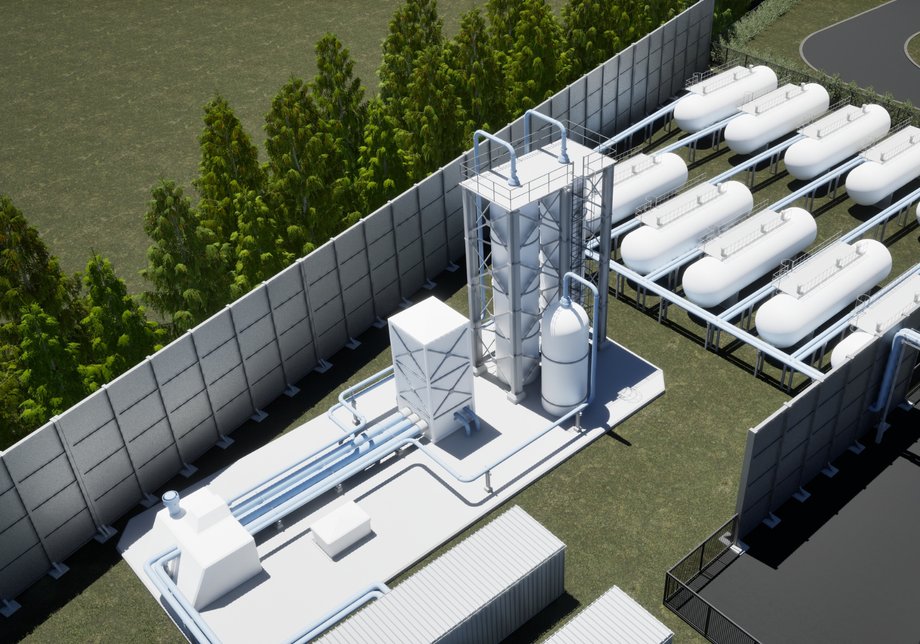
Green hydrogen from Sanok is to be intended mainly for industrial needs
Smaller cities easier to decarbonize?
Anna Kornecka, head of Hydro Sanok, expresses hopes that the project of electrification of the municipal heating system will benefit not only its customers (almost 70 percent of the city's inhabitants), but also other residents of Sanok who use individual heat sources.
– Thanks to the savings on the purchase of allowances, there will be more funds in the city budget for other investments. Our investment will meet EU requirements for effective heating systems; In addition to large amounts of energy from renewable energy sources, we also plan high-efficiency cogeneration (simultaneous production of heat and electricity – editor's note), as well as potentially waste heat from hydrogen-producing electrolysers – says the company's president.
He adds that the city also counts on attracting investors and developing the staff needed in modern energy projects. – We are talking to the State University of Warsaw. Jana Grodek in Sanok, which is planning to create a new energy field, which could be an interesting offer for students of local high schools and technicians, who could later start working locally in Sanok – he says.
Kornecka notes that in addition to large investment areas that enable the location of a large PV installation and favorable water resources for the production of green hydrogen, decarbonization is also facilitated by the relatively small size of the local heating network. Green technologies such as photovoltaics with electrode boiler and storage can be more easily scaled here.
– It is no coincidence that the decarbonization of heating, also carried out by companies such as Veolia, is starting today in smaller cities. In our region, apart from Sanok, interesting projects are also being developed in Krosno and Leżajsk, and throughout the country, e.g. Zgorzelec or Lidzbark Warmiński. Green electrification of heating is easier here than in large metropolises. The sensitivity of residents of smaller cities to dramatically rising heat prices is also much lower, he explains. He adds that the production of green hydrogen is in line with the assumptions of the Podkarpacka Hydrogen Valley association, in whose work Sanok is also involved. – In Podkarpacie, the production of green hydrogen as a driving force of the regional economy has been talked about for several years – he comments.
“We do not propose experiments”
According to the current schedule, the installation in Sanok is to be ready for operation in 2028. However, political controversies could potentially stand in her way. In March this year, city councilors revoked the resolutions of intent adopted earlier, which made it possible, among other things, to make land available for a PV installation. The debate also raised doubts about the sense of investing in hydrogen.
Our interlocutors say that the allegations are part of the dispute between the new majority and the new mayor, with whom the project is associated. – We are trying to convince the councilors to our project, pointing out a number of benefits for residents that the project can bring – says Anna Kornecka briefly, recalling the already mentioned advantages such as stabilizing heat prices and a pro-development impulse for the city.
– As a minority shareholder in a special purpose vehicle, we guarantee that all liabilities will not burden the city budget – assuming continued cooperation in accordance with applicable agreements, including those regarding the provision of land for photovoltaics. As tenants, we will bring income to the city, adds Aleksander Naumann.
It also declares that the technologies used to electrify the heating system in Sanok are tested and safe. – We do not propose experiments or solutions that have not been previously tested in practice. The 94 MW photovoltaic farm will not be the largest installation of this type in Poland, and electrode boilers are a proven solution; in Finland alone, the installed thermal capacity in this technology exceeds 1.4 GW. However, we bring an idea for the management of summer energy production from PV, thanks to which it will not be wasted, making the project an attractive investment for the financial market – he sums up.