Romanians, the last one went to film in Europe. “At a time when we have to defend our democracy, culture is not encouraged,” says producer Ada Solomon / What other countries do


Since the pandemic, cultural consumption has decreased, and people give less resources, either money or time, to go to the film, says producer Ada Solomon, in a dialogue with Hotnews. The situation of Romania is not a singular one, but other countries are looking for solutions to attract people. A concrete example comes from France.
- This article was carried out within the cross -border project Pulse by Stefania Gheorghe (Hotnews, Romania), Federico Caruso (OBCT, Italy), Francesca Barca (Voxerop, France), Petr Jedlička (Deník Referndum, Czech), Lena Kyriakidi (Efsyn, Greece).
- The first part of the article: How Romania came to close thousands of cinemas. “It was a phenomenon that hangs very hard in the performance of any Romanian films,” says Tudor Giurgiu
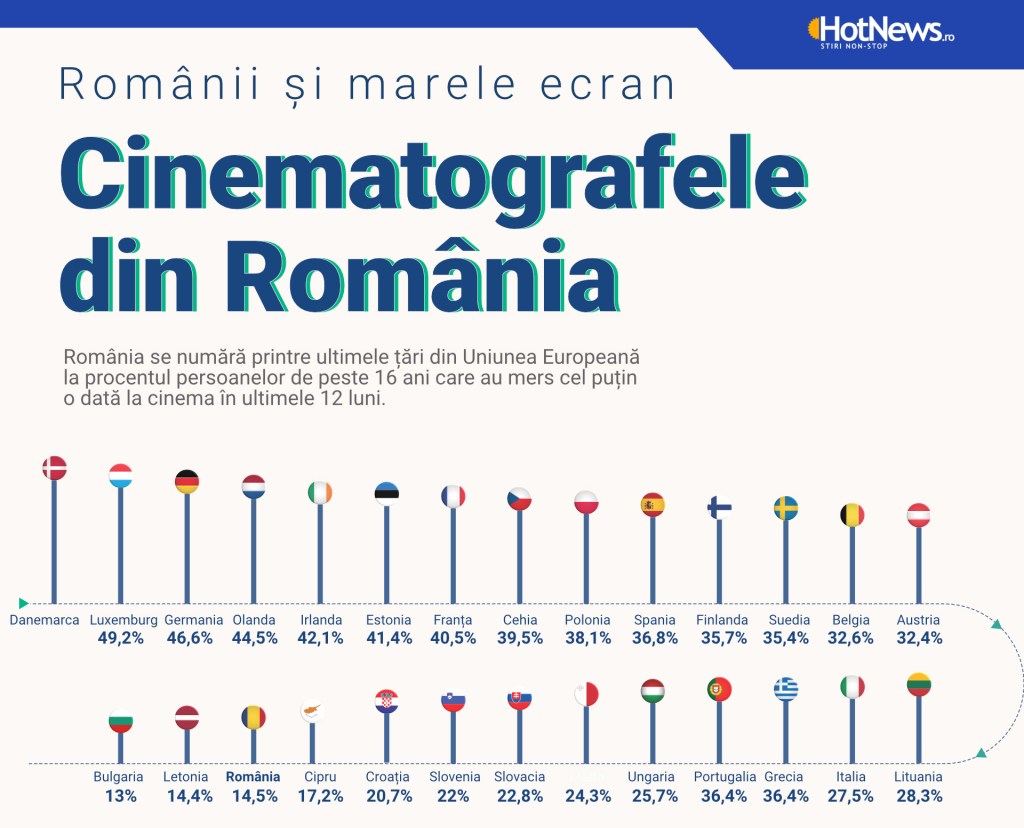
Romania is among the latest EU countries for the percentage of people over 16, who went to the cinema at least once, in the last 12 months, the Eurostat data from 2022 shows. Only 14.5% of Romanians went to watch a movie at the Cinema. The only countries that exceeded Romania at the bottom of the ranking are Lithuania (14.4%) and Bulgaria (13%.
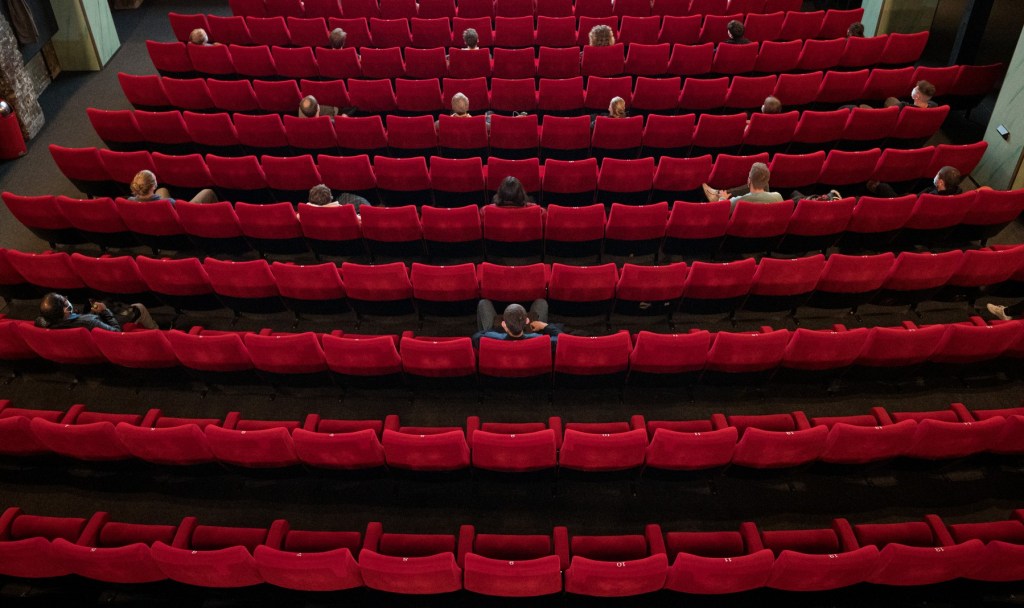
The causes are multiple, explains the producer Ada Solomon, for Hotnews. “In the field of degradation of the cinema audience, the pandemic and discovering the diversity of platforms during the pandemic, when there was no other solution, contributed to the decrease of consumption,” she says.

The TV is more “comfortable” than going to the cinema
The same reasons are also invoked by several people that Hotnews met at a cinema in Bucharest.
Dan comes to the cinema “at most once a year”. Asked why it doesn't come more often, his answer is simple: “The TV. I watch movies. I watch 4-5 times at a movie. It's more comfortable.”
The same opinion is Marian, who came to see a movie with his son. “Now we look at the next few days come with the rest of the family,” says the man. He rarely comes to the cinema – “the children come more often” – because they work abroad.
“There is no concern at the level of authorities to bring the public to the showrooms”
“The streaming platforms have matched, they have been folded perfectly on a new life pattern, in a society in which the man is suffocated, he has deadlines, he has a run and the pressure is maximum. The increase in the number of subscriptions, the offers, the fact that they broadcast in the first, exclusively, and not only film, and sports, and other events, and other events, Tudor Giurgiu.

He says, however, that it is not a phenomenon that happens only in Romania. In the US, the United Kingdom or France has closed cinemas because they “have no longer resisted competition.”
Manufacturer Ada Solomon claims that no streaming platform can replace the experience of a film seen at the cinema and criticizes the lack of measures to encourage consumption.
“There is no concern at the level of authorities to bring the audience into the showrooms, of any kind, to cultivate the taste of consuming culture. At a time when we need to defend our democracy, culture is a redoubtable and non-lethal weapon, which could do wonders, but is not encouraged, supported, on the contrary,” says Ada.
“It should have been a serious involvement”
Tudor Giurgiu believes that the discussion of going to the cinema must be started in childhood: “It is about the education that children receive at school, what social media offers you, how toxic the tiktok has become.”
“For years, it should have been a serious involvement in stimulating and causing debates on how to educate children and how we get used to another way to watch movies, to understand movies and how the documentary film, for example, can help you have a critic judgment, open your horizons.
“There is something else passing on pure entertainment”
He also believes that the festival he has been organizing annually in 2002, TIFF, has been a “game changer” in the way in which the public in Romania sees the films, especially the author.
“TIFF is a concrete example of stimulation-I was talking about critical thinking-passion for cinema, to show people that there is something else passing pure entertainment. On a bigger scale we talk about an audience that has changed in 23 years, some generations have passed over us, but the rooms are full, or we are in the air.
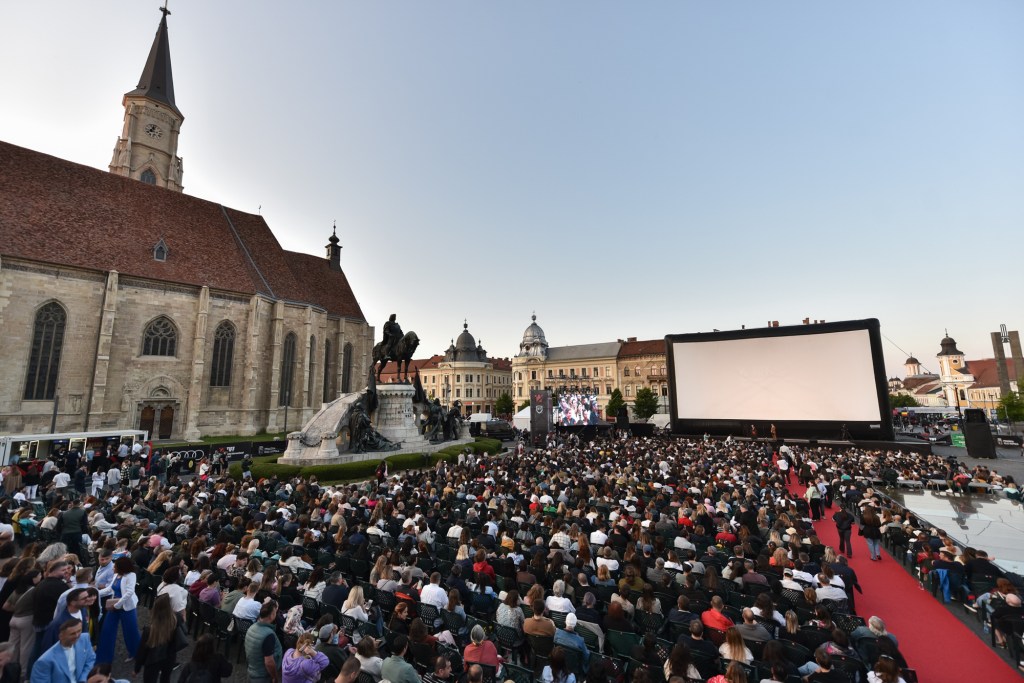
At TIFF people can see productions from all over the world: Scandinavian films, India or Korea, which, says Tudor Giurgiu, are looking for years later.
The Romanian film that “reborn” the appetite of the public
Also about the need for some initiatives of the state to support the film infrastructure, the film critic Victor Morozov also speaks, in the dialogue with Hotnews.
“The cinema will not die as a collective practice, as a practice of seeing movies in the cinema – this historical place of the film, a popular charter, will not disappear. But he must now coabite, compete with various other ways to consume information, to consume images and movement,” says the critic.
He also says that “the domestic public, the Romanian public, has this desire to go to the cinema.” The example? The Romanian film “Teambuilding”. Thus, this film was also considered by the director Tudor Giurgiu a “t0” moment for the Romanian cinema.

“The appetite of the public for the local product has been reborn and it seems to me that we live in a completely different paradigm and dynamic from that moment until now, ”says director Tudor Giurgiu, in the dialogue with Hotnews, about the film published in 2022.
The film directed by Alex Coteț, Matei Dima and Cosmin Nedelcu sold over 980,000 tickets in cinemas throughout the country, thus becoming the Romanian film with the largest receipts in the last 30 years, but also the film with the biggest receipts ever released on the Romanian market.
The movie Spiderman: No Way Home, which has been released in 2021, sold over 550,000 tickets, and the 2009 Avatar movie, which owned the record for most movies sold, brought nearly 879,000 people to the movie theater.
A similar situation was also in Greece, another country where consumption has decreased as a result of pandemic and developing streaming platforms. The film “Stelios”, about the life of the greatest Greek singer, Stelios Kazantzidis, attracted, in 2024, 850,000 Greeks in the cinema. 11% of the tickets sold all year were for this movie.
The price of tickets, another aspect that affects the consumption
Another explanation related to decreasing consumption may also be related to ticket prices. Marius, a 23 -year -old, said for Hotnews that he goes to the cinema “about once a season”. He does not have a budget allocated to cultural activities, but he recognizes that the prices seem a bit high for the salary he earns.
For example, a ticket to a 2D movie at Cinema City, in Bucharest, costs, on a Wednesday, 44.5 lei, with a reservation fee. For students, students, pensioners and people with disabilities, the ticket costs 40.5 lei, and the children pay 36.5 lei.
Every Tuesday, there are discounts. The price of a ticket to a 2D movie is 20 lei, and for the 3D a spectator will get out of pocket 22 lei.
There are also lower -priced cinemas, but they have lower rooms and fewer movies. The ticket to the same movie as the one from Cinema City, also on a Wednesday, costs at Cinemax 19 lei. Here, Monday and Tuesday, tickets cost 15 lei.
At Cinema Elvire Popesco, the general tariff is 25 lei, and for students, students and pensioners, 10 lei. People with disabilities have free access.
What prices are in other countries
In Greece, the average price of a ticket is 7-8 euros (35-40 lei), but there are weekly offers at summer and winter cinemas, where tickets are 5 euros (25 lei).
In the Czech Republic, however, the prices are higher. The price of a cinema ticket today is between 8 and 15 euros, ie between 40 and 75 lei. 10 years ago, the highest price was 50 lei.
The lesson offered by France: Subscription for cinemas
France, a country where cinema consumption is high, has several initiatives trying to attract people. Here, 40.5% of the French went to the cinema at least once, in 2022. There are almost three times as in Romania, but in a much larger population.
At the same time, all cinemas have introduced prices adapted to the public or the moment of projection: students or young people under 26, numerous families, seniors, children under 12, 14 or 18 years, morning projections, subscriptions and loyalty cards.
For example, at the UGC cinematic chain, for 24 euros a month, ie 120 lei, a person has unlimited access to the cinema, and, if accompanied, the companion pays an 8 euro ticket, the equivalent of 40 lei.
Such subscriptions encourage the consumption of cinema and make this habit to be accessible to the French, in the context in which prices for shows, theaters or concerts are higher.

The PULSE project is a European initiative to promote cross-border journalistic partnerships, co-financed by the European Commission (DG Connect) within Multimedia actions by Grant Agreement LC-0272862. HotNews.ro collaborates in the project with other prestigious publications in Europe: Delfi (Lithuania), Deník Referndum (Czech Republic), the largest Austrian newspaper Der Standard (Austria), some of the largest publications in Greece – Efsyn, El Confidential, Spain, the largest Polish newspaper Gazeta Wyborcza, the oldest analytical and information site. MediaPool, one of the largest HUVG HUVG and Italian newspaper with economic profile for 24 hours, one of the oldest and most powerful publications in the peninsula.
Three renowned transnational media organizations-OBCT (Italy), N-OST (Germany) and Voxerop (France) will coordinate the project activities.