Cryptocurrency crash. Bitcoin and ethereum are falling sharply. Traders are losing hundreds of billions of dollars

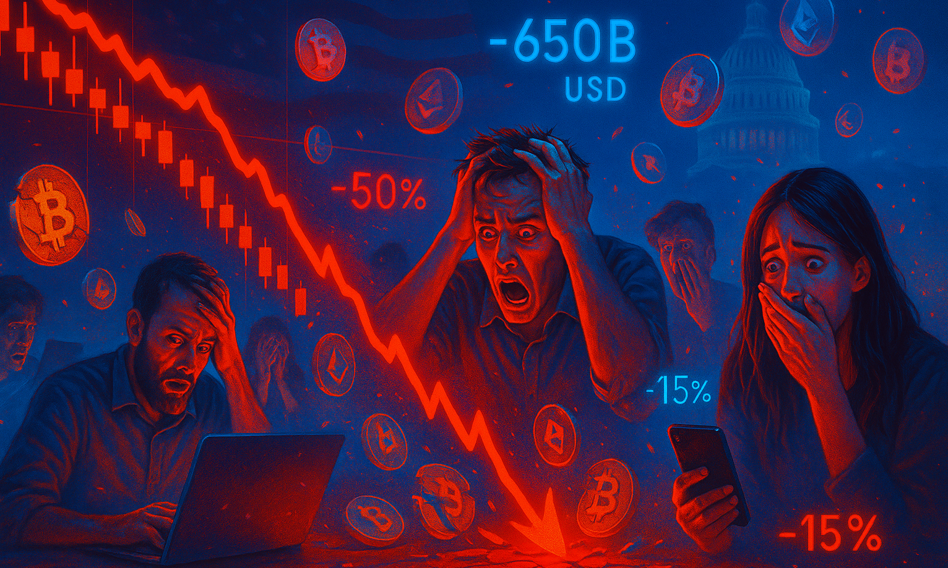
Donald Trump's single social media post triggered a tsunami of panic that wiped out over $650 billion from the cryptocurrency market in 24 hours. While millions of investors watched in horror as their savings melted and the stock markets refused to obey, someone made a fortune in the shadow of this tragedy. This is the story of “Black Friday” – the day that went down in history as the biggest single-day massacre on the cryptocurrency market.
The calm Friday morning of October 10, 2025 did not herald the coming disaster. Bitcoin and Ethereum rates remained at stable, high levels. Bitcoin was at a record high on Monday, October 6, and Ethereum was close to its all-time high. Everything changed in an instant.
The spark that ignited the global fire was Donald Trump's entry on the Truth Social social networking site. The US president announced plans to introduce it 100% customs duties on all “critical software” and goods from China, which would come into force on November 1, 2025. This was a response to Beijing's tightening of controls on the export of rare earth metals, which are crucial for the global technology industry.
The reaction was immediate. Investors, frightened by the prospect of an escalation of the trade war between the world's two largest economies, rushed to sell risky assets. Krzysztof Kolany wrote about what was happening on the stock market in his summary of Friday's session on Wall Street.
Bloodbath in numbers: A historic wave of liquidations
What happened next can only be described in one word: slaughter. In just 24 hours, the global cryptocurrency market capitalization, according to reports CoinMarketCapdropped from USD 4.3 trillion to USD 3.65 trillion, which means that almost $650 billion.
Bitcoin, the king of cryptocurrencies, has taken a dive. Its price briefly dropped below the psychological barrier of $110,000. Depending on the liquidity of a given exchange, there were markets where the bitcoin rate even approached the level of 100,000. dollars.
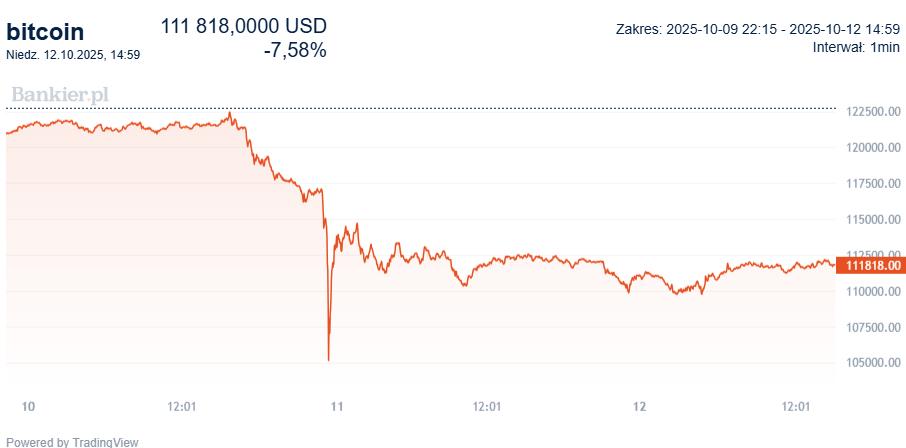
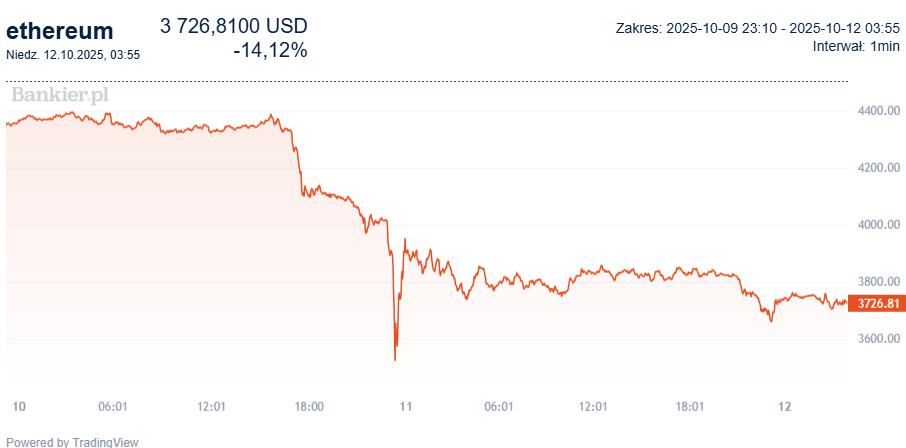
For example, on the Bitfinex exchange, the lowest bitcoin price recorded was $103,310, which meant a decline of 15%. On Coinbase, the lowest quote is 107,000. dollars, and on Binance 107.5 thousand. dollars. Other major cryptocurrencies suffered even more: Ethereum fell by up to 20% at its worst.
However, the real drama took place on the derivatives market. This is where fear turned into pure panic. Investors who had been playing for growth using leverage were swept out of the market by a wave of automatic liquidations. Portal The Block reported on liquidations approaching 10 billion dollarswhile other sources like Financial Expressciting data from CoinGlass, said about 19 billion dollars liquidated items. It was, as analysts unanimously emphasize,
the largest single-day liquidation event in cryptocurrency history.
Imagine the emotions of a trader who looks at the screen and sees his position, secured by his life savings, being closed at a loss and he can do nothing. On that day, according to The Block website, the positions of over 1.6 million such traders were liquidated. In one, the most dramatic hour after Donald Trump's tweet, $7 billion disappeared from the market. It's a financial trauma that could impact an entire generation of investors.
The apocalypse of small tokens
If the declines in Bitcoin and Ethereum could be called a bloodbath, what happened in the markets of smaller tokens was a real apocalypse. There is an old market rule: when bitcoin has a cold, altcoins get pneumonia. Last Friday, this rule was revealed in all its brutality.
While institutional investors and large players focused on defending their positions in core assets, panicked retail investors fled smaller, riskier projects en masse. In these market areas characterized by lower liquidity, even small sell orders can trigger an avalanche. And that's exactly what happened.
The charts of many tokens from the GameFi, decentralized finance (DeFi) and popular memecoins sectors turned into almost vertical red lines. The charts of some smaller tokens turned into vertical lines, and some went straight to zero. Where Bitcoin lost several percent, they plunged by 30, 40, and often over 50%. Within hours, entire ecosystems that had taken months to build turned into zones of ruins. It was total surrender.
Downhill runs of 50-60 or even 70% https://t.co/3hBIA5QrkK
pic.twitter.com/8aPtjsoXMn— Daniel Kostecki, CAI (@Dan_Kostecki) October 10, 2025
In their descriptions of last Friday's events, investors do not avoid comparisons to losses incurred during such historic events as the bankruptcy of FTX, the Covid crash or the 2018 collapse. According to one of them, all these events together did not result in the pogrom that took place on October 10, 2025.
What happened now will be remembered for years.
The largest liquidation event in crypto history worse than #FTX,
#COVIDor #2018 combined.Altcoins dropped 60–80%, some nearly to zero. A pure leverage massacre.
Yet, every such brutal flush has led to the next major rally.… pic.twitter.com/2JV5VYAiyh
— Marzell (@MarzellCrypto) October 11, 2025
Suspicious transactions preceded the crash
After the initial shock wore off, facts began to come to light that cast a shadow over the entire event. As the portal reports in detail MitradeFriday's panic may not have been a surprise to everyone. On the contrary, it seems that someone knew exactly what was coming and cold-bloodedly prepared to profit from Friday's crash.
According to the analyzes cited by the portal, already two days before the breakdown
one of the big players (called whales in stock exchange slang) started opening huge short positions (i.e. bets on a price drop) on bitcoin and ethereum. Barely thirty minutes before Donald Trump posted on Truth Socialthe same investor doubled its exposure to decline. This almost perfectly timed move seems like it couldn't have been a coincidence.
When the president's tweet triggered a wave of panic selling, these previously open positions were closed, and the profit of this one player from this operation could amount to almost 200 million dollars.
Earned? Earned, so now you can cancel everything. 😆 https://t.co/cMdL2WZyqo
pic.twitter.com/7bgoc3pKND— Ergorg (@Ergorg) October 10, 2025
Chaos on the stock exchanges: Technology is adding fuel to the fire
As if that wasn't enough, technology failed in the middle of the chaos. When investors needed access to their funds most – to close positions, cut losses or simply escape from the market – the largest stock exchanges began to have problems.
They were particularly severe on the Binance exchange. As we read on the website The Blockusers massively reported system failures and, even worse, “depeg” – i.e. the loss of linking the rates of several instruments with the price of the instruments to which they were directly related. This included, among others: USDE, BNSOL and WBETH.
For thousands of investors, it was the essence of a nightmare: they saw their portfolios melting before their eyes, while being “trapped” in a system that refused to obey. The Binance exchange later issued a public apology, promising compensation to some affected users. As you can read in the official announcement of the exchange, it is carrying out an analysis of forced liquidations on USDE, BNSOL and WBETH pairs and will want to compensate the losses incurred by customers.
However, in an entry posted on Binance's official profile on the X website (formerly Twitter), the exchange also encourages its other customers who have encountered technical problems to submit complaints to the customer service department. However, it stipulates that losses resulting from market fluctuations and unrealized profits will not be compensated. As always in such cases, asserting your rights will not be very easy.
This event once again showed that in moments of high market volatility, the infrastructure of cryptocurrency exchanges is unable to bear the burden of activity of individual investors.
As the dust from Friday's battle slowly settles, the market is licking its wounds. Bitcoin managed to recover slightly on Saturday and Sunday, returning above 111,000. dollars, and the ethereum rate exceeded 4,000 on Sunday afternoon. dollars. Yet fear still lingers in the air.
October 10, 2025 was a day that taught a painful lesson. The market has once again demonstrated the dangers of excessive leverage, which acts as a double-edged sword – it magnifies profits, but in times of panic it leads to catastrophic, cascading losses.