“We are not in war, but we do not live in peace.” The statement of German Chancellor Friedrich Merz, made last month, was short, but full of historical echoes.
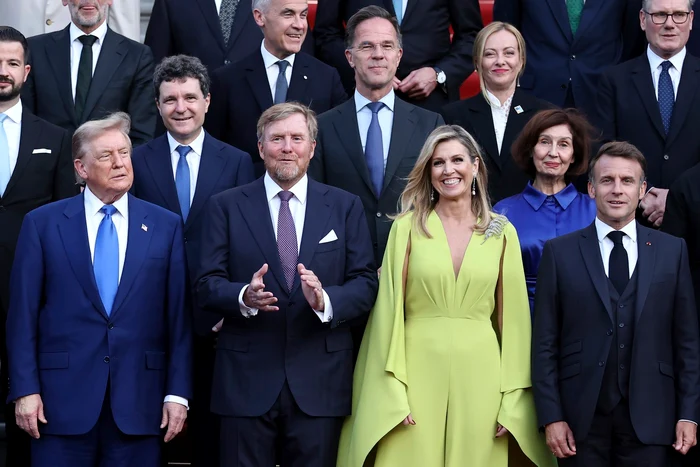
Donald Trump at the NATO Summti in Copenhagen/Photo: Profimedia
It does not have the drama of Sir Edward Gray's famous words, spoken on the eve of World War I – “lamps are extinguished everywhere in Europe” – but it warns, as clearly, that a page of history returns.
In recent months, several air incursions suspected of being the work of Russian drones and aircraft have violated the air space of some NATO states. In parallel, maritime and cyber activities of hostile character have intensified.
After almost eight decades of peace considered inviolable, Europe begins to wonder if its tranquility has not actually transformed into an illusion. The notion of increasingly invoked is that of “gray area” – an ambiguous state, located between war and peace, in which the challenges do not wear uniforms and the fronts are digital, economic or psychological.
An uneasy Europe
Friedrich Merz is not the only one who warns the danger. Former NATO Secretary General, George Robertson drew attention to the vulnerability of European civil infrastructure in the face of cyber attacks.
“We can believe that it is just a coincidence that sabotages appear simultaneously in so many places in Europe?”he asked rhetorically, at an event in Scotland. “We have to worry about the attacks in the gray area. It will be too late if the lights are extinguished.”
In recent weeks, several European airports have been temporarily closed due to suspicious drones. NATO airplanes were raised from the ground, and the incidents revealed the lack of preparation of the continent after decades of “strategic sleep”.
The shadow of American doubt
Against these events, the uncertainty regarding the force of security guarantees offered by the United States in NATO partners also increases.
President Donald Trump has repeatedly stated that the Ukraine war would not have erupted if he had been at the White House. However, the incidents that now shake Europe take place during its mandate.
His ambivalence towards the Western Alliance, the contradictions in defining the “red lines” and the oscillating relationship with Vladimir Putin fears that Russia deliberately tests the limits of European patience.
In the US, transatlantic tensions can only enter the public sphere, dominated by internal crises: the assassination of Charlie Kirk, the development of the National Guard in several cities and the government block.
Drones that shake the European order
The most serious recent violation of the NATO space was reported by Poland, where several Russian drones entered the national territory. Although American officials did not confirm if it was a deliberate action, the extent of the incident was unprecedented.
During the same period, the airports in Copenhagen, Oslo and Munich were temporarily closed due to drone observations, and NATO intercepted Russian aircraft above Estonia.
In addition to the air challenges, the “ghost” fleet of Russia – old ships, used to bypass the sanctions imposed due to the Ukraine war – it is suspected of participating in sabotages on the submarine infrastructure.
The Kremlin rejects the accusations, qualifying them as “western hysteria” and a pretext for dangerous military consolidation. With an ironic smile, Vladimir Putin recently said, “I will not do this anymore,” denying that he would have drones capable of reaching Germany, France or Portugal.
“Slow boiling” of Europe
Western experts believe that all these episodes are part of a “hybrid war” strategy.
“Russia tests the limits of NATO solidarity”says Kirsten Fontenrose, an American specialist in anti-drone technologies. “It is like the story of the frog placed in a pot: the temperature rises slowly, and the frog does not jump out. Russia gradually warms the water, to see how much it can force.”
The Kremlin also pursues a political stake: to undermine the internal unity of Europe and to look fear among voters. Former Russian president Dmitri Medvedev was explicit: “It is important for Europeans to feel fear on their skin. To tremble for animals led to the slaughterhouse.”
Europe is armed – but is it ready?
In response, several NATO states have strengthened their air defense on the eastern flank. The United Kingdom and France sent planes, and Poland invoked Article 4 of the NATO treaty, which allows urgent consultations between the Allies. The construction of a “drone wall” on the eastern borders of Europe is discussed.
The irony of history causes Ukraine, who has been in war for almost four years, to now provide military training to NATO states on Russian tactics.
At the same time, the allies promised to increase the defense expenses to 3.5% of GDP, an objective that suits the American leader Donald Trump.
Tomorrow's challenge: Society's resilience
Experts, however, emphasize that true security is not reduced to the army.
“Defense must be a mission of the whole society”says George Robertson. “Everyone has to know what to do in an emergency situation.”
Nicholas Dungan, a strategic analyst at cogopraxis, believes that cooperation between the private sector and military structures is essential: “Most critical infrastructure is in the hands of companies. Without them, no defense strategy can work.”
Time, warns Dungan, is not on the side of Europe. “Maybe, without wanting, Russia did a NATO service: it reminded how fragile peace is.”