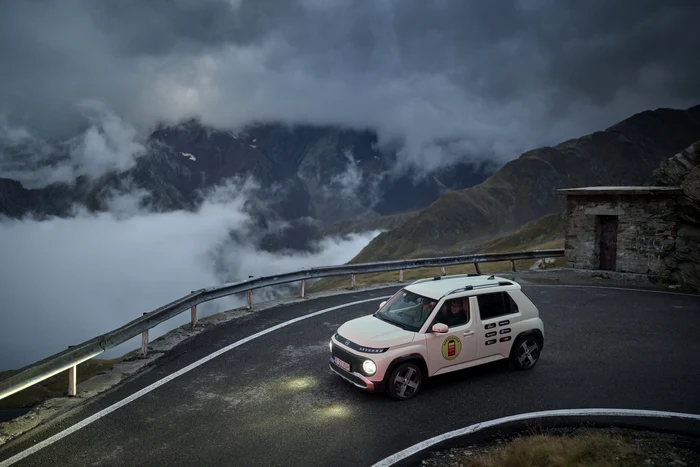
Hyundai Inster in EuroCharge 2025 Photo: Autocritical
How to show the Hyundai Inster Mezin after Eurochange 2025, a 4,593 km marathon test.
I couldn't say that Hyundai stood with my hands in the breast when it comes to electrification. Hyundai is the second producer, after Porsche, who came with an 800V – Ioniq 5. electric model. And I could say that he has reached the level in which he has an electric model in each segment, including in this border area between segment A and B where inter with his 3.8 meters long. Slightly over 10 cm longer than Dacia Spring.
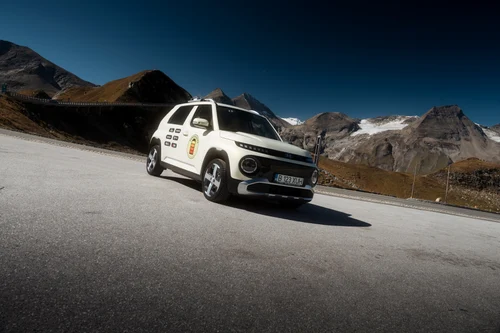
Image 1/11:
Hyundai Inster in EuroCharge 2025 Photo: Autocritical
With Hyundai Inster I met on the day of Marathon, on the day I had over 1,100 km. I don't want to turn this distance into a trophy, but for a regular driver is a challenge. Those who get behind the wheel and do around the planet twice until stopping for any physiological need are reminiscent of some gods and do not address them.
So, a little more than 1,100 km, in an electric vehicle I position on the upper border of segment A. What day was waiting for me …
Car
Hyundai Inster – a small segment crossover, with a length of 3,825 mm and a wheelbase of 2,580 mm. The battery has a capacity of 46 kWh, and the declared autonomy is 360 km. Front traction, 115 hp and 147 Nm. It is loaded at AC stations with up to 11 kW and 85 kW at DC stations. Tested model price – 25,585 euros with VAT included.
Hyundai Inster has a special charm given so dimensions and design. Aesthetically, from my point of view is something that should have been a Fiat Panda electric version. Sympathetic on the outside, with generous doors cut for light access in the car. And the tailgate has a good cut that allows you to load bulky luggage, and a large trolley is a bulky baggage for this car.
It is an urban model, it offers four spacious places, surprisingly spacious both on the legs and head. The 238 -liter luggage compartment represented a challenge for the luggage of two people left at home 2 weeks plus the photographer's photo equipment. The solution was the folding of the rear seats, we did.
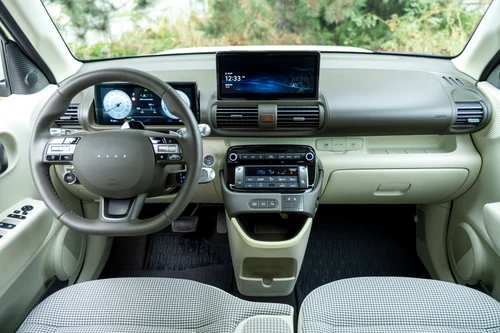
Image 1/24:
Interior details Hyundai Inter Photo: Autocritical
Inster is the cheapest model in the tour, it costs in the Long Range Luxury 25,585 euros. Inside it is sufficiently tonic and cheerful, and the materials are at the class level.
There are small details that give a special charm to the interior, see the front seats that leave the impression that it would be joined and form a sofa. The rear seats are sliding to release a little more space in the trunk if not used.
But there are also details that take you out of their minds. The most agitating is the system that monitors the degree of attention of the steering wheel. Basically, if you turned your head to make sure at an intersection “salt with Dojana”. Too much. Irritating is that the car has some parameters defined for the assistance systems, and no millimeter +/- tolerance.
And when you overcome this frame, all kinds of audio alerts are born inside, on different voices and different tones. No matter how careful I was on the road I could not run without their trigger. And inevitably I remembered Hyundai Santa Fe, the model in the spring tour, which had the same appeals. And something tells me that this kind of feedback is not singular to the Hyundai models.
How to drive
Taking into account dimensions, and the fact that I had over 1,000 km in front, most of them to consume on highways, I cannot say that we were in enthusiasm. The pleasant surprises were related to the vivacity of the car in the highway, with good halves at higher speeds, even if he had come to the meeting with 115 hp and 14 Nm. Even if it looks like an insignificant detail, the ability to integrate yourself into fluid traffic, without representing a “stopper” for the rest of the participants is a detail related to the safety of the trip. Then I also liked the stability of the car at highway speeds, both stability in a straight line and the fact that I did not notice being significantly affected by the side wind.
Even if it is a model that should be mentioned “urban” in the birth certificate, the direction is not so easy as to increase your pulse on the running on the highway. A day to run on the highway that meant 5 stops for loading. The lowest average load value was 40 kWh, and reached 70 kWh – the best. But I discovered that these values are also influenced by the station.
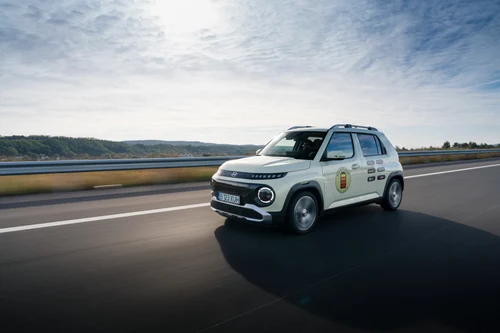
Image 1/7:
Hyundai Inster in EuroCharge 2025 Photo: Autocritical
Again, a detail that gives you confidence on the long road is that the forecast of autonomy is a real one, you can rely on it. So much confidence I had in the words of the car that I did not reduce the running speed, I went 130 km/h to the loading station. The penultimate stop was with 1% battery and autonomy charge 2 km, the last with 2% and 3 km autonomy.
Hyundai Inster is definitely a charming citadel, maybe a bit vocal. And for long roads, if you have another option, choose it, if not, with a little organization, you reach the destination.
Tested car price: 25,585 euros with VAT, via BT Leasing: from 323 euros/month
Main partner: Schaeffler, loaded by OMV Emotion, funded by BT Leasing from Banca Transilvania, put on the road by Michelin, technologized by Server Confit
In the photo gallery you will find the graphs for each day in the tour with all the relevant data.
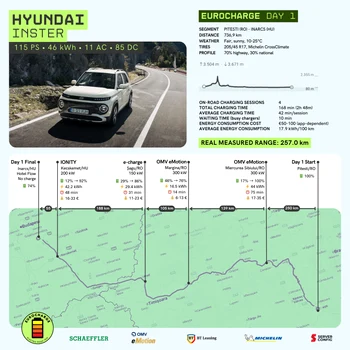
Image 1/8:
Route and consume day 1 photo: self -criticism