The largest project in the history of humanity enters a decisive phase. Under the leadership of an American giant, humanity is close to getting “infinite energy”


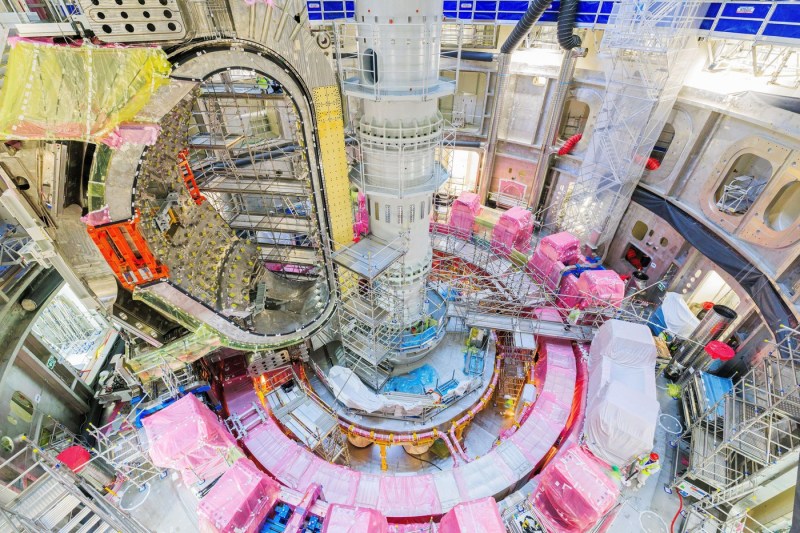
ITER (International Thermonuclear Experimental Reactor). Credit Line: Moirenc Camille / Hemis.FR, Hemis / Alamy / Profimedia
A bold attempt to store solar energy goes from project to reality. An international team begins the difficult task of assembling one of the most complex cars ever built. The stake is huge: if the viability of nuclear fusion will be demonstrated, the path to “infinite energy” will be opened.
In the south of France, ITER (International Thermonuclear Experimental Reactor), the megaproiect aimed at replicating solar energy on Earth, has entered the most critical phase so far, and the eyes of the scientific world are overwhelmed, according to information on the ITER website, quoted by the specialized press.
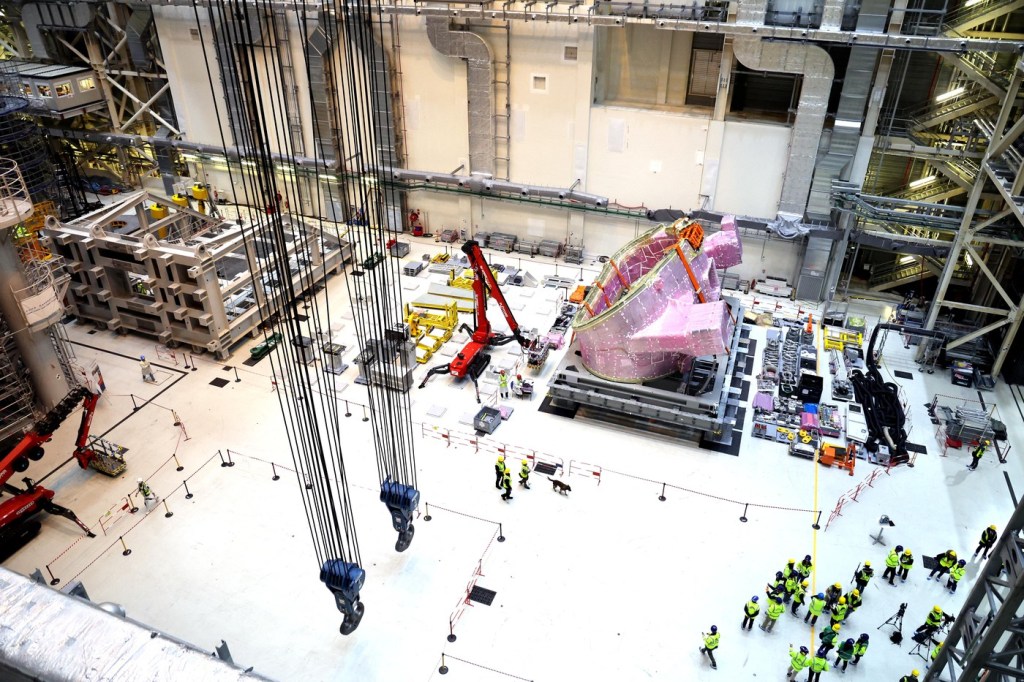
Iter began the final assembly of the core of its reactor in August this year. The task is monumental. Engineers must weld together nine massive steel sectors, each weighing almost 400 tons, to form the ITER Vid Va vid vessel. This room will contain a heated hydrogen plasma day to 150 million degrees Celsius, hotter than the middle of the sun.
Westinghouse Electric Company, the American nuclear giant, has won a contract worth 168 million euros to drive this process. Westinghouse has been working with ITER for over a decade and has played an essential role in the manufacture of key pieces for the vacuum vessel, including the manufacture of five sectors in cooperation with its Nensaldo Nuclear and Walter Tosto partners.
Iter, an “nuclear”
ITER is a rare example of global scientific cooperation. Nations that often compete in other fields have united their forces to solve one of the greatest challenges of humanity: how to supply our future without destroying the planet.
35 nations are attended by 35 nations: US, China, Russia, Japan, South Korea and all European Union states.
Each country contributes with vital components: magnets from Japan, coils from Russia, US cooling systems, China power sources. Europe provides five sectors of the vacuum vessel. They all arrive in Cadarache, southern France, where the pieces are assembled.
Each contribution matters, and each piece must fit perfectly to make the fusion. Due to this Iter collaboration, Iter has often been called an “nuclear UN”, where politics is replaced by the universal language of science.
Dream: transforming merger into energy
The final objective is amazing: the production of 500 MV (megawatt) with only 50 MW of entry energy. This yield ten times higher would prove that merger is no longer a dream, but a practical source of energy for the future.
But the road was not easy. When Iter started in 2010, scientists hoped to obtain the “first plasma” until 2018. The deadline was repeatedly postponed, as the complexity of the project became obvious. Now, the new goal is to achieve complete merger experiments by 2035.
This delay highlights the great challenge of the merger. However, the progress of Iter proves that patience gives fruit. “If we can capture the energy of the stars, it is worth waiting for several decades,” said a researcher.
The path to infinite energy
Iter itself will not generate electricity for houses and cities. Instead, it is a test bench – a proof of the concept that will open the way for the next generation of reactors known as demo. These cars are designed to take over what ITER is learning and transforming this knowledge into real energy.
The advantages of the merger are huge, according to scientists. Unlike traditional nuclear fusion, it does not produce long -term hazardous radioactive waste. There is no risk of melting. Its fuel – hydrogen isotopes – is abundant, with sufficient quantities in the oceans of the Earth to feed civilization for millions of years. If Iter is successful, it could transform not only energy production, but even the future of our planet.
The merger energy has long been called the “Holy Grail” of Science. Now, for the first time, humanity is closer than ever to have it. For both researchers and decision makers, the promise to store stars' energy is no longer abstract-it is welded, piece by piece, in a quiet corner of Provence.