The lesson for Romania of the “miracle” of Moldova: “He did something that the Romanian politicians hesitate, depoliticized the administration”


The historian Cosmin Popa, specialized in the history of the Soviet Union, explained how a small country managed to overcome the terrible hybrid war machine in which Russia has pumped hundreds of millions of euros and what lessons can learn from here.
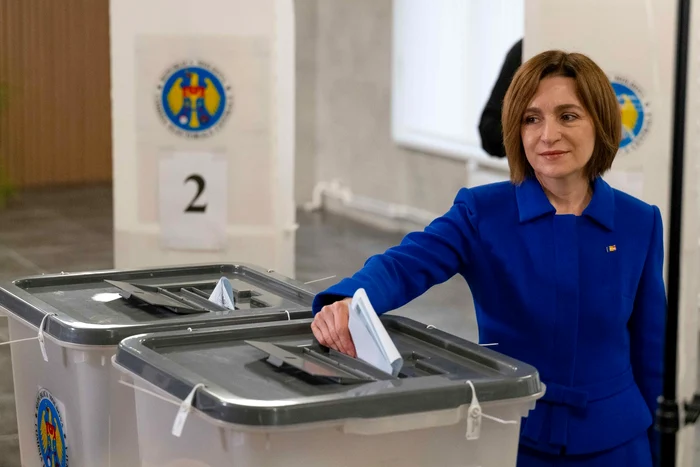
Maia Sandu made a real administrative revolution. Photo: Profimedia
On September 28, 2025, the Republic of Moldova organized parliamentary elections with a major stake: the future of the country's orientation to the European Union versus the pro-Russia direction. The final results reconfirmed the strengthening of the pro-European ruling party, the Action and Solidarity Party (PAS), which obtained about 50.2% of the votes and will hold 55 of the 101 mandates in the Parliament.
The option of citizens was shaped in a tense context, marked by accusations regarding misinformation, cyber threats, and possible attempts of external influence. In order to guarantee an electoral process as transparent and correct as possible, the Moldovan authorities have resolutely implemented a series of measures such as:
The exclusion of pro-Russian parties: The central electoral commission, following judicial decisions, forbade the participation in elections of the parties “The heart of Moldova” and “Moldova Mare”, on reasons such as illegal financing, electoral bribe and links with declared illegal entities.
Anti -corruption and investigations actions: There were searches, almost 250, arrests, including open files for alleged illegal financing from Russia or used for electoral manipulations.
Measures in the field of information security / misinformation: Authorities, together with international organizations and online platforms (Meta, Tiktok, Google, etc.), organized simulation exercises (“stress tests”) for hybrid threats, set up the media monitoring hubs and online content, blocked sites that spread propaganda or disinformation, and intensified controls on external media.
Electoral legislation and sanctions: The electoral code was revised to close certain legal portions, for a better regulation of the campaign financing and for the legislative guarantees regarding the integrity of the electoral process. Also, very clear sanctions have been established for those caught with the sale of votes), illegal financing, etc.
The historian Cosmin Popa, a researcher of the “Nicolae Iorga” History Institute of the Romanian Academy specialized in the history of the Soviet Union and European Communism, explained for “Adevărul” how a country like the Republic of Moldova has achieved the hybrid war machine and what lessons can Romania can learn from these elections.
The action model that allowed Russia's defeat
The truth: How did the authorities of the Republic of Moldova acted in the counteracting the hybrid war carried by Russia? Is it a lesson for Romania?
Cosmin Popa: What happened in Moldova is not only a lesson, but also a precedent for the way they act against the destabilization inspired by Moscow. Because you see a very clear model of action in the Republic of Moldova:
1. Strengthening institutions.
2. The courage to act exactly in the neuralgic points of the propaganda and destabilization system funded and inspired by Russia.
3. Combating the electoral fraud according to all the rigors of the law, of a very clear and determined manner.
4. I would also say the courage to use all the legal tools to stop the political diversion with the risk of being wrongfully accused of police intervention in the political game.
And besides, the Moldovan authorities had the courage and decision to hit the Russian propaganda system exactly in its neuralgic points, at the points where it was the best and where it started from the premise that the Moldovan authorities will not have the courage to intervene, namely in Gagauzia. In Gagauzia, where the Moldovans destroyed not only an electoral corruption network, but also a political destabilization network, which practiced the fully technical coup.
And this shows you that you are dealing with some authorities who know exactly what to do, who do exactly what they promise, and who have all the courage to act despite the shouts and valleys of the opposition inspired by Moscow.
And there is something that differentiates the situation in Romania, from the one in Moldova. Unlike what is happening in Romania, in the Republic of Moldova we have a president who assumes leadership openly, clearly, has a political vision and a vision of organizing the country. And he is truly a guarantor of the constitutional order because he does concrete things for his defense.
And lastly, I would say we have something else. We still have some special services that did not wait to see where the political wind blows and then intervene. They prevented the political and propagandistic actions inspired by Russia.
Two revolutions superimposed in the Republic of Moldova
How did Maia Sandu manage to transform the state apparatus, which I knew very weak, into a very effective device in counteracting this very effective Russian propaganda machine?
It was made from the previous elections, when PAS won the major majority in the Parliament, which printed the political decision, and cursive, and speed. And it was done on the basis of a very clear action program. Because, unlike what is happening in Romania, the Moldovan authorities, to a large extent, have opened to civil society, used everything that could give the best civil society in the Republic of Moldova.
And more than that, they did something that Romanian politicians hesitate to do, for reasons, for my point of view, not so hard to understand. They set up the reform of the entire institutional system two fundamental values: the first is professionalism, and the second is morality. There are no empty words when you talk about professionalism and morality in the functioning and organization of an efficient and modern administration.
To these are added another number of others, say, long -term actions. Effective digitalization, preparation of institutions in charge of defending democracy, attracting valuable human resources from all over the world, so the opening of the state apparatus to true specialists, not only to the specialists of the political parties, because we all know that in the political parties there is no longer a class of so-called technoc. all and are good at all.
And that led to the result we see.
From what you say, I understand that a real administrative revolution has taken place in the Republic of Moldova over the last 4 years.
You are perfect right, in Moldova two overlapping revolutions, not very noisy, but not observed. Namely, a European national revolution on the background of the Ukraine war, as I said, accelerated the national construction of Moldovans, who have opened most of them Romania, at least by language, and took a resolute civilization and political option.
And the second, the administrative revolution, which you were talking about on the one hand. On the other hand we must understand something: and Russian propaganda and destabilization have their limits, because sooner or later they are exhausted, to say, the demographic basin to which it is addressed.
What effects does this phenomenon have, to exhaust the demographic basin to which Russian propaganda is addressed?
It determines an important thing, namely the transfer quite quickly to techniques specific to the coup. Because in the conditions in which you have some authorities and a political party that opens their Romanian identity, the European Directorate, the Western Civilization option and you have an exhaustion of the Demographic Basin of Russian Propaganda, things must somehow settle and it is wonderful to be cut by vote and not otherwise. It is by far one of the best news that democracy could receive in Europe the result of these elections.
“The Romanian parties must be imposed a clear limit”
In the situation where Romania is located today, can we take over some of the lessons of these elections? Did you talk about institutions, for example, are institutions that should be created in Romania or should they work better?
I do not think that Romania is in the position of creating institutions, but it is certainly in the position to make them more efficient. And in this sense there are multiple pressures that come from below and an example in this regard was the protest of the officials of the Ministry of Finance, who asked for things related to the professionalization of the administration, not social and economic issues. That is, there was spoken about the depoliticization of administrative structures. I believe that the Romanian parties must be imposed a clear limit on the level by which they can go with the politicization of state structures. Because under contrary conditions, and here I am not just talking about the civil administration, I also speak of the army, the Ministry of Interior, the special services and of course the civil administration, the education.
And from this point of view, if a very clear legal limit will not be set on the maximum level at which the politicization can descend in the state structures in Romania, it will be very difficult to ever have an administration and professional officials.
The budgetary problems that Romania has today would have been a very good opportunity for the creation of the strategic directions of such a reform, but it seems to me that it is a chance that the Romanian politicians keep in mind as if they would do nothing but prepare the land of the populists.
The main lesson for Romania
As for this part of courage and assumption that Russia is our enemy and we must counteract the hybrid war against Romania, how do you think politicians are managing the situation?
I believe that Romania has more enemies. It has internal enemies and has external enemies. I believe that the main enemy of Romania is, in fact, an alliance between incompetence and lack of vision in the way this country is administered. So, if you want, the internal dynamic is much stronger than the external one.
Of course, if we refer to Russian destabilization, Russia is a nuclear power, but what happened in Ukraine, has also spent in Moldova, what is happening in Northern Europe, Baltic countries, attacks on Poland, shows that Surely Rusia has reached, if you want, exasperation. And she looks like something else. It also shows that in the Kremlin offices there are not only great strategies, but in fact, there are some officials of Putin, whose mission is the destabilization of European societies, but they do these things pedaling on a recipe that is not very clear. Because they have begun to lose the propagandistic battle in certain countries, the emphasis will be more and more in the next period on the technique of the coup. So I expect that in the next period we have a number of technical incidents, a series of air space violations and so on, which is already happening.
So, from this point of view, the situation of Romania has improved with the elections in Moldova. And Moldova showed us to everyone that in a much harder situation than that of Romania, with much less resources than Romania has, it can be very effective.
So, the main lesson that we have to learn from here is that the problem in Romania is not the absence of resources, but the absence of vision and the absence of political courage so that we go in the direction in which we certainly know that we must reach.