The chain of weaknesses in the capital: cars on the sidewalk, bicycles among pedestrians and a city stuck in traffic. What is to be done?


Bucharest remains among the cities of Central and Eastern Europe where the use of bicycle as a daily means of transport is almost non -existent. Friendly City Index (FCI), an initiative based on the Bolt expert, shows that only 0.48% of the inhabitants of the capital pedal daily to get to work or school. The causes concern both the lack of infrastructure and the lack of safe storage spaces. These realities were discussed in the debate “City and Mobility”, organized last weekend at Street Delivery, where officials and experts tried to sketch the first solutions.
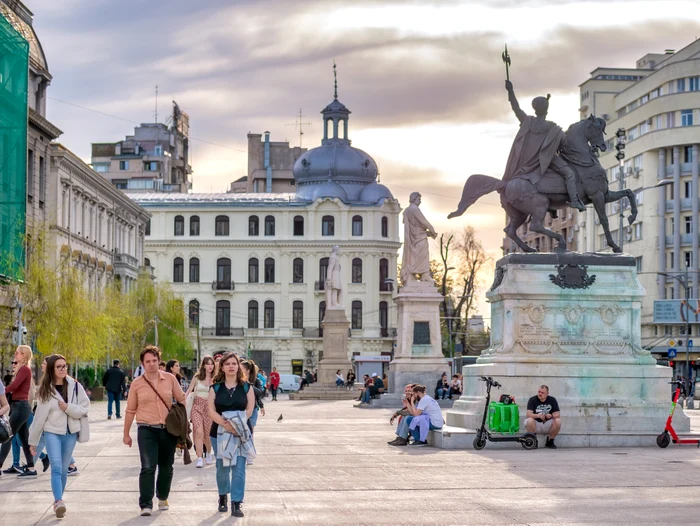
Photo source: Shutterstock
“This is one of the biggest problems in the lack of bicycle use, because the citizens who live in the block and who would be tempted to use the bicycle, have nowhere to store it during the night. There are many associations that have already given rules inside the stairs so you can not leave your scales. Citizens can rent them.said George Tuță, mayor of Sector 1.
From Buzesti to Victoriei: a missed connection for years
Another neuralgic point of urban mobility is about the lack of continuity of the velo runways. Currently, Bucharest has some symbolic routes, but they do not communicate with each other, which makes them a little useful for daily transport. “I conclude with a single project that I want to start with as soon as possible this year, from Buzești to Calea Victoriei. We have two very important bike tracks. They are not connected with each other. And then we identified the Grivița Calea, for which it was a project from 2016, a feasibility study in Pidu (the integrated plan of urban development), There we want to expand the sidewalks, to eliminate the part of the parking lots to connect the two tracks. said the mayor.
If the project is put into practice, this could be one of the first moments when the capital's administration takes the step from fragmentary projects to a vision connected for alternative transport.
How could Arthur Verona Street look like
The debate took place right on Arthur Verona Street, which became a symbol of Street Delivery and urban spaces reopened to the community. For the mayor of Sector 1, the street offers an example of how infrastructure can be rethought, but with immediate effect on the quality of life. “For a street as this is, instead of organizing parking on both sides and the unique meaning in the middle, I think we can only one side to have parking lots, and on the other side we have a bicycle track, to allow both directions and larger pedestrian areas. pedestrians ”he explained.
A friendly city: between intention and reality
Friendly City Index places Bucharest a lot behind other capitals in the region when it comes to alternative mobility. If in Riga or Warsaw bicycles and public transport are already competitive options, in Bucharest users are hit by fragmentation, the lack of dedicated parking and road insecurity.
“According to the FCI, the traffic is felt as a big problem by Bucharest. In the top 10 cities in the EEC who say they are facing the traffic jams, 9 are from Romania. The first place is Timișoara, then follows Bucharest. Speaking strictly of the capital, 33.33% of Bucharest people spend two to three hours in traffic, He declares for the truth Maria Duda, architect and founding member of the Association of Urban Education and Design “Base. We open the city”.
The problem of traffic is just one of the faces of an insufficiently adapted urban infrastructure to the real needs of the inhabitants. Almost half of Bucharest, 47.34%, believe that green spaces are missing from their neighborhoods. “In order to design truly functional streets, we must start by creating them for the disadvantaged groups. For example, when we prioritize the shadow, the cool areas and the access to the water, to a pec. points to the architect.
Bicycles, a lost chapter for the capital
If in the Baltic and Central-European capitals between 11% and 23% of the inhabitants use the bicycle for transport, in Bucharest the percentage is only 0.48%. “The capital is deficient in this chapter. Only 0.48% of the people surveyed use the bicycle for daily transport, the data offered by the FCI shows. Citizens from 9 countries were questioned, and from Romania, inhabitants of 10 cities. But also in the other countries, the number of people who are based on bicycles is relatively low, in the sense that in the first places, in Poland, Estonia. Lithuania, with a percentage between 11 and 23%. Maria Duda explains.
Specifically, in this regional painting, Bucharest stays long ago. While Estonia or Poland invest massively in tracks, smart bicycles and speed reduction policies, the capital of Romania is just beginning to outline the first coherent routes.
How quickly can a city change?
Maria Duda believes that urban transformations can have a visible effect faster than we think, when the solutions are designed on a human scale. “People are very receptive to models that positively impact their daily experience, especially if they are designed to appear as natural, natural, small problems. We have examples from the country which, although initially viewed with suspicion, have quickly become a landmark: the transformation of the big market and the small market from Sibiu into the pedestrian spaces,” she says.
Even in Bucharest there are signals that changes are possible. “The introduction of bicycle tracks on Calea Victoriei, which was a time set by a signaled network, has taken 2-3 years to be adopted and now has a significant number of users. And the latest example, also supported by the FCI study, is the effect of the unique public transport. Last year, the former PG – current president of the country – had a revolution. Magheru at personal car traffic.completes the specialist.
The bottom question: What is the common interest?
The discussion about priorities – Velo tracks, public spaces or smart parking – is a complicated one. “I think it is necessary to ask ourselves the following question: what is our public interest, common? In urbanism, what is the science that studies as we live together, it is essential not to separate the components of the urban ecosystem. Any approach has an effect in all other aspects, therefore it would be considered first and foremost the emergencies, I have to eliminate the risks,
A concrete example: speed reduction. “The reduction of speed to 30 km/h on all central arteries should, in addition, already offer the possibility of a much more comfortable coexistence and with a diminished risk of cars with cyclists.concludes Maria Duda.
Pedestrians, the last in the chain of weaknesses
If official debates talk about projects and investments, on online forums the dissatisfaction of the inhabitants reaches a much more direct tone. On R/Romania and R/Bucharest, a discussion started from the experience of a parent who posted and a photo gathered hundreds of reactions. It starts like this: “Today it was to hit my child, within five minutes, both a bicycle and a scooter on the sidewalk.”
“The cyclists and scooters who circulate like this, at speed and without caring about the other participants on the sidewalk, are the perfect mirror of the Romanian drivers. Change My Mind!”, Write a user. Another completes: “Their mentality is:” Yes, what, to hit me the car? “, As it respects no rule neither on the road nor on the sidewalk.”
The stories are numerous and have a tone of revolt. “A scooter came directly into me and my friend. When I said something, he replied that” I hit the cars on the street. “tells another participant.
Others bring into question the responsibility of the authorities: “The solution is simple: without bicycles/scooters on the sidewalk, street tracks, separated with pillars, according to European norms. Only our politicians do not have the courage to upset a million drivers who scream that the street is for cars.”
In the debate, the comparison with the cars parked illegally appears in the debate: “Funny that in the picture posted the first thing that jumps in your eyes is that there should not be the cars, not bicycles”writes someone. “Those cars how do I get there? Also on the sidewalk.
Others point out that shades are lost in heated discussions. “There is a huge difference between going slowly, carefully, on an empty sidewalk and gonna with 25 km/h among pedestrians. But the law does not make this difference. And then, how do we sanction only the irresponsible?”
Finally, the same conclusion remains, respectively: the pedestrian is always endangered. “They do not want to die on the road, it is a chain of weaknesses caused by cars.” Write another commentator. And another ends the discussion by saying: “I do not want to solve the chaos in the city, just not to die on the sidewalk.”