
Employers feel the pressure of wage increases. The average cost of an employee climbs to 8,500 lei/month



Foreign workers in Bucharest, photo: HotNews.ro / Adrian Vasilache
Romania 2024 was marked by spectacular developments on the labor market, with higher salaries, increased costs for employers and significant differences between sectors and regions, a statement broadcast on Thursday by the National Institute of Statistics.
Wages grow but with major gaps
The average monthly gross salary at national level reached 2024 at 8,061 lei, 14.5% higher than the previous year, and the average monthly net salary increased by 12.4%, reaching 4,959 lei. Employers felt the pressure of these increases, the average monthly cost of the labor force climbing to 8,439 lei/employee, 14.4% higher compared to 2023.
The highest salaries were found in areas such as IT and communications (with 90.1%above average on economy), banks and insurance (63.6%) and energy (58.0%). At the opposite end, hotels and restaurants, other services, real estate, agriculture and the cultural sector had values below the national average, sometimes even over 40% less.
Gen and territory differences remain a hot topic
In 2024, women had a average gross monthly salary of 7,907 lei, 3.6% less than men. The net difference reaches 5.4%, women earning 275 lei per month than men. The disappearances of remuneration are the most pronounced in finance and insurance (39.4%), industry (21.2%) and IT (17.2%).
Territorial, the regions of Bucharest-Ilfov, Cluj, Timiș, Iași and Brașov enjoy the highest average net salaries, while Teleorman, Vâlcea, Vrancea and Covasna are at the tail of the ranking, below the average of over 21%.
More employees but not everywhere
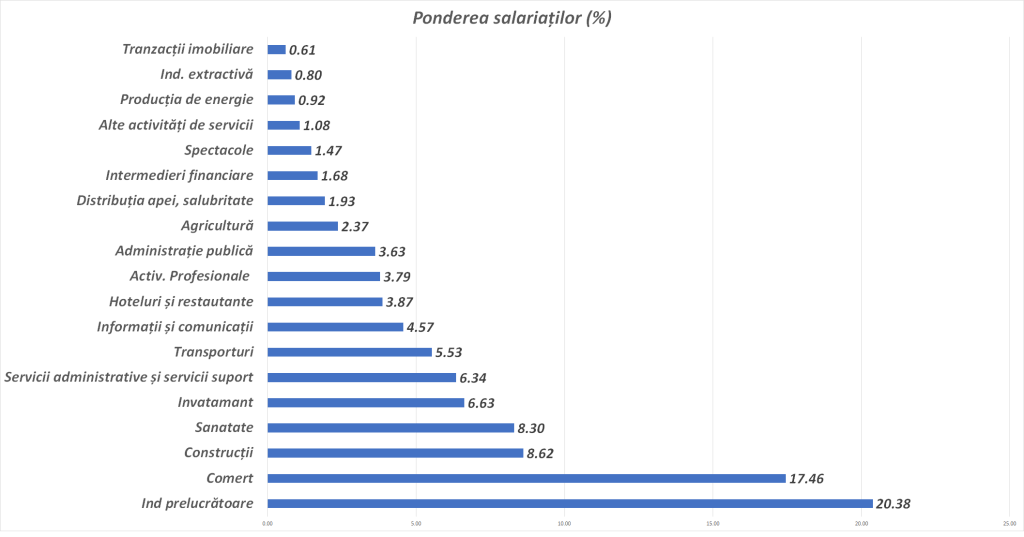
The average number of employees in 2024 increased to 5.45 million people, by over 88,000 compared to the previous year. At the end of the year, almost 5.75 million employees were in activity, most (77.1%) in private companies. The major increases of employees were seen in trade, administrative services, health, education and construction, but there were also sectors where the herds decreased, such as the processing industry and the public administration.
Focus on expanding sectors
The commercial services sector dominates the labor market, with over 64% of the employees, while agriculture and fishing add only 2.4%. Education and health remain areas with a female majority (73%, respectively 80%), while construction and extractive industry are predominantly masculine, with over 80%of employees.
The costs and aids of the state
The state intervened by budgetary transfers to support employers affected by technical unemployment or temporarily reducing the activity, but the share of these transfers in total expenses was lower than the previous year, with the highest amounts to industry, administrative services, construction, trade and hotels.


