Unique restoration in Corvin Castle. The secret of used ceramics produced by the same factory after a century and a half


The Knights Hall in Corvin Castle regains its appearance from the end of the 19th century, with the same materials used in the restoration since then: ceramic tiles produced by a famous factory in Hungary, established for over a century.
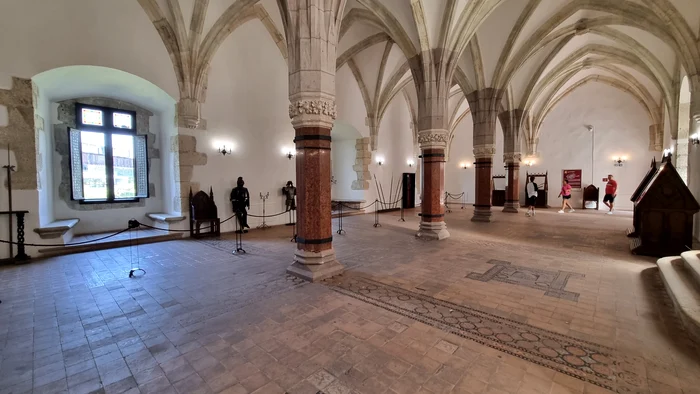
Knights Hall in Corvin Castle. Photo: Corvin Castle Museum
The painted ceramic plates that make up the floor of the Knights' Forest will be replaced with some identical ones, made by the same manufacture that delivered them and those mounted almost a century and a half ago, when the Corvin Castle entered the largest restoration in its history.
“The ceramic plates made in the 19th century, in an advanced state of degradation, will be disassembled, packaged and stored, part of them to be part of an exhibition dedicated to the restoration of the castle. At the same time, the archaeological research will be started, which will provide important information about the construction phases. of the tasars and with those of preparation of the support layer of the new floor ”, informed the Museum of Corvin Castle.
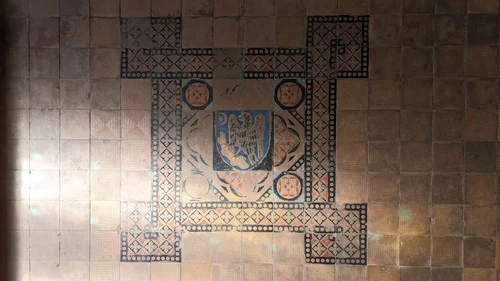
Image 1/13:
Hall of Cavalilor Photo Castle Museum Corvinilor (1) JPG
According to the representatives of the museum, after the devastating fire of 1854, in 1868 the restoration of the Knights Hall was started by Ferenc Schulz. The works were completed only after 1890, when the architects Antal Khuen and István Möller made the drawings on the basis of which the Zsolnay factory in Pécs, Hungary, produced the ceramic tiles used to park the room.
“In the current restoration, after more than a century, the same company will produce the ceramic plates for the Knights Hall in Corvin Castle, identical to the original ones and made by the same technological process.”informed the Museum of Corvin Castle.
Ceramic factory, famous at the end of the 19th century
The Zsolnay factory was established in 1853 by Miklós Zsolnay, in Pécs, in Hungary. Ten years later, his son, Vilmos Zsolnay, joined the company and led her to international recognition, presenting innovative products at world fairs and international exhibitions.
The workshops produced construction ceramics, which became more and more popular since the mid -1880s. Zsolnay products have reached Vienna and other cities of Austria, after Vilmos Zsolnay tied friends to some of Hungary's most important architects.
In the years 1884–1885, the factory participated in extensive works to reconstruct some historical monuments: at the Mátyás Church in Buda, next to Fri FriS Schulek; at the Kassa Cathedral (Košice); And at the Corvin Castle of Hunedoara, together with Imre Steindl. Within these restorations and reconstructions, not only original architectural details were used, but especially roof and ridge tiles.
In 1885 the experiments with frost -resistant construction ceramics began – which was later called – and in parallel Vilmos Zsolnay continued research for enriching the colorful frostings of “Iranian” style. The material resulting in the first stage was called “Steindl”, after the famous architect who restored the Corvin Castle between 1870 and 1880 and the Parliament Palace in Budapest at the end of the 19th century.
Since 1894, Imre Steindl has used this material for the exterior and interior decorations of the Hungarian Parliament. In order to meet the increasing demand, in 1895, a specialized factory in the production of pyrogranites was established on the land of exploitation in Pécs. At the beginning of the 20th century, Zsolnay construction ceramics became a landmark of urbanization, being used in town halls, post offices, exhibition halls, large shops and even private constructions.
Corvin Castle, in the 2019 yard
The Corvin Castle has remained open to tourists, even though in the last six years it has been almost uninterrupted in the site. The restoration works, started in 2019 and financed from European funds, are to be completed in 2027.
The second project, currently carried out, includes the restoration of several interior and exterior frescoes, the replacement of the floor in the Knights Hall, the restoration of the two access bridges, the restoration of the bears pit and its integration in the visiting circuit, making a floor on the artillery terrace, restoring the armor's armor from the tower of the tower, From the inner courtyard, the modernization of electrical and lighting installations, as well as the implementation of a unitary video surveillance system, equipped with wireless cameras.
“We remind that a first stage of restoration was carried out with the help of a project worth 5 million euros, won by Hunedoara City Hall and carried out with the support of ADR West, through ROP 2014 – 2020, and a second stage is now in progress – thanks to a project worth 6.6 million euros, co -financed by PNRR”informed the Museum of Corvin Castle.
The restoration of the medieval ensemble is a rigorous one and is carried out under the supervision of archaeologists and historians, shows the representatives of the museum. In the end, most of the defining elements of the styles that have marked the evolution of the edifice will be enhanced: Gothic, Renaissance, Baroque, classic, neo -Gothic, with romantic influences and elements specific to medieval military architecture.