INVESTIGATION. “I thought I came to a European country.” Suddenly declared suspected of terrorism, a foreign student was left free for seven months to study and work in Bucharest. Then he was deported, without seeing any evidence


Upon returning from the Christmas holiday, from 2024, spent in France, the young Tunisian Mohamed Benzid Buidi is stopped by the Security forces at Otopeni Airport and informed that, in his absence, he was revoked the residence in Romania. He is not given a reason. The young Tunisian spends 12 days in detention at the Center for Accommodation of Foreigners taken in public custody Otopeni. After months of trial, he learns that he is suspected of terrorism, but without him having access to evidence in this regard. In front of the final judgment, in July he is deported, shows an investigation published today by the Snoop site.
- Mohamed came to Romania in December 2022, and for almost three years he studied on the French language profile from the Faculty of Physical Education and Sport, within UNEFS.
- For seven months, although he was a “suspect of terrorism”, the Romanian state allowed Mohamed to work and go to college.
- The only political affiliation of the young man discovered in the investigation published by Hotnews and Snoop during the documentation was solidarity with the Palestinians in Gaza.
- Another Arab immigrant told Snoop how it was accused of being a danger to national security, as a direct consequence of publishing messages of solidarity with Palestinians in Gaza.
- SRI did not provide information on Mohamed's case, but replied that the institution prioritizes the measures taken to prevent terrorism acts. Nor did the General Inspectorate for Immigration (IGI) and did not provide details about the revocation of the young man's resurrection.
- The young man has a ban on 15 years of entry into the Schengen area, and on July 14 he was deported.
On December 28, 2024, Mohamed Benzid Buidi returns from a vacation to France with his brother, Ahmed, where they spent Christmas with their sister. At the landing, just before the aircraft doors open, a flight attendant announces to the microphone that Mohamed is expected by the border guards at Henri Coanda Airport. Amazed, the young man makes his way out, while some passengers chant his name. Ahmed follows him, believing that his brother may have forgotten his passport in France.
The police inform Mohamed that on December 24, while he was gone, he was revoked the right to stay. It is now illegal on the territory of Romania. Without specifying the reason, I put two options in front of him. He can go directly to Tunisia, his native country, or to be taken to the Center for Accommodation of Foreigners taken in public custody Otopeni. Advisory by a hasty -contacted lawyer, Mohamed chooses the center until he can ask for clarification to the Romanian authorities.
Seven months followed in which Mohamed and his family fought in court to find out the reason for revocation.
“I lost the faculty, the family here.” Preparations for deportation

“I don't know anything and I lost everything,” says Mohamed Benzid, 23, Snoop and Hotnews.
We are in the apartment of his brother from Militari Residence, in a living room arranged in a modern and practical style. On the walls are shown pictures of the family, and in the display case, objects from Tunisia and other travelers. Tall, with curly hair caught in a tail, Mohamed rules Romanian well after almost three years in the country. He speaks kindly and detached, as if he would tell some friends the horror he has gone through and that he still does not understand.
“They said they were a danger,” Mohamed summarizes. Even until now, the reason why it is suspected of terrorism remains secret.
In two days, Mohamed has to leave the country in which he came to study. Here he worked, traveled, tied friends and met Larisa, his girlfriend. “Basically, I lost college, I lost the family I have here,” he adds. “I do not want to cry, because I have cried during this period.”
The young man comes from a wealthy family from Monastir, a tourist city in Tunisia, famous for his beaches. His father, a businessman, owns an apartment block, an olive farm and the building of a shopping center, El Braka, in Kasserine, the city where Mohamed was a child.
His mother is the owner of a store with traditional dresses. Mohamed also has a sister, Hanna, and a older brother, Ahmed (32), who has been living in Romania for 12 years.
On Ahmed's Tiktok account, you can see videos about eggplant salad, manele, coliv and how to get its Romanian citizenship. Ahmed studied at Polytechnic Bucharest, and now works as a Mainframe engineer for BNP Paribas. Recently he opened a shop in the neighborhood, decorated in Tunisian style, a mixed shop at benzid. “We wanted to do something like a family, but now I am my girlfriend and we think about how to do it, that in two people you can't,” says Ahmed about the little business.
At his urging, Mohamed decided to come to study in Romania, but not before the mother to visit and give the verdict: the country is beautiful, and people are good. For almost three years he studied in the French language profile from the Faculty of Physical Education and Sport, from the National University of Physical Education and Sport Bucharest, where he was also part of the basketball team. To maintain, Mohamed worked as a delivery at Domino's Pizza.
“I thought I came to a European country, that I would be more free, that I will have rights, to think better about my future,” says the young man. “But my experience was not so.”
In court: suspected of terrorism
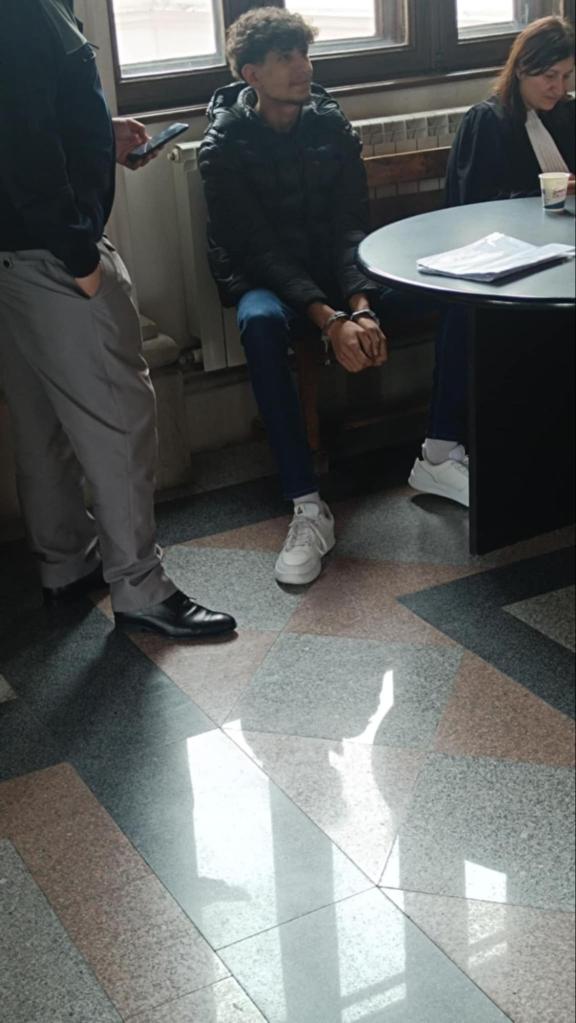
“I know one hundred percent that I didn't do anything,” says Mohamed. Supported by his family, he sued the Ilfov Immigration Service. He challenged the return decision, the revocation of the residence permit and the prohibition of entry into the Schengen area.
From January to March, court hearings were postponed because there were not enough documents in the file. At the fourth hearing, the judge gave the SRI representatives to put more evidence in the file.
In January 2025, Igi Ilfov mentioned that the revocation of the right to residence was based on the provisions of article 77, paragraph 3, letter A. of GEO 194/2002. Specifically, the reason was that Mohamed would no longer have fulfilled the conditions for which this right was granted, and the decision to be escorted abroad came from his refusal to leave Romania, when he was “illegally detected” at Henri Coandă airport. Thus, it was stated that it is forbidden to enter Romania for a period of six months, according to article 106^4 of GEO 194/2002.
A report of the General Inspectorate for Immigration included in the file mentioned that Mohamed “appears in SINS (no national report of signals) with the alert to not allow the entry into the territory of the Schengen states”, a measure valid until December 24, 2027.
There are data that do not meet reality, according to Mohamed and his family. In the documents submitted by the authorities, the penultimate entrance of the young man to Romania would have taken place on September 24, 2024, at Otopeni Airport. But at that time, when Mohamed returned from the vacation in Italy, he crossed the border with Hungary, by car, a passage filmed by one of his friends and posted on social media.
Also in the documents submitted by the authorities, it was stated that Mohamed had requested the extension of his residence permit on April 20, 2023. But Mohamed says he had never submitted this application. As for the number of the residence permit, his lawyer noticed that Igi introduced two different numbers, one of them belonging to another holder.
The note from the SRI
Subsequently, the young man learned that the decision not to be allowed to return to the country was holding a report from the Service of National Signs and Schengen (SRI), issued on December 24, 2024. According to this note, the SRI asked the Border Police to ban Mohamed's Romania for a period of 15 years. Article 8, paragraph 1, letter B) was invoked, corroborated with article 106^3 paragraph (2) and article 106^4 paragraph (10) of the Government Emergency Ordinance 194/2002, regarding the regime of foreigners in Romania.
Specifically, the text of the law concerns the persons reported by international organizations and specialized institutions in combating terrorism, accused “of financing, preparing, supporting in any way or committing acts of terrorism”.
The prohibition of entry for persons accused of links with terrorist groups is 15 years.
During the meetings of the Bucharest Court of Appeal, IGI invoked only the law under which Mohamed was accused, not the evidence they were based on. In April 2025, the family of Buidi was notified that the classified information can only be consulted by a lawyer who owns an ORNISS certificate, so they hired a second lawyer, Manuela Stoica Josan. Only the lawyer cannot inform his client about those included in the file, according to the law.
After studying the classified documents, lawyer Manuela Stoica Josan argued in court that, from the information collected by SRI, it does not follow that Mohamed would be involved in an act of terrorism, so it would be a danger to national safety.
The lawyer also added that no international organization had reported that Mohamed had in any way supported some terrorist group.
What do the services respond to the request of the SNOOOP reporters about the case of the young Tunisian? Read the continuation in snoop.ro