How did the flag of the pirates of the world be the gang of the Z -Generation Protests Symbol


The recent protest movements of young people compared to government repression have revealed a strong symbol adopted by the young generation, surpassing the cultural borders a popular flag among the manga fans depicting a skull with a straw hat and a wide smile, reports CNN.
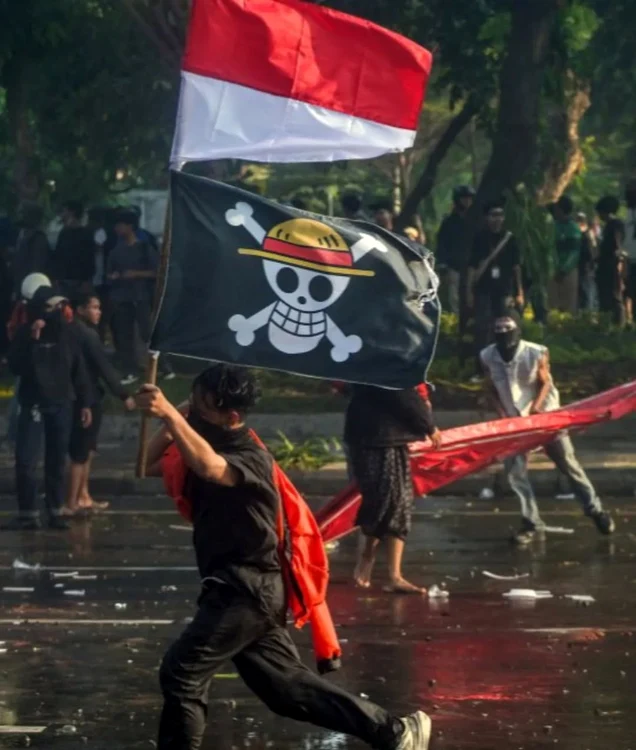
While the famous Singha Durbar Palace in Nepal was filled with flames last week, the protesters determined to tear down the government hanging a flag of the pirates above the golden gates of the building.
The association of such a flag with the historical complex that now hosts government buildings could have seemed bizarre, but for the protests of the Z generation that filled the streets of Nepal, removing the country's prime minister and triggering two days of bloody social disorders, the gesture was a symbolism.
The flag was taken from the book Manga Popular One Piece, written by Eciichiro Oda, which reports the story of the charming captain of the pirates Monkey D. Luffy and his crew of maladaptors. They start on the road in a ship arboring a Jolly Roger flag, depicting Luffy, with his straw hat and his typical radiant smile.
For fans of the book, the flag symbolizes Luffy's mission to fulfill his dreams, release the oppressed and fight against the autocratic world government. It is fearless and determined, but it also has a few aces in the sleeve to overcome its opponents, including the ability to envy to avoid capturing through its rubber body of great flexibility.
In the real world, the One Piece flag has passed the borders and crops to become a slogan and a symbol of protest movements led by young people.
In Asia, the flag has gained popularity as a tool for political expression and challenge during the protests in Indonesia, Philippines and Nepal, occasionally appearing on the streets of Paris.
“It symbolizes the aggressiveness and the determination to remove anything out of our way,” explained Bikhyat Khatri, who contributed to the organization of protests in Nepal.
“Many young people from Nepal love the anime. I wanted the movement to be characteristic of generation Z, so the slogans and symbols used during the protest were related to things with which the young people from Generation could be identified.”
The symbols of pop culture, the portacocea of the messages of young people
Luffy appeared for the first time in the popular magazine Manga Week Shonen Jump in July 1997. At that time, the character was 17 years old and owed the superpower of consuming a mythical fruit.
One Piece has since dropped the world record for most copies published by an author of the genre, according to Guinness World Records.
Over 500 million copies have been printed worldwide. The cartoon series inspired a television series, podcasts and fan sites. In 2023, it was adapted by the Netflix platform.
Andrea Horbinski, an expert in Manga and Anime, with a doctorate in modern Japanese history, says she was not surprised that the One Piece flag was adopted on behalf of a political cause.
Luffy, the protagonist, is a cheerful character who has the power to smile in the face of adversity.
“You can't help but support it,” Horbinski notes.
No challenge is discouraging for the young man with the ambition to become king of the pirates, only to manage to find the treasure.
“Luffy is very determined. He has this mission. Instead, he and his crew suffered failures, but they have not given up react and they remember people when they bring the flag to such protests.”
Nuurrianti Jalli, professor of media and communication at the Oklahoma State University, appreciates that these symbols are particularly effective in the context of protests, as “they can help highlight what people are trying to say without having to actually say it in words.”
Through the Internet and social networks, these symbols have the power to cross the borders to galvanize other young people who share similar concerns.
“I'm not talking about the same language, but I understand what it is,” Jalli said.
When the real and digital world is intertwined
Characters and symbols in popular culture are often adopted by protesters to talk about a common cause or a value system.
Pepe the Frog, a far right online mema, was adopted by the pro-democracy protesters in Hong Kong in 2019, while the three-fingered greeting in the hunger games is used by young pro-democracy protesters and opponents of the 2021 military coup in Myanmar as a symbol of resistance.
“The flag One Piece Jolly Roger is a useful symbol because it can be easily adapted from one protest to another and infused with new meanings, specific to time and place,” explained Natalie Pang, a teacher in the communication department and new media at the National University of Singapore.
In Nepal, the protesters displayed slogans such as “Generation Z will not be silent”, “Your luxury, our suffering!” And “Necokids”, to convey the feeling of anger that the children of politicians display their luxurious lifestyle on social networks.
“As a visual symbol, it gains a lot of popularity, because it is, in a way, quite expressive for people to gather around it and say:” I support these symbols, these values ”,” said Pang.
“It is not just about mobilizing people around the values, but also about mobilizing potential to join those protests.
Through social networks, an interlocking between the real world and the digital world is created, ”she added.
“We are witnessing a kind of remixing, a simultaneous spread of cultures of political expression and popular culture.”
A symbol-poverty
In Indonesia, the One Piece flag became a kind of pavement after the inhabitants chose to fly it before the holidays of Independence in August.
Government officials accused the protesters of trying to divide the country and compared the flag of betrayal.
These comments, as well as the reports from the local press about the confiscation of flags by the authorities and the removal of murals, determined Amnesty International to issue a statement by which the request of the Indonesian government “cease to suppress freedom of expression”.
While he was putting the latest tweaks in his wall painting with a spray, representing Jolly Roger, a straw hat, Indonesian artist Kemas Muhammad Firdaus told the news agency Reuters that Manga Drawing is “a symbol for the government, so he has to look at his people.”
“Many Indonesians fly the one-piece flag because they want the government to listen to them,” Fedaus told Reuters, while wearing his own flag Jolly Roger.
“Finally, people hope that the government will solve the current problems.”