Romania and its neighbors face a crisis of housing: they are old, inefficient energy and vulnerable to earthquakes


Europe is facing a major challenge: most of its housing fund was built in the decades after the war, before the standards of energy efficiency and seismic safety become mandatory. Romania perfectly illustrates this continental problem, with dramatic consequences for the safety of citizens and for the climatic objectives of the European Union.
- Article made in the European Pulse project by Dan Popa (Hotnews.ro), Miguel Ángel Gavilanes (El Confidential- Spain), Iev Kniukštienė and Ieva Vidūnaitė (Delphi-Lithuania) and Martin Putschögl (Der Standard, Vienna)
The alarming situation of Romania:
- 64% of homes were built before 1980, with 8% dating before 1946
- Romania is the third country in the EU exposed to seismic risk, after Greece and Italy
- 1,578 people died in the 1977 earthquake, and 35,000 houses collapsed (estimates)
The generalized European issue:
- In Spain, over 81% of buildings are classified with the weakest energy rating (E, F, G)
- In France, almost a third of the homes were built before 1949
- Austria has 850,000 houses built before 1945
Ambitious renovation programs:
- Romania: 2.8 billion lei for the program “Wave of renovation”
- Spain: 3.42 billion euros from Nextgenerational funds
- France: 6.7 billion euros for energy renovations
- Lithuania: Simplified system with fixed payments (89-172 euros/m²)
A worrying statistic: Romania's homes, among the oldest in the EU
The data shows a harsh reality: Romania has one of the oldest housing funds in the European Union. About 8% of the dwellings date before 1946, while 56% were built between 1946 and 1980. Only 35% of the Romanian Real Estate Park was raised after 1980, when the construction standards began to improve significantly.
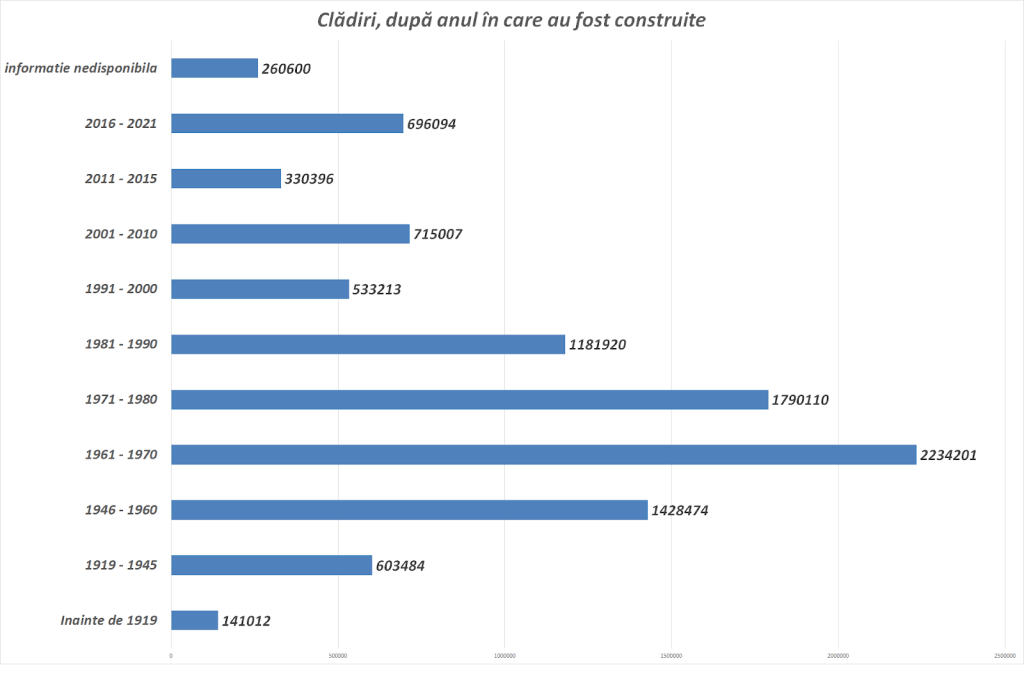
The situation becomes even more dramatic in the rural area, where the proportion of extremely old homes increases to 10% for those built before 1946. This statistic is not just a demographic curiosity – it reflects a real vulnerability that can have devastating consequences.
In most big cities (Bucharest, Cluj-Napoca, Iași), the old apartments are more expensive than the new ones, especially due to the central position and the developed infrastructure
“Bucharest is the best example, with the largest price difference in favor of the old apartments, which benefit from a more central position. In contrast, only in Craiova, Oradea and Timișoara we observe an inverse phenomen of Marketing Real Estate Europe, OLX Group (Storia and OLX Imobiliare).
Seismic risk: a constant threat
Romania occupies the third place in the European Union at the exposure to seismic risk, being exceeded only by Greece and Italy. The seismic source Vrancea affects two thirds of the national territory and has a major impact in the south and east of the country, including in the Capital.
The earthquake of March 4, 1977 remains a painful memory: 1,578 people lost their lives, of which 1,391 in Bucharest alone, and almost 35,000 houses collapsed. This tragedy emphasizes the extreme vulnerability of the old Romanian housing fund in front of the seismic phenomena.
A generalized European issue
Romania is not an exception in the European landscape. In Spain, most of the houses in Madrid (about 600,000 out of 1.5 million) were built between 1961 and 1980, while in the last decade (2011-2020) only 46,485 new housing units were erected.
Barcelona presents a similar situation: out of the 808,746 homes, most were built in the same two key decades (1961-1970 and 1971-1980). The year 1980 became a crucial landmark in Spain – only from that moment the new buildings had to meet the standards of thermal conditions.
France is facing the same challenge: almost one third of the unifamilial homes were built before 1949 and represents 45% of the energy consumption for residential heating. In addition, 44% of the multifamilial homes date from 1949-1974.
Austria is no exception: from almost 4.2 million apartments and houses, about 850,000 (20%) were built before 1945. Four -fifth of the housing fund dates from the post -war period, with a boom of constructions between 1960 and 1980.
Energy inefficiency: a huge bill
The consequences of this architectural heritage are energetically devastating. In Spain, over 81% of the existing buildings are classified with the weakest energy ratings (E, F or G), on an A to G. This percentage increases to 84.5% when we talk about energy consumption. The Spanish real estate sector is responsible for just over a third of the country's CO2 emissions.
Renovation strategies: billions of euros invested in modernization
Conscious of the extent of the problem, the European countries have launched ambitious energy renovation programs, financed massively through European and national funds.
Romania It launched the program “Wave of renovation” with a budget of 2.8 billion lei, aiming at improving the energy efficiency of at least 4,333 buildings. Programs include complete thermal insulation, modernizing heating systems and replacing windows, with the goal of reducing heating consumption by at least 40%.
Spain He has allocated 3.42 billion euros from Nextgenerational funds for the residential renovation program, following the implementation of 510,000 projects by 2026. The objective is elections: reducing non -renewable primary energy consumption by at least 30%.
France He mobilized 6.7 billion euros through the France Relance strategy, of which 2 billion euros increased the financing for the Maprmerénov 'program. The owners can benefit from generous aid – up to 28,000 EUR for complete renovations.
Lithuania has implemented an innovative system with fixed rates and simplified procedures. To reach the energy efficiency class B, the costs vary between 89-172 euros per square meter, depending on the size of the building and the type of renovation.
Challenges of applying energy efficiency strategies
Although the funds are substantial, experts warn that the rhythm of renovation remains insufficient. “We have to multiply what is done in Spain every year by 10,” says Dolores Huerta, general manager of the Council for Green Buildings in Spain.
In Romania, access to financing has been simplified – the new schemes no longer require co -financing from the owners, which allows several families to benefit from renovation. The private sector joined efforts through major projects such as “Effective Romania”, led by OMV Petrom and Energy Policy Group.
The modernization of the European housing fund represents not only an economic and environmental necessity, but also a matter of public safety. With climatic changes that intensify extreme phenomena and European climatic neutrality goals by 2050, energy renovation has become a strategic priority.
The success of these programs will depend on the ability of governments to simplify bureaucratic procedures, to maintain long -term financing and to convince citizens to participate in this necessary transformation of how we live in Europe.