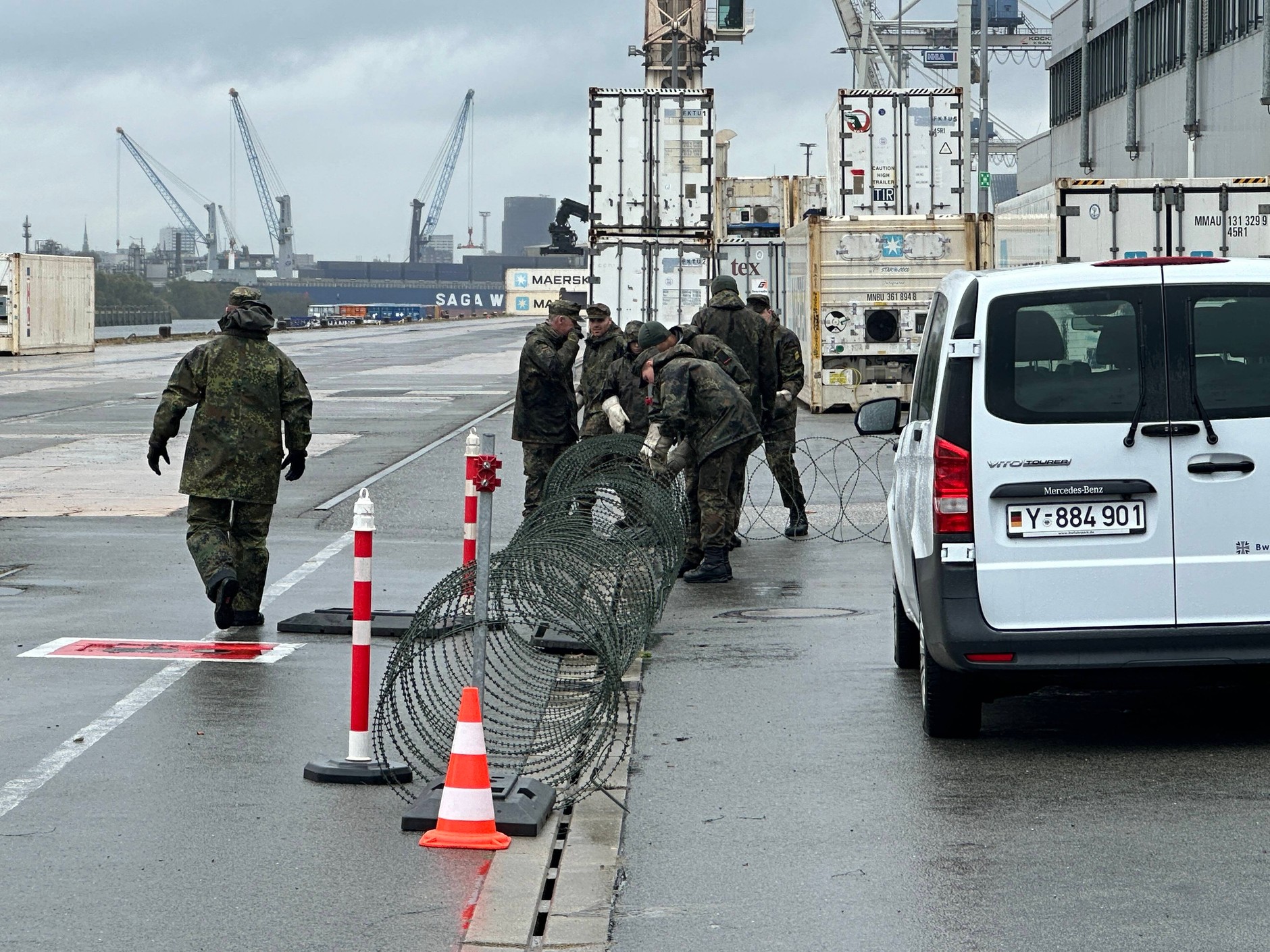
At night, columns of military vehicles pass through Hamburg, and helicopters provide them with protection from the air. In the port for several days there are protective posts planted with soldiers of Feldjaeger – the Bundeswehr military police – and reservists from the homeland protection company. Police, fire brigade and technical services (THW), Senate and offices support the Bundeswehra, among others in the care of many wounded.
This is what the coming week will look like. From 25 to 27 September, the “Red Storm Bravo” maneuver will take place in the port and in the city [ang. Czerwona burza]in which The German army together with civil services will conduct exercises related to the transfer of troops to the eastern flank of NATO. After “Red Storm Alpha” last year this is the second large Bundeswehr exercise in Hamburg since Russia's invasion of Ukraine in February 2022.
– In the National Command in Hamburg, we want to test specific skills, such as the management of the column, together with other military units. We want to think about the situation in the field of drones. What are the possibilities? What threats await us? – said Captain Kurt Leonards, commander of the Bundeswehr national command in Hamburg, in an interview with Welt am Sonntag. – We also want to practice how we can help with a mass influx of wounded. It is special that we do not want to do it in an isolated place, at a military training ground, but in the urban environment, and above all in cooperation with other civil rescue services.
Leonards manages maneuvers along with his staff at the Operational Center in the barracks of Reichsident-Ebert-Kaserne in the Iserbrook district. Bundeswehra engages about 500 soldiers and about 50 wheeled vehicles in “Red Storm Bravo”. Exercises have been planned since the beginning of the year. They simulate how the freight ship and the aircraft deliver to Hamburg soldiers and materials, which are then transported to the east, to the Baltic countries, to the border with Russia. The ship and plane are only fictitious elements of maneuvers, while the movements and actions of people and military vehicles in the city are to be practiced in the most realistic way.
Soldiers of the German armed forces laying barbed wire in the port of Hamburg as part of the “Red Storm Alpha” exercises, Hamburg, Germany, September 26, 2024.Steven Hutchings / PAP
NATO estimates that around 2029 Russia will be able to seriously provoke the alliance or actually attack Member States, such as the Baltic States – Estonia, Latvia or Lithuania. As soon as this situation can happen, they showed the last weeks: Poland has applied for consultations pursuant to art. 4 NATO Treaty after at least 19 Russian drones invaded the Polish airspace, mainly from Belarus, but also from Russia itself. A small part of them were shot down.
Did the unmanned military devices that hit Western Ukraine accidentally flew to Poland? Or maybe Russia once again tested NATO, as is often the case with its “hybrid” war? Initially, the situation remained unclear. But This week, Polish President Karol Nawrocki said “Die Welt”: – We have no doubt that it was an attack directly from Moscow. NATO is currently strengthening its air defense in Poland as part of the “Eastern Serenity” operation.
The starting scenario for “Red Storm Bravo” is based on a similar case: Estonia feels seriously threatened by Russia, asks for consultations in accordance with art. 4 of the NATO Treaty and asks to move troops to the east. In fact, on Friday, Estonia did this after Russian fighters violated the Estonian airspace on the Baltic Sea. – Reality overtook us – says Lieutenant Colonel Juergen Bredtmann, head of communication at the National Command in Hamburg.
“Operational Plan Germany”
Recent events show how quickly the war in Ukraine can escalate NATO – and how slowly the Germans are preparing for it. “Operational Plan Germany”, a document originally of over 1000 pages, describes how the Bundeswehr in cooperation with relevant federal and national bodies is to organize the displacement of large NATO units to Central and Eastern Europe. However, the operating plan is secret. Also for this reason, public opinion in Germany is not aware of how complex and long -lasting are preparations aimed at ensuring Germany's defense readiness within NATO.
Germany is the central area of NATO mobilization and march in the case of tensions and defense against Russia. And Hamburg, with the largest seaport in Germany, will be one of the logistics transport hubs if necessary. However, the Hanseatic City – unlike, for example, Bremerhaven with the American Army base – there is virtually no current experience in the transfer of military troops and equipment.
That is why we would like to conduct these scenarios in the urban environment and in cooperation with civil rescue services to be able to contribute to building immunity, also in the field of defending the entire state. It is important that we communicate in a common language with the police, fire brigade, THW and other services, that we have a common position and that people who meet in these various organizations have already known each other
– says Leonards.
Mobilization of people and specialist knowledge requires time and motivation – but not much compared to the expenditure related to the modernization of infrastructure. Many German roads, tracks and water routes are in poor condition, and especially the bridges are not suitable for safe transport of large military equipment, such as tanks with a mass of over 50 tons or howitzers. These deficits are particularly visible in the case of heavily loaded communication routes in German seaports. For many years, the economy appeals to the public authorities to remove these bottlenecks – and now there is also a military component.
Three decades of neglect
The Central Association of German Sea Port Operators (ZDS) estimates that the construction and renovation projects related to defense in German seaports and national connections will cost three billion euros [12 mld 792 mln zł] – this is part of the total amount of EUR 15 billion [63 mld 960 mln zł]which ZDS estimates for the renovation of German seaports. According to the port industry, in the coming years these funds should be provided primarily by the Federal Government to prepare ports for future foreign trade and energy supply – and for defense.
– Sea ports are in the same situation as the Bundeswehr – since the unification of Germany Modernization has been neglected for over three decades – notes Florian Keisinger, general director of ZDS, in an interview with Welt am Sonntag. – In the case of the Bundeswehr, this deficit was already understood and the social consensus was achieved that it should be eliminated. In the case of seaports, we are still far from this point – he adds.
A few weeks ago, ZDS contacted the Federal Ministry of Defense to find out whether the co -financing of port renovations could also be organized from state defense expenses. – To modernize the port infrastructure, we need a separate position in the budget of the Federal Ministry of Defense, in section 14 – says Keisinger.
– In the event of a Bundeswehra conflict and German allies, the use of seaports must be allowed. Sea ports are gaining a completely new role in this way, to which they are currently not prepared at the moment – he adds. The second important topic from the point of view of the port economy is the protection of critical infrastructure, “for example, against drones and espionage, especially in the context of the so -called hybrid war. These are currently everyday situations.”
Continued article under video material
“Everything works very well in Hamburg”
Hamburg economic authorities agree with this analysis.
The largest port of Germany must be prepared for these tasks. Renovation and construction of quays with high load capacity, lifts with high load capacity for reloading, providing sets of wagons, preparing surfaces and necessary protective mechanisms belong to the investments that should be implemented for this purpose
– says the spokesman.
Hamburg partly finances such projects himself, for example the renovation of the Steinwerder Kais quay on the southern side of the Blohm + Voss sea shipyard: – Given investment needs, it is not possible to cover all the needs of military logistics from municipal funds. This is a federal task, which will be implemented in German ports in the coming years – informs the spokesman.
In Hamburg, however, you can also find out where working on increasing defense capabilities is progressing. – Cooperation between the Chamber of Commerce, the Bundeswehra and the Senate in the field of the operational plan for Germany and in general in the scope of increasing immunity and defense capabilities, it functions very well in Hamburg. This is not obvious – says Philip Koch, managing director of the Department of the International Chamber of Commerce in Hamburg: – Our task in the Chamber of Commerce is primarily to improve cooperation between all entities involved in this complex process and the economy.
The head of the Bundeswehr regional command is also full of praise: – In Hamburg, everything works very well. From the very beginning, as soldiers of the Bundeswehr, we have not experienced any concerns about contacts here. On the contrary, says Kurt Leonards. – In Hamburg we are also conducting a very intensive exchange of information with a civil society.
Two weeks before the start of “Red Storm Bravo” the Navy captain appeared in the Chamber of Commerce at a conference for enterprises interested in EU funds to increase immunity in crisis situations. Leonards gave his basic lecture “Germany is no longer in war – they are no longer in peace.” Therefore, he often travels around the city, also at the request of enterprises, offices and rescue services. In the Chamber of Commerce, the day after the inlet of drones to Poland, he explained why he must update his lecture with new examples every week: – For over 30 years we did not deal with the topic of defense of the country and the alliance. And now we have to do it, because the topic of “hybrid action” has long ago reached Germany.
Olaf Preuss is an economic reporter “Die Welt” and Welt Am Sonntag for Hamburg and northern Germany. One of the main topics he touches is the sea economy – navigation, ports and shipyards, but also writes about the arms industry and the Bundeswehra.
I’m Ashley Davis as an editor, I’m committed to upholding the highest standards of integrity and accuracy in every piece we publish. My work is driven by curiosity, a passion for truth, and a belief that journalism plays a crucial role in shaping public discourse. I strive to tell stories that not only inform but also inspire action and conversation.